Key takeaways
- Measure your blade length first: Band saw blades are not interchangeable. Check your manual or measure your current blade end to end — 70-1/2″, 72″, 93-1/2″, 111″, and 131-1/2″ are all common, and a half-inch error means the blade won’t tension.
- Go as wide as your saw allows: Width fights beam deflection, which is what causes barrel cuts. Use 1/2″ if your saw is a 10-inch benchtop model, and step up to 3/4″ if you’re running a 14-inch or larger frame with the guides to support it.
- Low TPI wins for deep cuts: Aim for 2–4 teeth per inch. Deep gullets carry sawdust out of a 6-inch-tall kerf; a 10 TPI blade packs solid, generates heat, and stalls. Expect a rougher face and plan to plane or sand.
- Match tooth material to your workload: Carbon steel (SK5) is inexpensive and easy to replace, ideal for occasional resawing in softwoods. Carbide-tipped costs more up front but holds an edge through hard maple, exotics, and reclaimed stock loaded with grit.
- Respect your saw’s tension limit: Small saws can’t develop the tension a wide, thick blade needs. Low-tension designs and thinner 0.032″ gauges are engineered specifically to track straight without pushing your frame past what it can handle.
Resawing is the moment your band saw stops being a curve-cutting toy and starts acting like a lumber mill. You feed a 6-inch-wide slab of walnut in, expect two clean book-matched panels out, and instead you get a blade that wanders halfway up the cut, leaves a washboard face, or bogs down until the motor whines and the wood scorches. Nine times out of ten the saw isn’t the problem. The blade is.
Resaw blades live by a different rulebook than general-purpose blades: wide bodies to resist deflection, low tooth counts with deep gullets to evacuate long ribbons of waste, and tooth geometry aimed at speed over finish. This guide breaks down what actually matters when you’re standing at the saw with a board on edge, then walks through the blades worth your money in 2026 — from budget carbon steel for a 10-inch benchtop unit to carbide-tipped monsters that outlast a dozen ordinary blades.
Our top picks



As an Amazon Associate we earn from qualifying purchases at no extra cost to you. Ratings are shown as listed on Amazon.
🛒 Best Price Today on Amazon
Prime members get fast, free shipping on everything above, plus member-only deals. New members get a 30-day free trial — cancel anytime.
How to Choose a Band Saw Blade For Resawing (2026)
- Measure your blade length first: Band saw blades are not interchangeable. Check your manual or measure your current blade end to end — 70-1/2″, 72″, 93-1/2″, 111″, and 131-1/2″ are all common, and a half-inch error means the blade won’t tension.
- Go as wide as your saw allows: Width fights beam deflection, which is what causes barrel cuts. Use 1/2″ if your saw is a 10-inch benchtop model, and step up to 3/4″ if you’re running a 14-inch or larger frame with the guides to support it.
- Low TPI wins for deep cuts: Aim for 2–4 teeth per inch. Deep gullets carry sawdust out of a 6-inch-tall kerf; a 10 TPI blade packs solid, generates heat, and stalls. Expect a rougher face and plan to plane or sand.
- Match tooth material to your workload: Carbon steel (SK5) is inexpensive and easy to replace, ideal for occasional resawing in softwoods. Carbide-tipped costs more up front but holds an edge through hard maple, exotics, and reclaimed stock loaded with grit.
- Respect your saw’s tension limit: Small saws can’t develop the tension a wide, thick blade needs. Low-tension designs and thinner 0.032″ gauges are engineered specifically to track straight without pushing your frame past what it can handle.
The Best Band Saw Blade For Resawing (2026)s Reviewed
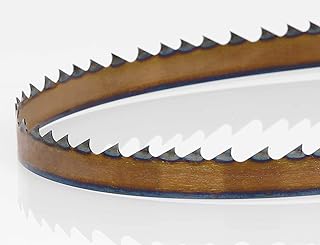
Timber Wolf 3423VPC 93.5″ x 3/4″ Low Tension Resaw Blade
The silicone steel body and variable-pitch tooth pattern let this blade run at noticeably lower tension than a comparable carbon blade, which is a genuine gift to 14-inch saws with lighter frames. It’s the blade I reach for when resawing figured stock, since the variable pitch smooths out chatter and leaves a face that needs minimal cleanup.
Dark Stone DS23427 111″ Carbide-Tipped, 3/4″ x 2 TPI
Hook-tooth carbide on an 111-inch loop puts this squarely in 17- and 18-inch saw territory, and the payoff is a blade that tracks dead straight through 8 inches of hard maple without complaint. The cost per blade is steep, but the working life against abrasive hardwoods and reclaimed lumber makes the math work if you resaw regularly.
Dark Stone DS23406 131-1/2″ Carbide-Tipped, 3/4″ x 2 TPI
Same aggressive hook geometry as its shorter sibling, sized for large-frame cabinet saws, with a 0.032″ gauge that keeps tension demands reasonable for a blade this wide. If you’re milling your own veneer or breaking down thick slabs, this is a set-it-and-forget-it choice for months at a stretch.
SK5 Carbon Steel Bandsaw Blade 4-Pack, 93-1/2″
Two 1/2″ 6 TPI blades plus 1/4″ and 1/8″ options make this the sensible starter kit for a 14-inch saw, letting you resaw moderately and still swap to tight curves for chair parts. The 6 TPI count is higher than ideal for deep cuts, so slow your feed rate and keep the piece under about 4 inches tall for best results.
AYAO 70-1/2″ x 1/2″ 4TPI Hardened Teeth
Purpose-sized for the Craftsman 921400 and Rikon 10-305 and 10-3061, this blade brings a proper 4 TPI resaw pitch to saws that usually ship with something far too fine. The hardened teeth hold up well in pine and poplar, and at this price you can keep a spare on the wall without guilt.
Frequently Asked Questions
What TPI is best for resawing?
Two to four teeth per inch. The rule of thumb is three to six teeth in the workpiece at any moment; on a 6-inch-tall board, even 2 TPI keeps a dozen teeth engaged, and fewer teeth means bigger gullets to clear the enormous volume of dust a deep cut produces.
Is a carbide blade worth the extra cost?
If you resaw more than occasionally, yes. A carbide-tipped blade can run many times longer than carbon steel before dulling, and it holds a straight cut through the entire life of the blade rather than gradually starting to drift.
Why does my blade cut a curved or “barreled” face?
That’s usually blade deflection from a too-narrow blade, insufficient tension, or feeding faster than the gullets can clear. It can also be blade drift — set your fence to the blade’s natural drift angle rather than parallel to the miter slot.
Can a 10-inch benchtop band saw resaw at all?
Within limits. Expect roughly 3 to 4 inches of capacity, use a 1/2″ 4 TPI blade, take your time, and accept a rougher surface. Trying to force a 3/4″ carbide blade onto that class of saw won’t work; the frame can’t tension it.
Final Thoughts
For most home shops running a 14-inch saw, the Timber Wolf 3423VPC is the smartest single upgrade you can make — low tension, straight tracking, and a surprisingly clean face. If you’ve got a larger saw and you resaw hardwoods often enough to notice blade costs, step up to the Dark Stone DS23427 carbide-tipped blade and stop changing blades for a season. And if you’re working on a compact benchtop saw, the AYAO 70-1/2″ 4TPI gets the tooth geometry right for a fraction of the price.