Concrete slabs are honest about their flaws. Yours has probably picked up a rust halo where the jack stands sat, a dark bloom under the oil pan, and a fine layer of dust that migrates into the house no matter how often you sweep. Epoxy sounds like the answer until you read the prep instructions: grind, acid etch, patch, wait for a dry stretch of weather, then hope the moisture vapor coming up through the slab doesn’t peel your weekend’s work in six months. That’s a real project, not a Saturday.
The good news is that the modular and roll-out options have gotten genuinely good, and they install with a rubber mallet instead of a floor grinder. This guide walks through the three approaches worth your money — containment mats that catch snowmelt and drips, solid interlocking tiles that carry vehicle weight, and open-grid drainage tiles that let water pass through to the slab. I’ll cover load ratings, what actually matters in an unheated garage, and which products hold up once a car is parked on them daily.
Our top picks



As an Amazon Associate we earn from qualifying purchases at no extra cost to you.
🛒 Best Price Today on Amazon
Prime members get fast, free shipping on everything above, plus member-only deals. New members get a 30-day free trial — cancel anytime.
How to Choose a Garage Flooring Ideas (2026)
- Solid vs. open-grid tiles: Solid tiles give you a smooth surface for rolling toolboxes and creepers, and they keep dropped hardware from disappearing. Open-grid drainage tiles let meltwater and wash runoff drain to the concrete, which is what you want if you park a wet vehicle indoors or rinse gear regularly.
- Load rating, read carefully: Advertised numbers like 40,000 lbs are usually distributed capacity across a spread of tiles, not point load from a single jack stand. If you plan to lift a vehicle, put a plywood or steel plate under the stands to spread the force, or set the stands directly on bare concrete.
- Material and cold weather: Polypropylene is stiff, chemical-resistant, and cheap per square foot, but it gets brittle in deep cold and can crack under a hot tire that’s just come off the highway. PVC stays more flexible and takes impact better. In an unheated northern garage, that flexibility is worth paying for.
- Slab flatness and thickness: Interlocking tiles telegraph every dip in your concrete. Sweep and check with a straightedge before you buy, and add 5 to 8 percent for cuts around door thresholds, posts, and the slope toward your garage door.
- Coverage math: A 12×12-inch tile is one square foot, so a 48-pack covers a single parking bay’s high-traffic zone, not a full two-car garage. Roll-out mats are sold by dimension instead, which is simpler if you only want the area under the vehicle protected.
The Best Garage Flooring Ideas (2026)s Reviewed
Garage Mats Oversize Parking Mat, 8.8 x 22 Ft
This is the fastest fix on the list — unroll it, let it relax for a day, and the raised edges start containing snowmelt, road salt, and oil drips instead of letting them spread across the slab. The absorbent face wicks and holds a surprising amount of liquid, though you’ll want to plan on hosing it off outdoors a couple times a year rather than letting it saturate.
Interlocking Garage Floor Tiles, 12″x12″ 48-Pack
A solid-surface modular tile that snaps together tight enough to feel like one continuous floor, with an oil- and stain-resistant top that wipes clean. The 48-piece count works out well as a single-bay install or a workbench zone; the hidden interlock means no visible seam tabs to catch a caster.
VEVOR Garage Floor Tiles, Red 50-Pack
At just over half an inch thick with texture on both faces, these are stout enough for daily parking and can be flipped when one side wears. The red is genuinely useful if you’re laying a checkerboard to mark bay boundaries or a tool zone, and installation is a mallet-and-knee-pads job with no adhesive.
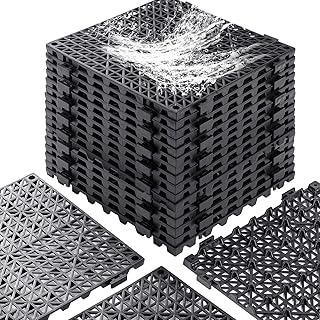
VEVOR Interlocking Drainage Mat, 24-Pack
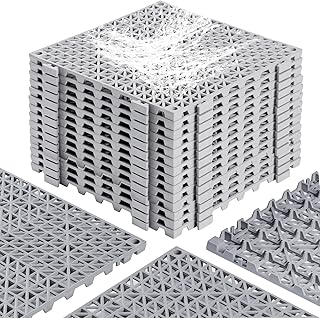
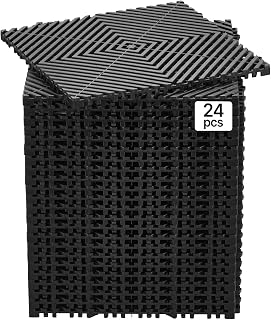
Open-grid PP tiles that raise you off the concrete so water, mud, and shavings fall through instead of pooling underfoot. At 24 pieces this is a targeted purchase — a wash bay, a mudroom entry, or the strip where wet boots and bike tires come in.
Jocoevol 60-Pcs Interlocking Drainage Tile
The best value per square foot here if you need real coverage, with 60 tiles of heavy-duty polypropylene and enough grip to stay safe when soaked. Self-draining designs like this run cooler in summer too, since air moves under the surface rather than trapping heat against the slab.
Frequently Asked Questions
Will hot tires damage interlocking tiles?
Quality polypropylene and PVC tiles resist hot-tire pickup far better than roll-out vinyl, which can soften and stick. If you regularly pull in after long highway drives, choose thicker tiles with a textured face and let the vehicle cool a few minutes before parking.
Do I need adhesive or underlayment?
No. Interlocking tiles float on the slab and hold position by weight and edge lock. Skip adhesive entirely — it defeats the main advantage, which is lifting a tile to clean or replace it.
What happens to moisture trapped under the tiles?
Solid tiles can hold vapor against the concrete, so leave a small perimeter gap and pull a section up seasonally to let it breathe. Drainage tiles avoid the issue entirely by keeping air moving underneath.
How do I cut tiles around obstacles?
A fine-tooth jigsaw blade or a sharp utility knife scored several times both work. Cut slightly proud, dry-fit, then trim — polypropylene doesn’t forgive an over-cut.
Final Thoughts
For most garages, the 48-pack of interlocking floor tiles delivers the biggest visual and functional upgrade for a single afternoon of work, while the Jocoevol 60-piece drainage tiles are the smarter call in wet climates or wash areas. If you’d rather not tile at all and just want the slab under your vehicle protected from salt and drips, the 8.8 x 22 ft oversize parking mat handles that in about ten minutes.