Key takeaways
- Measure your blade length twice: Band saw blades are not interchangeable by wheel size alone. Check your manual, or wrap a string around both wheels with the tension released to the midpoint of travel. A 93″ blade will not fit a saw wanting 105″, and a half-inch of error means a blade you can’t return.
- Go as wide as your saw allows: Width is what stops beam deflection in a tall cut. If your guides and wheels accept 3/4″ or 1″, use it. Benchtop saws with 10-inch wheels usually cap out at 1/2″, and forcing wider stock will crack the blade at the weld.
- Keep tooth count low: For resawing hardwood over 3 inches tall, you want 3 to 6 TPI. Fine-pitch blades in the 10-18 TPI range are for metal and thin sheet goods; run one through cherry and the gullets pack solid within an inch.
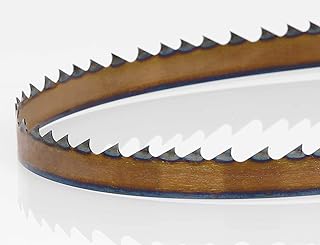
- Match tooth geometry to the job: Hook teeth with positive rake pull chips aggressively and suit deep wood cuts. Raker and wavy sets shine on metal and mixed material. Variable pitch smooths vibration and reduces the harmonic chatter that shows up as ripple marks.
- Know your tension budget: Bimetal blades want serious tension and reward a stout frame. Silicon steel low-tension designs are built for saws that can’t crank up hard, including older cast-iron 14-inch machines with tired springs.
Resawing is the moment your band saw either earns its keep or embarrasses you. You feed a 6-inch-wide chunk of walnut through, expecting two clean bookmatched leaves, and instead you get a barreled cut that wanders off the line halfway up and leaves you 3/32″ of waste to plane away on both faces. Nine times out of ten the machine isn’t the problem. The blade is. Most saws ship with a general-purpose 1/2″ 6-TPI blade that’s fine for curves and dimensional stock, and thoroughly wrong for slicing thick hardwood along its length.
A dedicated resaw blade fixes more than tracking. Wider blades resist deflection, low tooth counts clear chips before they weld themselves into the gullet, and the right tooth geometry keeps the cut from hardening and glazing over. Below are six blades I’ve either run in my own shop or seen do reliable work in others, spanning small benchtop 10-inch saws through 14-inch cast-iron workhorses and larger industrial frames. I’ve broken down what each one is good for, plus the sizing math you need to get right before you click buy.
Our top picks


As an Amazon Associate we earn from qualifying purchases at no extra cost to you. Ratings are shown as listed on Amazon.
🛒 Best Price Today on Amazon
Prime members get fast, free shipping on everything above, plus member-only deals. New members get a 30-day free trial — cancel anytime.
How to Choose a Band Saw Blades For Resawing (2026)
- Measure your blade length twice: Band saw blades are not interchangeable by wheel size alone. Check your manual, or wrap a string around both wheels with the tension released to the midpoint of travel. A 93″ blade will not fit a saw wanting 105″, and a half-inch of error means a blade you can’t return.
- Go as wide as your saw allows: Width is what stops beam deflection in a tall cut. If your guides and wheels accept 3/4″ or 1″, use it. Benchtop saws with 10-inch wheels usually cap out at 1/2″, and forcing wider stock will crack the blade at the weld.
- Keep tooth count low: For resawing hardwood over 3 inches tall, you want 3 to 6 TPI. Fine-pitch blades in the 10-18 TPI range are for metal and thin sheet goods; run one through cherry and the gullets pack solid within an inch.
- Match tooth geometry to the job: Hook teeth with positive rake pull chips aggressively and suit deep wood cuts. Raker and wavy sets shine on metal and mixed material. Variable pitch smooths vibration and reduces the harmonic chatter that shows up as ripple marks.
- Know your tension budget: Bimetal blades want serious tension and reward a stout frame. Silicon steel low-tension designs are built for saws that can’t crank up hard, including older cast-iron 14-inch machines with tired springs.
The Best Band Saw Blades For Resawing (2026)s Reviewed
Timber Wolf 3423VPC 105″ x 3/4″ Silicon Steel Resaw Blade
This is my default recommendation for anyone resawing wood on a 14-inch saw with a riser block. The variable-pitch silicon steel body tracks straight under moderate tension, runs noticeably quieter than bimetal, and leaves a surface clean enough that a light pass with a smoothing plane finishes the job.
Lenox Classic Pro Vari-Raker 106″ x 1″
At a full inch wide with 5-8 variable TPI, this bimetal blade has the beam strength to hold a line through tall stock without bowing. It needs a rigid saw and real tension to perform, but on a properly set up machine it’s about as stable as resawing gets.
Lenox Diemaster 2 154″ x 1/2″ 6 TPI Hook Tooth
Hook teeth with positive rake are exactly the geometry you want for deep cuts, and the bimetal construction survives the occasional hidden nail or mineral streak that would strip a carbon blade. Built for larger industrial frames, so confirm your saw takes a 154″ loop.
AYAO 70-1/2″ x 1/2″ 4 TPI Hardened Teeth
Benchtop saw owners get overlooked in resaw discussions, and this is the practical answer for Rikon 10-305 and Craftsman 921400 machines. Four TPI in a hardened-tooth 1/2″ blade is genuinely capable of clean 4-inch resaws, and the price makes it easy to keep a spare in the drawer.
Lenox Classic Tuff Tooth Vari-Raker 93″ x 3/4″
The 10-14 TPI pitch puts this firmly in metal-cutting territory rather than wood resawing, but the 3/4″ width and bimetal build make it the right call if you’re slicing aluminum stock or thick-wall tube on a shop saw. Don’t buy it expecting to break down hardwood.
Frequently Asked Questions
What TPI is best for resawing wood?
Three to six TPI covers nearly all wood resawing. The rule of thumb is three teeth in the cut at any moment. In a 6-inch-tall board that math points to the coarse end, since packed gullets cause more burning and drift than any other single factor.
Do I need a 1″ blade, or will 1/2″ work?
1/2″ resaws fine up to about 4 inches with good technique and a fresh blade. Beyond that, wider stock genuinely helps. Just confirm your saw’s rated maximum first, since overwide blades stress the wheels and can crack at the weld.
Why does my cut drift even with a new blade?
Usually blade drift, not blade defect. Most saws cut a degree or two off parallel to the miter slot. Make a test cut freehand along a marked line, note the angle your workpiece naturally wants, and set your fence to match. Also check guide clearance and confirm the tires aren’t glazed.
How long should a resaw blade last?
A quality blade run at correct tension and speed handles 100 to 200 board feet of hardwood before you notice increased feed pressure. Bimetal outlasts carbon steel several times over. Once you’re pushing harder to make the same cut, stop, since a dull blade damages surfaces and heats the weld.
Final Thoughts
For most home furniture makers on a 14-inch saw, the Timber Wolf 3423VPC is the blade I’d buy first, since it delivers clean resaws without demanding tension your machine may not have. Step up to the Lenox Classic Pro 1″ if you’re running a heavier frame and want maximum stability in tall stock, and grab the AYAO 70-1/2″ if you’re working on a benchtop Rikon or Craftsman where fit matters more than anything else.