Key takeaways
- Rail design: Rack-and-pinion rails keep both ends of the fence moving in sync, so it stays parallel to the blade no matter where you park it. Single-point clamp fences rely on you nudging the tail end straight, which gets old fast on repeat rips.
- Lock repeatability: Set the fence to 12 inches, cut, swing it away, bring it back. If the cut width shifts, the cam lock or rail faces are worn or under-engineered. Look for a lever with adjustable tension you can dial in yourself.
- Rip capacity you’ll actually use: 24 to 26 inches handles most furniture work; 30 to 32 inches lets you cut a full sheet in half without flipping it. Extra capacity means a wider footprint, so measure your shop before chasing the biggest number.
- Fence face and squareness: A tall, flat face gives featherboards and tall-stock jigs something to grip. Check that the face sits dead square to the table and can be shimmed if it isn’t.
- Upgrade path: Some saws take aftermarket fence systems on standard bolt patterns. If your saw’s motor and trunnions are solid, swapping in a better fence is the cheaper fix.
What's inside
Ask anyone who has spent a weekend ripping plywood down to cabinet parts what makes or breaks a table saw, and the answer usually isn’t horsepower. It’s the fence. A fence that drifts a few thousandths out of parallel turns a clean rip into a tapered mess, leaves burn marks down the offcut, and in the worst case pinches the stock hard enough to kick it back at you. Most stock fences on budget saws lock down square only if you baby them, and after a few hundred cuts the plastic cam and thin extruded rail start telling on themselves.
This guide skips the spec-sheet theater and looks at the saws whose fences actually hold a line under real shop conditions: dusty rails, humidity swings, and repeated repositioning across a full sheet of ply. We cover jobsite saws with rack-and-pinion rails, a cabinet-class saw for the shop that never moves, and one aftermarket fence system worth bolting onto a saw you already own instead of replacing it.
As an Amazon Associate we earn from qualifying purchases.


🛒 Best Price Today on Amazon
Prime members get fast, free shipping on everything above, plus member-only deals. New members get a 30-day free trial — cancel anytime.
How to Choose a Table Saw With Best Fence (2026)
- Rail design: Rack-and-pinion rails keep both ends of the fence moving in sync, so it stays parallel to the blade no matter where you park it. Single-point clamp fences rely on you nudging the tail end straight, which gets old fast on repeat rips.
- Lock repeatability: Set the fence to 12 inches, cut, swing it away, bring it back. If the cut width shifts, the cam lock or rail faces are worn or under-engineered. Look for a lever with adjustable tension you can dial in yourself.
- Rip capacity you’ll actually use: 24 to 26 inches handles most furniture work; 30 to 32 inches lets you cut a full sheet in half without flipping it. Extra capacity means a wider footprint, so measure your shop before chasing the biggest number.
- Fence face and squareness: A tall, flat face gives featherboards and tall-stock jigs something to grip. Check that the face sits dead square to the table and can be shimmed if it isn’t.
- Upgrade path: Some saws take aftermarket fence systems on standard bolt patterns. If your saw’s motor and trunnions are solid, swapping in a better fence is the cheaper fix.
The Best Table Saw With Best Fence (2026)s Reviewed
DEWALT DWE7491RS 10-Inch with Rolling Stand
The rack-and-pinion fence here is the reason this saw keeps showing up in trim carpenters’ trucks: it glides out to 32-1/2 inches, locks without racking, and returns to the same setting cut after cut. Add the 15-amp motor and the foldable rolling stand, and it’s the most complete jobsite package for someone building furniture in a garage that doubles as parking.
Delta T3 30-Inch Fence System
If your saw’s guts are fine but the fence is the weak link, the T3 is the honest fix — a heavy square-tube fence riding a machined rail, with fine adjustment that lets you creep up on a dimension by a hair. Confirm your saw’s rail mounting before ordering, then expect a noticeable jump in cut consistency for a fraction of a new saw.
JET JTAS-10XL30-DX Deluxe XACTA
This is the shop-permanent choice: 3 HP on 230V, a cast-iron top that damps vibration, and the XACTA fence, which is about as close to set-and-forget as fences get across its 30-inch rip. It needs a dedicated circuit and floor space, but for hardwood ripping day after day it doesn’t flinch.
Evolution R10TBLX 10-Inch Jobsite Saw
Evolution packs in things you normally buy separately: a zero-clearance throat plate for cleaner edges on veneered ply, a dado plate for joinery, and a precision fence with a solid lock across its 26-inch rip. The 3-3/8-inch depth of cut also means you can stand 4x material on edge for the occasional bench build.
DEWALT DWE7485 8-1/4-Inch Compact
The smaller sibling keeps the rack-and-pinion fence in a body light enough to carry one-handed, which makes it the right pick for tight shops and small-part work. The tradeoff is depth of cut and rip capacity, so pair it with a track saw if full sheets are part of your routine.
Frequently Asked Questions
How do I check whether my fence is parallel to the blade?
Mark one tooth on the blade, raise it fully, and measure from that tooth to the fence at the front of the table. Rotate the blade so the same tooth is at the rear and measure again. Anything beyond about 0.005 inch of difference is worth correcting.
Is a rack-and-pinion fence really better?
For repeat positioning, yes. Both rails advance together, so the fence can’t skew as you slide it. Single-point fences can be just as accurate once locked, but they demand more attention every time you move them.
Can I add a better fence to a cheap benchtop saw?
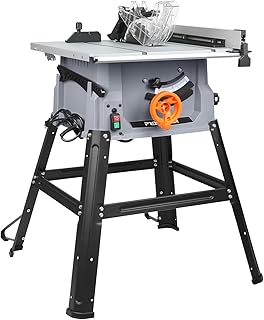
Sometimes. Saws like the Prostormer 10-inch have short rails and a light table, which limits what a full aftermarket system can bolt to. A shop-built auxiliary fence face clamped to the stock fence is often the better return on effort.
Should the fence be shorter than the blade for ripping?
On solid wood, a fence that ends near the back of the blade reduces pinching as the board relieves internal stress. Many fences let you slide the face forward to mimic this, which is worth doing before ripping tension-prone hardwood.
Final Thoughts
For most home furniture builders, the DEWALT DWE7491RS hits the sweet spot: a fence that holds true, 32-1/2 inches of rip, and a stand that rolls out of the way. If your shop is fixed and you’re cutting hardwood regularly, the JET XACTA is the long-term answer, and if you already own a decent saw with a sloppy fence, the Delta T3 fixes the problem for less than the cost of starting over.