Key takeaways
- Fence repeatability: Set the fence to 12 inches, lock it, measure front and back of the blade. Then unlock, swing it out, and reset it. If the numbers drift more than a hair, you’ll be measuring twice on every single cut for the life of the saw. Rack-and-pinion fences hold their setting far better than the older clamp-and-hope designs.
- Rip capacity versus footprint: A 32-inch rip lets you split a 4×8 sheet down the middle in one pass. A 24-inch rip means you’re doing that job with a circular saw and a straightedge first. Decide honestly whether you’ll be handling sheet goods or mostly dimensional lumber before you pay for the wider table.
- Stand mechanics: Rolling stands with a foot-pedal release get set up in about ten seconds. Scissor stands are lighter and cheaper but demand two hands and some hip leverage. If you’re moving the saw in and out for every project, the rolling stand pays for itself in patience.
- Blade height and bevel adjustment feel: Turn the height crank through its full range before you commit. Gritty, loose, or backlash-heavy adjusters mean you’ll never quite hit a precise dado depth. Smooth travel with a positive stop at 90 degrees is the tell for decent internal machining.
- Dust and safety hardware: A working dust port that actually fits a shop vac hose keeps sightlines clear and cleanup short. Check that the riving knife or splitter is tool-free to remove and reinstall, because a splitter that’s a chore to swap is a splitter that lives in a drawer.
What's inside
Buying a table saw for a home shop means wrestling with a pile of contradictions. You want rip capacity wide enough to break down a sheet of plywood, but the saw has to tuck into a corner of the garage when the car comes back in. You want a fence that lands dead-on without a mallet tap, but you’re not spending cabinet-saw money on a tool you’ll use a few weekends a month. And every spec sheet reads the same: 15 amps, 10 inches, 5,000 RPM. The numbers stop telling you anything useful right about the time you actually need help deciding.
What separates these saws in practice comes down to three things you can’t read off a box: how square the fence stays after it’s been knocked around, whether the stand can be deployed solo without a wrestling match, and how much of the assembly is stamped steel versus cast metal. This guide sorts through the portable and jobsite saws that DIYers actually buy, flags where each one earns its keep, and points out the compromises worth accepting versus the ones that’ll bite you six months in.
As an Amazon Associate we earn from qualifying purchases.



🛒 Best Price Today on Amazon
Prime members get fast, free shipping on everything above, plus member-only deals. New members get a 30-day free trial — cancel anytime.
How to Choose a Table Saw For Diyers (2026)
- Fence repeatability: Set the fence to 12 inches, lock it, measure front and back of the blade. Then unlock, swing it out, and reset it. If the numbers drift more than a hair, you’ll be measuring twice on every single cut for the life of the saw. Rack-and-pinion fences hold their setting far better than the older clamp-and-hope designs.
- Rip capacity versus footprint: A 32-inch rip lets you split a 4×8 sheet down the middle in one pass. A 24-inch rip means you’re doing that job with a circular saw and a straightedge first. Decide honestly whether you’ll be handling sheet goods or mostly dimensional lumber before you pay for the wider table.
- Stand mechanics: Rolling stands with a foot-pedal release get set up in about ten seconds. Scissor stands are lighter and cheaper but demand two hands and some hip leverage. If you’re moving the saw in and out for every project, the rolling stand pays for itself in patience.
- Blade height and bevel adjustment feel: Turn the height crank through its full range before you commit. Gritty, loose, or backlash-heavy adjusters mean you’ll never quite hit a precise dado depth. Smooth travel with a positive stop at 90 degrees is the tell for decent internal machining.
- Dust and safety hardware: A working dust port that actually fits a shop vac hose keeps sightlines clear and cleanup short. Check that the riving knife or splitter is tool-free to remove and reinstall, because a splitter that’s a chore to swap is a splitter that lives in a drawer.
The Best Table Saw For Diyers (2026)s Reviewed
DEWALT DWE7491RS 10-Inch with Rolling Stand
This is the saw most serious hobbyists land on and stop shopping. The 32-1/2-inch rip capacity handles full sheets, the rack-and-pinion fence returns to the same spot every time, and the foldable rolling stand deploys with one foot and one hand.
SKIL TS6307-00 10-Inch Portable Jobsite Saw
SKIL built this one around a rack-and-pinion fence and a genuinely useful dust port, which puts it well above its price bracket for accuracy. The folding stand is lighter than a rolling base, so it’s the pick if you’re carrying the saw up steps or loading it into a hatchback.
DEWALT DWE7485 8-1/4-Inch Compact Saw
The smaller 8-1/4-inch blade trades some depth of cut for a saw one person can carry in each hand and stow on a shelf. Rip capacity still hits 24-1/2 inches, which covers cabinet parts and trim work without fuss, and the fence quality carries over from DEWALT’s bigger models.
SKIL SPT99-11 Worm Drive Table Saw with Stand
Worm drive gearing puts more torque at the blade, so this saw grinds through wet pressure-treated stock and thick hardwood without the bog you get from direct-drive competitors. It’s heavier and pricier than the rest, and worth it if your projects involve deck framing or 8/4 lumber.
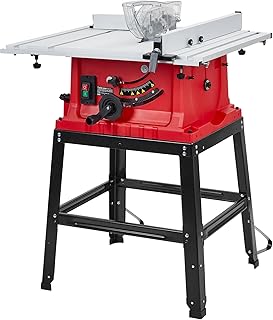
10-Inch 15A Table Saw with Stand and Protective Cover
A 36 x 25-inch tabletop gives you meaningful support for wider workpieces at a budget price, with 90-degree crosscut and 0-45 degree bevel capability covered. Expect to spend an evening dialing in the fence and miter gauge, but the fundamentals are sound once it’s tuned.
Frequently Asked Questions
Is a 10-inch blade necessary, or will 8-1/4 inches do?
An 8-1/4-inch blade cuts roughly 2-1/2 inches deep at 90 degrees, which handles 2x material and anything thinner. You only need the 10-inch if you’re cutting 4×4 stock, resawing, or making deep bevel cuts through thick hardwood.
Do I need a stand, or can I set the saw on a workbench?
A benchtop setup works if your bench is rock solid and at a comfortable height, but the outfeed problem doesn’t go away. Most stands also fold flat for storage, which a workbench does not.
How much does blade quality matter on a jobsite saw?
Enormously. The stock blade on almost every saw here is a general-purpose 24- to 40-tooth combination blade, and swapping to a 60- or 80-tooth thin-kerf blade will improve cut quality more than spending another two hundred dollars on the saw itself.
Can these saws cut aluminum or plastic?
Yes, with the right blade and a slow feed rate. Use a non-ferrous or plastic-specific blade, clamp the workpiece, and never freehand it. The universal-motor saws listed here have plenty of speed for the job.
Final Thoughts
For most DIYers building furniture in a garage, the DEWALT DWE7491RS is the saw that ends the search: full-sheet rip capacity, a fence that holds true, and a rolling stand that makes setup a non-event. If your budget is tighter or you carry the saw more than you roll it, the SKIL TS6307-00 delivers surprisingly precise cuts for the money, and the DEWALT DWE7485 is the right call when shop space is genuinely scarce and you can live with a shallower cut.