Anyone who has tried to hang crown molding or assemble a run of shaker cabinets with a hammer knows the appeal of a nailer: one squeeze, one perfectly sunk fastener, no dented workpiece. The catch is that a nail gun is only half the tool. Pair a good brad nailer with the wrong compressor and you get a machine that either can’t keep up with your trigger finger, or one that shrieks loud enough to wake the whole house every time the motor kicks on. Shop owners with a detached garage can shrug that off. If you’re building a bookcase in a spare bedroom or a basement corner, you can’t.
This guide sorts through the compressors that actually make sense for nailing work, from ultra-quiet one-gallon units built for trim and cabinet assembly to six-gallon pancakes that can run two framing nailers at once. I’ve weighted the picks around the things that matter in practice: recovery speed, real-world noise, tank capacity versus how much of your bench it eats, and whether the pump will still be sealing air three winters from now.
Our top picks


As an Amazon Associate we earn from qualifying purchases at no extra cost to you.
🛒 Best Price Today on Amazon
Prime members get fast, free shipping on everything above, plus member-only deals. New members get a 30-day free trial — cancel anytime.
How to Choose a/an Air Compressor For Nail Gun (2026)
- CFM at 90 PSI: This single number decides whether the compressor keeps up. Brad and finish nailers sip roughly 0.3 to 0.5 CFM per shot, so 2 CFM is plenty. Framing nailers pull far more, and running two at once puts you in 4 CFM territory.
- Tank size versus portability: A one-gallon tank cycles often but tucks under a workbench and carries in one hand. Six gallons buys you longer stretches between motor kicks, which matters when you’re up a ladder with a hose trailing behind you.
- Decibel rating: Standard pancake compressors sit around 80 to 90 dB, roughly a garbage disposal at arm’s length. The quiet class runs 60 to 70 dB, closer to conversation volume. Indoors, that difference is the whole experience.
- Oil-free pump: No crankcase to check, no oil to change, no risk of oil mist reaching your finish. The tradeoff is a shorter service life than a cast-iron oil-lubricated pump, though for weekend furniture work that’s a fair trade.
- Coupler count and regulator quality: Two quick couplers let a helper work alongside you without swapping hoses. Look for a regulator that holds its setting instead of drifting as tank pressure drops.
The Best Air Compressor For Nail Gun (2026)s Reviewed
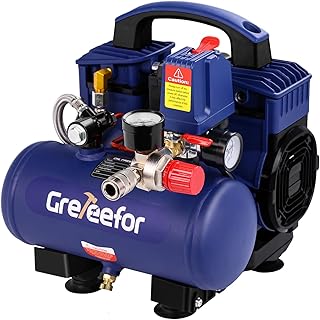
1 Gallon Ultra Quiet Portable 60 dB Compressor
At 60 dB with a 13-second fill from empty, this is the compressor for anyone assembling furniture inside the house rather than out in a shop. The 1.5HP motor keeps up comfortably with brad and pin nailers, and the one-gallon footprint means it lives on a shelf instead of claiming floor space.
Metabo HPT EC914S 6 Gallon Pancake
Four CFM at 200 PSI puts this in a different weight class: it will genuinely run a framing nailer and a brad gun simultaneously without stalling. The higher tank pressure also means more usable air per fill, so you cycle the motor less on long sheathing or deck runs.
FORNAX Ultra Quiet 1.3 Gallon
A close cousin to the quiet one-gallon units with a bit more tank and a 65 dB rating, the FORNAX suits shop-and-garage crossover duty, handling nailing, tire top-offs, and blow-gun cleanup. The 125 PSI ceiling is standard rather than generous, but it’s ample for anything a finish nailer asks of it.
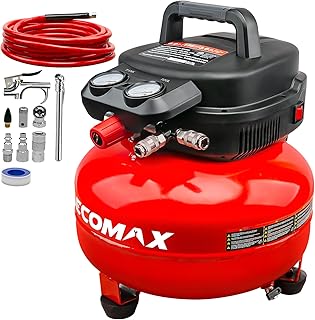
ECOMAX 6 Gallon Pancake
The ECOMAX earns its spot on value: 3 CFM at 90 PSI covers brad nailers and most finish work, and the ten-piece accessory kit plus dual couplers means you’re working the day it arrives. Not the compressor for framing, but a solid first air setup for a furniture-focused shop.
13 Gallon Portable, 3.7 HP
Six CFM and 13 gallons of storage is more than nailing requires, which is exactly the point. If you also spray finishes, sand with air tools, or work on cars, this is the unit that won’t leave you waiting on the pump mid-coat.
What to Look For in a Compressor for Nailers
Read CFM at the Right Pressure
Airflow is listed in cubic feet per minute, but the number only means something when it is paired with a pressure. The convention most brands follow is standard CFM (SCFM) at 90 psi, because that is close to the pressure many nailers operate at. A spec sheet that lists a bigger number at 40 psi is not directly comparable to one listed at 90 psi. Compare like with like, and match the figure against the air consumption in the nailer’s manual rather than against a generic rule.
Tank Size Is a Buffer, Not a Power Rating
The tank stores compressed air so the pump does not have to run on every shot. A bigger tank lets the motor rest longer between cycles, but it does not raise the delivery rate. The pump’s output (the CFM) decides how fast the tank refills. A worked example shows how much air the tank really holds, using Boyle’s law, with 7.48 gallons to the cubic foot and an assumed maximum tank pressure of 150 psi (confirm the actual figure on the model you want).
| Tank size | Total stored air at 150 psi | Air available while falling from 150 to 90 psi |
|---|---|---|
| 1 gallon | about 1.5 SCF | about 0.55 SCF |
| 6 gallons | about 9.0 SCF | about 3.3 SCF |
| 13 gallons | about 19.5 SCF | about 7.1 SCF |
Those figures show why bigger tanks help most with bursts of continuous nailing. A small tank can empty the useful air quickly, and then the compressor must run while you wait. The larger the usable reserve, the more the pump can idle during a run of trim.
Noise: Decibels Are Not Linear
A reading of 60 dB is about the level of ordinary conversation. Because the decibel scale is logarithmic, a difference of 10 dB is generally heard as roughly twice as loud, so the gap between a 60 dB unit and a conventional unit near 80 dB is far larger than the number suggests. Manufacturers measure noise under different conditions, so use the figure as a rough guide to which class a model belongs in.
Oil-Free Pumps, Power, and Circuit Limits
Many small compressors for nailers use oil-free pumps, which mean no oil to check or change but typically a louder sound. A 120 V compressor on a shared 15-amp household circuit can trip the breaker if something else is running, particularly when it starts under load. An extension cord that is long or thin can starve the motor of voltage, so shorten the cord, thicken the wire, or move the compressor closer to the outlet.
Hose and Fittings
A hose that is too narrow or too long causes a pressure drop between the regulator and the nailer. A 1/4 inch inside diameter hose is common for brad and finish nailers, and many users step up to 3/8 inch for longer runs. Check which coupler profile the compressor and nailer use, because the most common industrial style is not the same as automotive or other shapes.
Which Compressor Should You Choose?
| If you… | Choose… |
|---|---|
| Want the quietest and lightest option for occasional brad work indoors | The 1 Gallon Ultra Quiet Portable 60 dB Compressor or the FORNAX Ultra Quiet 1.3 Gallon |
| Need a jobsite-style pancake tank for trim and finish nailers | The Metabo HPT EC914S 6 Gallon Pancake or the ECOMAX 6 Gallon Pancake |
| Plan to run bigger nailers or do longer sessions | The 13 Gallon Portable, 3.7 HP, after checking its listed CFM against the nailer’s manual |
| Work in a shared house or apartment | One of the two quiet models, with a plan to take breaks and let the tank refill |
| Move the compressor between rooms often | The lightest option that still meets the airflow your nailer needs |
Confirm each unit’s maximum pressure, CFM at 90 psi, weight, and noise rating on the listing, since specifications can change between production runs.
Setting Up and Maintaining the Compressor
- Place the unit on a level surface with room around the pump for airflow.
- Close the drain valve, plug in, and let the tank fill to its cut-out pressure.
- Set the regulator to the pressure printed on the nailer, never above its maximum.
- Connect the hose and fire a few test nails into scrap to check the depth setting.
- After each session, open the drain valve to release moisture, because water inside the tank leads to rust.
- Periodically check the air filter and, on oil-lubricated pumps, the oil level.
Common Mistakes When Buying a Compressor for Nailers
- Buying on tank size alone. Pump output matters as much as capacity.
- Comparing CFM numbers at different pressures. Make sure both are at 90 psi.
- Forgetting to drain the tank. Moisture shortens a tank’s life.
- Running a long, thin extension cord. The motor may overheat or fail to start.
- Ignoring the duty cycle. Running a small pump continuously can overheat it, so give it rest breaks.
- Choosing the loudest model for a home shop. A louder unit may be fine in a detached garage but tiresome in a home.
Frequently Asked Questions
How much CFM do I need for a brad nailer?
Around 0.5 to 1 CFM at 90 PSI is sufficient for continuous work. Nearly any compressor sold today clears that, which is why tank size and noise usually matter more than raw output for trim and cabinet work.
Can a one-gallon compressor run a framing nailer?
Briefly, and then you’ll be waiting. Framing nailers demand roughly 2 to 2.5 CFM in sustained use, so a small tank spends most of its time recovering. Step up to six gallons for framing.
Do quiet compressors sacrifice performance?
Not meaningfully at this size. Quiet models use slower-turning induction motors, which run cooler and often last longer. Recovery times are comparable to noisier direct-drive units in the same tank class.
What PSI should I set for nailing?
Start at 90 PSI for brad and finish nailers, then adjust in five-pound steps until heads sink just below the surface. Softwoods need less, hardwood needs more.
Final Thoughts
For indoor furniture building, the 1 Gallon Ultra Quiet 60 dB unit is the easy recommendation: quiet enough to use in a living space and quick to refill. If your projects extend to framing or you want room to grow, the Metabo HPT EC914S delivers the 4 CFM that lets two nailers run at once, while the ECOMAX 6 Gallon pancake covers the same general ground at a friendlier price with accessories included.