
Key takeaways
- Age Range Description: Adult
- Mount Type: Doorway Mount
- Item Dimensions W x H: 37"W x 20.2"H
There is a middle path between accepting whatever a doorway bar does to your walls and drilling permanent holes, and it costs about fifteen dollars at a hardware store. A piece of quarter-inch plywood cut to sit behind the leverage arms spreads the load across a much larger area of drywall. Adhesive felt under the hooks stops trim from denting. A scrap of rubber matting under a tower’s feet stops it walking on tile. These are small interventions that meaningfully change how any of these bars behave in a real home.
This roundup is written for people willing to spend twenty minutes improving what they buy. Renters get solutions that leave nothing behind; owners get the option to build a proper backer and mount something permanent later. The six bars below are evaluated partly on how well they respond to that kind of modification, because a mid-range bar with a plywood spreader behind it often outperforms an expensive one installed straight out of the box.
Our top picks
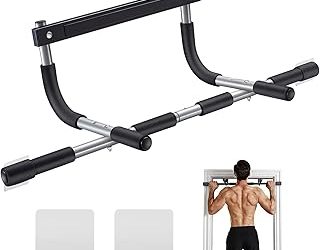
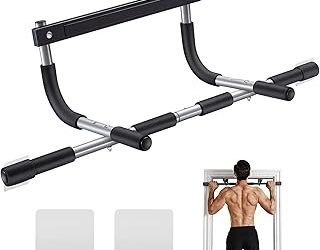
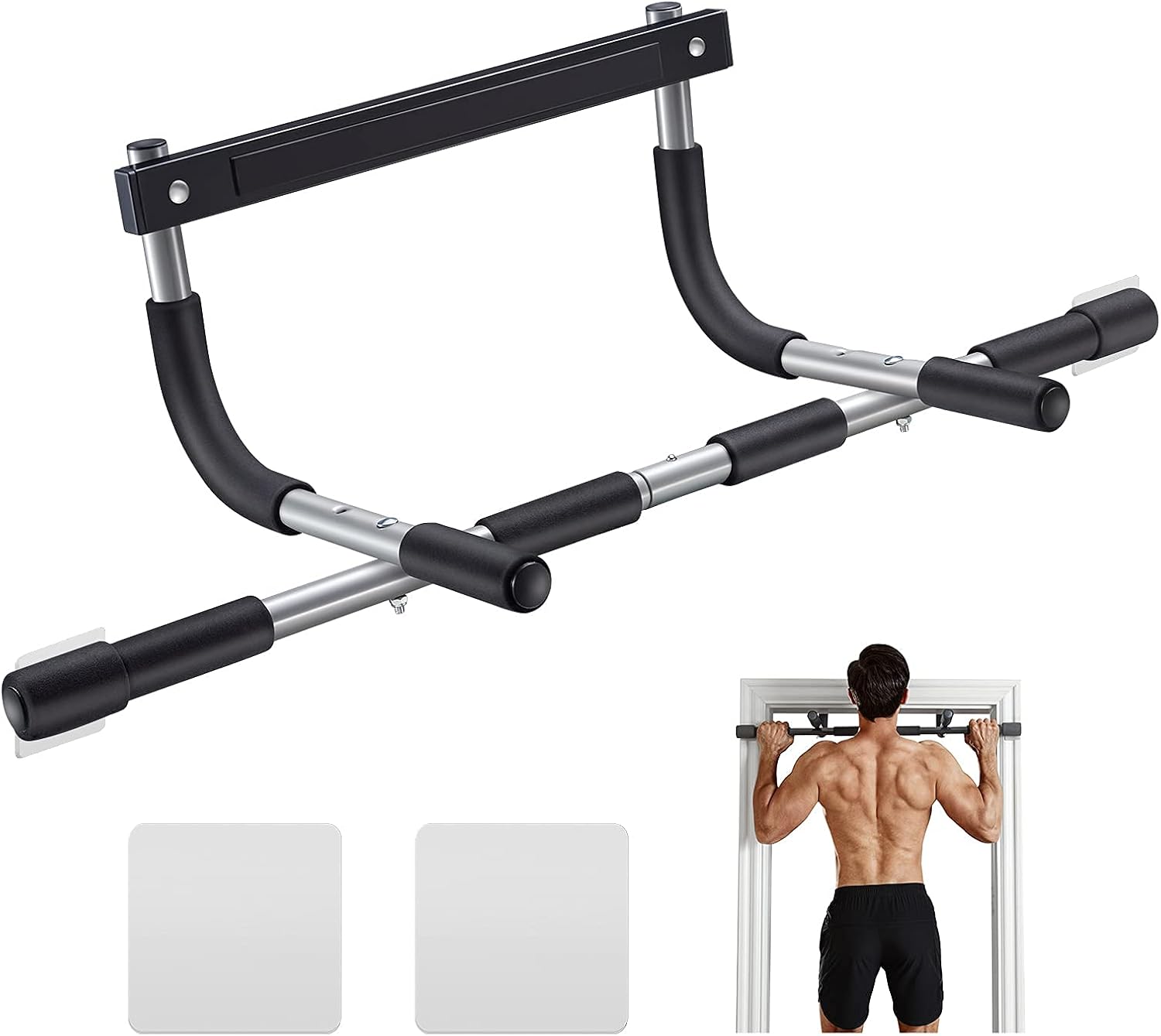 Ally Peaks Pull Up Bar for Doorway
- Age Range Description: Adult
- Mount Type: Doorway Mount
- Item Dimensions W x H: 37"W x 20.2"H
 Sportneer Pull Up Bar for Doorway
- Age Range Description: Adult
- Mount Type: Doorway Mount
- Item Dimensions W x H: 37.01"W x 6.69"H
| Product | Key specs | |
|---|---|---|
| Ally Peaks Pull Up Bar for Doorway | Age Range Description: Adult Mount Type: Doorway Mount Item Dimensions W x H: 37"W x 20.2"H | Check price |
 Ally Peaks Pull Up Bar for Doorway Ally Peaks Pull Up Bar for Doorway | Check price | |
| Sportneer Pull Up Bar for Doorway | Age Range Description: Adult Mount Type: Doorway Mount Item Dimensions W x H: 37.01"W x 6.69"H | Check price |
 2026 Upgrade Multi-Grip Pull Up Bar with 2026 Upgrade Multi-Grip Pull Up Bar with | Age Range Description: Adult Mount Type: Doorway Mount Item Dimensions W x H: 10.5"W x 2"H | Check price |
 Ally Peaks Pull Up Bar for Doorway Ally Peaks Pull Up Bar for Doorway | Check price | |
 SPORTSROYALS Free Standing Pull Up Bar SPORTSROYALS Free Standing Pull Up Bar | Warranty Description: 2-Year Warranty Maximum Weight Recommendation: 360 Pounds Warranty Type: No Warranty | Check price |
 New Upgrade Pull Up Bar for Doorway New Upgrade Pull Up Bar for Doorway | Check price | |
 Ally Peaks Pull Up Bar for Doorway Ally Peaks Pull Up Bar for Doorway | Check price |
As an Amazon Associate we earn from qualifying purchases at no extra cost to you.
Quick Comparison
| Product | Best For | Standout Feature | Watch Out For |
|---|---|---|---|
| Ally Peaks Multi-Grip Doorway Bar | Pairing with a plywood spreader | Wide arms sit well against a backer board | Arm spacing must be measured before cutting |
| Ally Peaks 440 lb Doorway Bar | Heavy users adding load spreading | Capacity to justify the extra setup work | More force means the backer must be sized properly |
| Sportneer No-Drill Doorway Bar | Simple felt-pad modifications | Clean contact points easy to pad | Adjustment range limits backer placement |
| Upgrade Multi-Grip Bar with Larger Hooks | Adding leather trim protectors | Big hooks accept a thick protective layer | Added padding can reduce hook engagement depth |
| Ally Peaks Width-Adjustable Doorway Bar | Dialing in a custom fit | Width tuning works with shimmed frames | Shims must not compromise the lock mechanism |
| SPORTSROYALS Free Standing Power Tower | Floor protection projects | Base accepts rubber mats and levelling shims | Shims must be secured or they migrate |
How to Choose
- Build a load spreader: A piece of quarter-inch plywood roughly 12 by 30 inches behind the leverage arms distributes force across several studs’ worth of drywall instead of two small pads.
- Use adhesive felt on hooks: Self-adhesive furniture felt under each hook prevents trim denting and costs almost nothing. Replace it when it compresses.
- Do not pad so much you lose engagement: Thick padding under hooks reduces how deeply they seat on the casing. Keep protective layers under about an eighth of an inch.
- Level a tower properly: Use hardwood or composite shims, not folded cardboard, and glue or screw them to the feet so they cannot walk out during a session.
- Plan a backer for permanent mounts: Owners can screw a 2×8 across two studs, then bolt the bar to that. It spreads load, hides mistakes, and looks intentional.
Top Picks Reviewed
Best with a Backer Board: Ally Peaks Multi-Grip Doorway Bar
The broad leverage arms make an ideal match for a plywood spreader, because they contact a large flat area rather than concentrating force at two small points. Cut the board to the arm spacing, paint it to match the wall, and the setup becomes noticeably gentler on drywall.
Measure the arm positions accurately first. A backer that is slightly too narrow puts the arms right at the edge, which concentrates force at the board’s perimeter and can crack it under repeated loading.
Best Heavy-Duty Base: Ally Peaks 440 lb Doorway Bar
If you are going to invest effort in load spreading, doing it around a bar with real capacity makes sense. The thickened steel here means the bar itself will never be the limiting element once the wall side is sorted.
Higher body weight demands a proportionally larger spreader. A small backer under a 240-pound user simply relocates the pressure rather than distributing it, so size the board generously.
Easiest to Modify: Sportneer No-Drill Doorway Bar
Clean, simple contact points mean you can add felt or thin foam in about three minutes with no measuring at all. For minimum effort and meaningful protection, this is the best starting platform.
Its adjustable span means the contact points move when you change the setting, so a backer board sized for one position may not suit another. Pick a setting and stay with it.
Best Trim Protection: Upgrade Multi-Grip Bar with Larger Hooks
The oversized hooks have enough depth to accept a proper leather or thick felt liner without compromising how they sit, which is exactly what decorative wood casing needs.
There is a limit. Add too much material and the hooks no longer clear the trim properly, which trades cosmetic protection for a genuine safety issue. Keep the liner thin and dense.
Most Tunable Fit: Ally Peaks Width-Adjustable Doorway Bar
Adjustable width lets you work around a doorway that is slightly out of square, which is common in older homes. Combined with a thin shim on the low side, you can get an even, fully seated fit that a fixed bar cannot achieve.
Shims must not interfere with the locking mechanism. Place them at the contact pads, not inside the adjustment hardware, or you compromise the one part that holds the bar together.
Best Floor Project: SPORTSROYALS Free Standing Power Tower
A rubber horse-stall mat or interlocking gym tiles under this frame solve three problems at once: they protect the floor, dampen noise, and give the base something grippy to sit on so it stops creeping during dips.
Levelling shims need to be fastened. Loose shims migrate out over a few weeks of use, and you will not notice until the frame starts rocking mid-set.
Frequently Asked Questions
Does a plywood backer really protect drywall?
Yes, substantially. It converts two concentrated pressure points into a distributed load across a much larger area, which is the same principle behind a wall plate on any bolted fixture.
What should I use to pad hook contact points?
Self-adhesive furniture felt or thin leather. Both are dense enough to spread force without adding so much thickness that the hooks lose engagement with the casing.
Can I make a doorway bar fit a wider opening?
Not safely by improvising. If the opening exceeds the bar’s rated span, use a joist mount or a free-standing tower instead of building spacers to bridge the gap.
How do I stop a power tower from sliding on tile?
Put a rubber mat under the entire base. Individual rubber feet can slip on polished tile, and a single continuous mat also spreads the point loads that chip grout.
Final Thoughts
A modest amount of preparation changes what these products do to your home more than the price difference between them does. Spread the load, protect the trim, level the base, and use dense rather than thick padding. Twenty minutes of work up front is what separates a bar you keep for years from one you take down after the first cracked corner bead.




Write Your Review
No reviews yet. Be the first to share your experience!