Key takeaways
- Find the best box fans for window use with our guide to size, airflow, noise, and safe setup, plus square fans that fit a standard sash opening well today.
The best box fans for window use are square, stable, and sized to fill the opening without forcing the sash or blocking the controls. A good window box fan moves a large volume of air through the room, pulls cooler evening air inside, or pushes warm and stale air out, depending on which way it faces. It should sit securely on the sill, leave room for the cord to run safely, and run at a speed that suits sleeping, working, or cooling a room after a hot day.


Quick answer: for most sash windows, start with a 20-inch box fan with three speeds, a carry handle, and removable feet. The Lasko Weather-Shield Performance Box Fan, model 3720, is the strongest match in this guide because its motor is described as weather resistant and it is made for window installation. If your window is sheltered and you want a lighter, slimmer fan that is easy to lift in and out each day, the Lasko 3733 is a practical alternative. For a plain spare, the Amazon Basics 3-Speed Box Fan covers the basics with wide feet and a simple top control.
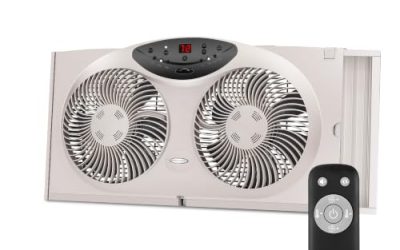
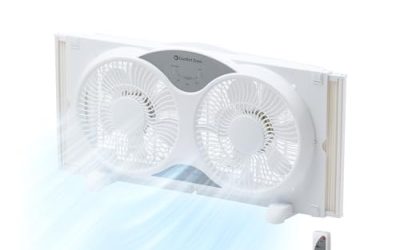
A box fan is not the same as a purpose-built twin window fan, which locks into the frame with expandable side panels and often reverses direction at the touch of a button. A box fan is a freestanding square fan that happens to fit many windows well, and you can also use it on the floor or on a table. The trade-off is that you must seal the gaps around it yourself, check that it cannot tip, and keep it away from rain unless the maker describes the motor as weather resistant. Every fan below is a box fan, not a tower fan, not an air circulator, and not an exhaust fan.
Quick Picks
Our Short List of 3
All 3 Picks at a Glance
| Product | Specs | Action |
|---|---|---|
| Lasko 3733 Slim Box Fan (B00002ND67) | Check price on Amazon | |
| Lasko Premium Box Fan 3723 (B000HHJ2I2) | Check price on Amazon | |
 Amazon Basics 3-Speed Box Fan (B08XKC9K14) | Check price on Amazon |
How to Choose
Measure the Window Opening First
Measure the width and height of the clear opening before you order. Most fans in this guide are about 20 to 22 inches wide and about 21 to 23 inches tall, so they suit a standard double-hung sash window. Measure from the inside of one side jamb to the other, and from the sill to the bottom of the raised sash, then compare both numbers with the listing. A fan that is too wide will not sit squarely, and a much narrower fan will leave gaps that let air slip around the sides instead of through the blades. Check the sill depth too: a box fan needs a flat, level surface that supports its full base. If the opening is smaller than 20 inches, look for a smaller box fan or a twin window fan made for narrow sashes.
Decide Which Direction the Air Should Move
A box fan in a window can work in two directions. Facing inward, it pulls cooler outside air into the room. Facing outward, it pushes warm, stale, or smoky air out. In the evening, when the air outside is cooler than the air inside, intake usually feels best. After cooking, or on a hot afternoon, exhaust can clear a stuffy room faster. Some households use two fans, one pulling air in at one end of the home and one pushing air out at the other end, which creates a cross breeze. Keep the path clear, open a window on the opposite side for make-up air, and keep curtains away from the blades.
Look at Airflow, Not Just Blade Size
Blade size tells you how large the fan is, not how much air it moves. The airflow figure, given in cubic feet per minute, is the number to compare. The fans in this guide list airflow from 1800 to 2000 cubic feet per minute on the highest speed, where the maker publishes a figure. Treat that figure with care, because makers do not all measure airflow in the same way. Use it as a rough guide, then look at the number of speeds, the blade count, the grille design, and the wattage. Three speeds give you a low setting for sleeping, a medium setting for steady air, and a high setting for fast cooling.
Check Noise and Sleep Comfort
A box fan makes sound, and that matters if it will run in a bedroom. Most listings give a noise figure in decibels, but the number alone does not tell you how the sound will feel. A steady, low hum is easier to sleep through than a rattling grille. Low speed is usually quiet enough for a bedroom, while high speed is better for daytime cooling. If you are a light sleeper, choose a fan with a true low speed and a stable base that does not vibrate against the sill, and keep it away from loose curtains and papers, which can flutter and add noise.
Think About Rain, Dust, and the Motor
A window is an exposed place. Rain can blow in, dust can settle on the blades, and condensation can form on the sill. Most box fans are made for indoor use, and their manuals warn against letting water reach the motor, the plug, or the cord. The Lasko 3720 is the exception here: its Weather Shield motor is described as weather resistant and made for window installation, so it is the safer choice when light rain might reach the opening. For every other fan, treat rain as a reason to remove the fan or close the window. Never leave a standard box fan running in an open window during a storm, and never let the cord sit in standing water. Unplug the fan before cleaning, and let it dry fully before you plug it back in.
Check Weight, Handle, and Daily Handling
A window fan is often lifted in and out every day, so weight matters more than it does for a fan that stays on the floor. The fans here weigh from about 5 pounds to about 9 pounds. Lighter models are easier to carry up stairs or move between rooms. Heavier models, especially those with a steel body, feel more planted on the sill and are less likely to shift on high speed. Look for a carry handle on top and feet that can be removed for window use if the listing describes that feature. A top-mounted control is easier to reach when the fan is in a window, and a short cord may force you to use an extension lead, which is best avoided.
Plan How to Seal the Gaps
A box fan only works well in a window when air has to pass through the blades. If there are wide gaps around the sides or above the fan, air will take the easy path around it, and the breeze will be weaker. Measure the gaps after the fan is in place, then fill them with foam weather stripping, a cut-to-fit insulation board, or a window fan sealing panel. Do not use loose cloth or cardboard that can get wet. Sealing also helps with insects, dust, and noise from outside, and a snug fit keeps the fan from rattling. Leave a way to remove the fan quickly, and do not fix it with screws through the frame unless the maker describes that as safe.
The Best Box Fans for Window Reviewed
Lasko Weather-Shield Performance Box Fan 3720 (B000BOCD1Y)
The Lasko Weather-Shield Performance Box Fan, model 3720, is the clearest window pick here. Its 20-inch blade moves air listed at 2000 cubic feet per minute on the highest of its three speeds, and its five blades sit behind a grille that includes the Wind Ring system, made to focus air forward. The fan runs on 112 watts, measures about 4.7 inches deep by 21.2 inches wide by 22.5 inches high, and weighs about 8.9 pounds. What sets it apart is the Weather Shield motor, described as weather resistant and made for worry-free window installation. It has a wide body for stability, a carry handle, three speeds, and removable feet, and the listing gives a two-year limited warranty.
Who it suits: homeowners and renters who want to leave a box fan in a window for the season, anyone whose window catches rain, and anyone who wants the strongest window-specific design here. Who should skip it: anyone with a window opening narrower than about 22 inches, and anyone who needs the lightest fan for daily carrying up and down stairs.
Lasko 3733 Slim Box Fan (B00002ND67)
The Lasko 3733 is a slim 20-inch box fan with three quiet speeds, a top-mounted control knob, and a lightweight frame with an easy-carry handle. Its listing gives airflow of 1800 cubic feet per minute, a wattage of 83 watts, five blades, and a weight of about 6.8 pounds. The mounting type includes window mount as well as floor mount, and the description says to put it in a window, on the floor in a bedroom, living room, or office, or anywhere you need a fan. The slim depth is the main advantage: at about 4.25 inches deep, it fits a shallow sill more easily than a wide-body model. The fan carries an ETL listing with a fused safety plug.
Who it suits: renters and anyone who lifts the fan in and out each day, bedrooms and small rooms where a slim fan is easier to place, and anyone who wants a simple, proven 20-inch box fan. Who should skip it: anyone who needs a weather-resistant motor for an exposed window, and anyone who wants the highest airflow figure in this guide.
Lasko Premium Box Fan 3723 (B000HHJ2I2)
The Lasko Premium Box Fan, model 3723, is a 20-inch box fan with three speeds, five blades, and the Wind Ring system, made to focus air movement without a larger motor. The listing gives a wattage of 112 watts, a blade length of 20 inches, and a weight of about 5 pounds, with a wide-body design for stability and a built-in carry handle. It is described as a way to circulate air conditioning, dispel stale air, and bring fresh air into a room. This model suits a window that is sheltered from rain, or a room where the fan will sit on the floor near the window. The wide body helps it stand firmly, and the top control is easy to reach.
Who it suits: anyone who wants a focused breeze in a bedroom or living room, and anyone who will use the fan in a window on dry evenings and on the floor at other times. Who should skip it: anyone whose window is exposed to rain, because this model does not describe a weather-resistant motor, and anyone who needs a published airflow figure to compare directly.
Amazon Basics 3-Speed Box Fan (B08XKC9K14)
The Amazon Basics 3-Speed Box Fan is a plain 20-inch box fan with three speeds, five blades, a carry handle, and extra-wide feet. The listing gives a wattage of 67 watts, a weight of about 5.8 pounds, and dimensions of about 6.8 inches deep by 20.86 inches wide by 21.33 inches high. The full dimensions let you check the fit against your window before you order, and the extra-wide feet are made to stop the fan tipping or wobbling while it runs. This is the simplest fan in the guide, and that is its strength: no timer, no remote, and no special grille system to learn. The lower wattage means it draws less power than the Lasko models here, which matters if the fan will run for many hours each day.
Who it suits: anyone who wants a spare for a bedroom, dorm room, or guest room, and anyone who values a light fan with clear dimensions and a stable base. Who should skip it: anyone who needs a published airflow figure to compare, because the listing does not give one, and anyone whose window is exposed to rain, because the listing does not describe a weather-resistant motor.
What to Check Before You Buy
Measure the window opening, the sill depth, and the distance to the nearest socket before you order, and compare all three with the dimensions in the listing. Check that the fan can sit level, that the sash can close onto the top of the fan or a sealing panel without pressing on the grille, and that the cord will not be pinched by the sash. Read the manual, especially the sections on window use, rain, and cleaning. A fan that is safe on the floor is not always safe in an open window. Check the warranty as well: the Lasko models here list a one-year or two-year limited warranty, so keep the receipt and model number.
Think about storage too. A box fan will spend part of the year in a closet, so choose one you can carry, clean, and store without strain. Wipe the blades and grille before storage, coil the cord loosely, and store the fan upright in a dry place. Finally, check the room, not just the fan. A box fan works best when air can move through the home, so open a second window or a door on the opposite side for make-up air. If the air outside is hotter than inside, close the window and use the fan on the floor instead.
FAQ
Can I use a regular box fan in a window?
Yes, in many homes a regular box fan works well in a window, provided the opening is wide enough, the sill is flat and level, and the fan sits securely without tipping. Seal the gaps around the sides and above the fan so air passes through the blades. Keep the fan away from rain unless the maker describes the motor as weather resistant, and never leave a standard box fan running in an open window during a storm.
Which way should a box fan face in a window?
Face it inward in the evening when outside air is cooler than inside air, so it pulls cool air in. Face it outward to push warm, stale, or smoky air out, such as after cooking. For a cross breeze, use one fan pulling air in at one end of the home and a second opening pushing air out at the other end.
What size box fan fits a standard window?
A 20-inch box fan fits many standard double-hung sash windows, because the fan is about 20 to 22 inches wide and about 21 to 23 inches tall. Measure your own opening first, because windows vary. If the opening is smaller than 20 inches, choose a smaller fan or a twin window fan made for narrow sashes.
Is a box fan or a twin window fan better?
A twin window fan is better when you want a fan that locks into the frame, seals the opening with expandable panels, and reverses direction at the touch of a button. A box fan is better when you want a fan that can also sit on the floor or on a table and move between rooms. If you plan to leave the fan in the window all season, a twin window fan is often tidier. If you lift the fan in and out each day, a box fan is often easier.
How do I keep a box fan from falling out of the window?
Place the fan on a flat, level sill, make sure its feet are in full contact with the surface, and lower the sash so it rests snugly on the fan or on a sealing panel. Fill the side gaps with foam weather stripping or a cut-to-fit panel so the fan cannot shift sideways. Keep the cord clear of the sash, check the fan after the first hour of use, and remove it before a storm.
Bottom Line
The best box fans for window use fit your opening, sit securely on the sill, and match how you will use them. Choose the Lasko Weather-Shield 3720 when rain may reach the window. Choose the Lasko 3733 when you want a slim, light fan for daily lift-in and lift-out use. Choose the Lasko Premium 3723 for a focused breeze in a sheltered window. Choose the Amazon Basics 3-Speed Box Fan for a simple, light spare. Measure first, seal the gaps, keep the cord and plug dry, and face the fan to suit the time of day.
Disclosure: As an Amazon Associate, we may earn from qualifying purchases.
More from Amazon
Programs that pair well with the guide above. Offers and eligibility are set by Amazon and may change.
A free business account with business pricing and bulk-buying tools for work, shop or home office.
Create a business accountFree shipping on eligible items, Prime Video and more. Eligible new members can start with a free trial.
Start a Prime free trialAudiobooks and podcasts to listen to on the go. Eligible new members can start with a free trial.
Try Audible freeAd-free music streaming. Eligible new subscribers can start with a free trial.
Try Music Unlimited freeAs an Amazon Associate we earn from qualifying purchases.