Key takeaways
- Measure before you buy: Building code wants blades at least seven feet off the floor. Hold a tape from the joist down — if you’re working with eight-foot ceilings, flush mount is your only real option, and anything with a downrod is off the table.
- DC motor over AC: A DC motor draws less power, runs quieter, and gives you six or more speeds instead of three. That granularity matters at night, when the difference between “gentle drift” and “wind tunnel” is one click.
- Dimming and color temperature: Look for stepless dimming rather than three fixed levels, plus a warm-to-cool range around 3000K–6000K. Warm light for winding down, daylight for getting dressed, one fixture doing both jobs.
- Blade span vs. room size: A 20-inch caged fan moves plenty of air in a 10×10 bedroom or nursery. Rooms past 200 square feet want 44 to 52 inches of sweep, otherwise you’ll run it flat out and still feel nothing.
- Check your wiring and controls: Most of these run on remote or app control, which means you don’t need a second switch leg in the box — a real advantage in older homes. Confirm the mounting bracket fits a standard fan-rated box, and never hang a fan from a box rated for lights only.
What's inside
Swapping a bedroom light fixture for a fan-and-light combo sounds like a Saturday afternoon job until you’re standing on a ladder with the ceiling plate in one hand, realizing the downrod you bought eats six inches of headroom you didn’t have. Bedrooms are where the fan problem gets genuinely tricky: ceilings run low, sleepers are sensitive to motor hum and blade wobble, and the light output that works fine in a kitchen turns a bedroom into an interrogation room at 10pm. Anyone who has installed a few of these knows the specs that matter aren’t the ones printed largest on the box.
This guide comes from the practical side of the job — mounting height, junction box compatibility, wire count, how a DC motor actually sounds at speed three when you’re trying to fall asleep. Below are six flush mount and low profile fixtures worth your time in 2026, from a wide 52-inch nickel model to compact caged fandeliers that read more like decorative lighting than fan hardware. Every one of them hugs the ceiling, and every one dims.
As an Amazon Associate we earn from qualifying purchases.



🛒 Best Price Today on Amazon
Prime members get fast, free shipping on everything above, plus member-only deals. New members get a 30-day free trial — cancel anytime.
How to Choose a Ceiling Fan Light For Bedroom (2026)
- Measure before you buy: Building code wants blades at least seven feet off the floor. Hold a tape from the joist down — if you’re working with eight-foot ceilings, flush mount is your only real option, and anything with a downrod is off the table.
- DC motor over AC: A DC motor draws less power, runs quieter, and gives you six or more speeds instead of three. That granularity matters at night, when the difference between “gentle drift” and “wind tunnel” is one click.
- Dimming and color temperature: Look for stepless dimming rather than three fixed levels, plus a warm-to-cool range around 3000K–6000K. Warm light for winding down, daylight for getting dressed, one fixture doing both jobs.
- Blade span vs. room size: A 20-inch caged fan moves plenty of air in a 10×10 bedroom or nursery. Rooms past 200 square feet want 44 to 52 inches of sweep, otherwise you’ll run it flat out and still feel nothing.
- Check your wiring and controls: Most of these run on remote or app control, which means you don’t need a second switch leg in the box — a real advantage in older homes. Confirm the mounting bracket fits a standard fan-rated box, and never hang a fan from a box rated for lights only.
The Best Ceiling Fan Light For Bedroom (2026)s Reviewed
POCHFAN 52 Inch Flush Mount Ceiling Fan
This is the one to reach for when the bedroom is genuinely large — 52 inches of blade span in a brushed nickel flush mount body, so you get real air movement without sacrificing headroom. Six speeds, dimmable LED, and ETL listing; installation is straightforward on a fan-rated box, and the low profile design means no downrod math.
LEDIARY Caged Fandalier, White Gold
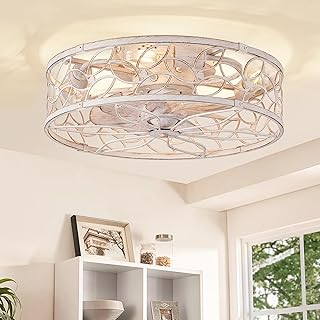
A caged bladeless design that reads as a light fixture first and a fan second, which solves the aesthetic problem in bedrooms where an exposed-blade fan looks wrong. The DC motor is genuinely quiet at low speeds, and app control means you can adjust it without hunting for the remote in the dark.
LEDIARY 20″ Caged Fandelier, Black Gold
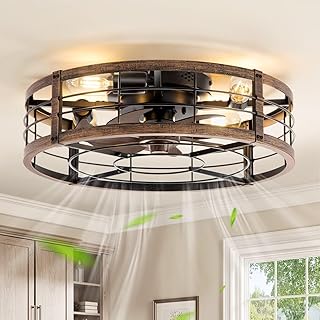
Same enclosed cage format in a black and gold finish that suits rustic or farmhouse rooms without tipping into novelty. At 20 inches it’s sized for smaller bedrooms and nurseries — six speeds from the DC motor, and the enclosure keeps curious hands away from moving parts.
LEDIARY 20″ Fandelier with 3 CCT LED
The three color-temperature settings and stepless dimming make this the most flexible of the compact LEDIARY models for a room that serves as both bedroom and workspace. The reversible DC motor is worth using — run it in reverse through winter to push warm air back down instead of letting it pool at the ceiling.
LEDIARY 20″ Modern White Fandelier
A cleaner, less industrial take on the 20-inch flush mount format, with stepless color temperature change rather than fixed presets. Six speeds, remote included, and the white finish disappears against most ceilings — a good pick when you want the fixture to stay quiet visually.
Frequently Asked Questions
Do I need a special electrical box to install one of these?
Yes. Fans require a fan-rated junction box or a properly braced support, because a standard light box isn’t built for the dynamic load of a spinning motor. If you open the ceiling and find a plastic box with two screws into drywall, stop and install a brace bar first.
Can a 20-inch caged fan actually cool a bedroom?
In a room up to roughly 150 square feet, yes — the DC motors in these compact fandeliers move air efficiently, and the enclosed cage directs the flow downward. Larger rooms need more sweep, which is where a 52-inch model earns its space.
Will the remote work if my wall switch is on a dimmer?
No, and this is a common install headache. Fan and LED electronics need constant line voltage, so replace any existing dimmer switch with a standard single-pole switch before you wire in the fixture.
How do I stop a new fan from wobbling?
Wobble almost always traces back to the mounting bracket rather than the blades. Confirm the bracket is tight against the box, that the ball joint seated fully in its notch, and that all blade screws are torqued evenly — flush mount designs are less wobble-prone than downrod fans to begin with.
Final Thoughts
For a large bedroom where airflow is the priority, the POCHFAN 52 Inch flush mount delivers the most sweep per inch of headroom. In smaller rooms, the LEDIARY 20″ Fandelier with 3 CCT LED is the most versatile pick thanks to stepless dimming and three color temperatures, while the ZMISHIBO Low Profile 19.7″ in black is a strong alternative if you want a timer function and a darker finish. All three install flush, all three run on quiet DC motors, and none of them will cost you the six inches of ceiling a downrod demands.