Key takeaways
- Measure your ceiling height first: Under 8 feet and you want a flush-mount hugger with no downrod, since code and comfort both want at least 7 feet of clearance under the blades. At 9 feet or more, a standard mount with a short downrod moves air far better than a fan pressed against the drywall.
- DC motor vs. pull chain: DC motors run quieter, draw roughly 60-70% less power, and give you six speeds plus reverse from a remote. Pull chains are dead simple, never lose a paired remote, and cost less to replace when something fails a decade in.
- Check the light temperature options: 3CCT fans let you switch between roughly 3000K, 4000K, and 5000K at the remote. A single fixed 5000K panel will feel harsh in a bedroom, so if the listing only names one color temperature, make sure it’s the one you want to live with.
- Confirm the mounting bracket style: Some low-profile fans hang the motor from a ball-and-socket, others require you to hold the full weight while threading screws. Look for a bracket with a hanging hook or slot — it turns a two-person job into a one-person job.
- Damp rating and ETL listing: If the fan goes on a covered porch, ETL damp-rated is not optional. Indoor-only fans on a patio will corrode at the blade arms and motor housing within a couple of humid seasons.
What's inside
Anyone who has stood on a ladder at 9 p.m., holding a fan motor overhead with one hand while fishing for a wire nut with the other, knows the real problem with 42-inch ceiling fans: the spec sheet rarely tells you what installation day will actually feel like. Small rooms need small fans, but “small” has become a catch-all category crowded with flush-mount hugger units, downrod models, DC motors, AC motors, and light kits that range from genuinely useful to barely there. Pick wrong and you get either a fan that ticks against the canopy at high speed or a light so cold and blue that the room feels like a dental office.
This guide is written from the ladder, not the marketing deck. I’ve looked at how these fans mount, whether the blade arms bolt on cleanly, how the remote pairing behaves, what the light output actually does to a 12×12 bedroom, and where each model earns its keep. Below you’ll find the current picks worth your time, a short checklist for matching a fan to your ceiling, and honest notes on the tradeoffs nobody mentions in the listing photos.
As an Amazon Associate we earn from qualifying purchases.




🛒 Best Price Today on Amazon
Prime members get fast, free shipping on everything above, plus member-only deals. New members get a 30-day free trial — cancel anytime.
How to Choose a/an 42-Inch Ceiling Fan With Light (2026)
- Measure your ceiling height first: Under 8 feet and you want a flush-mount hugger with no downrod, since code and comfort both want at least 7 feet of clearance under the blades. At 9 feet or more, a standard mount with a short downrod moves air far better than a fan pressed against the drywall.
- DC motor vs. pull chain: DC motors run quieter, draw roughly 60-70% less power, and give you six speeds plus reverse from a remote. Pull chains are dead simple, never lose a paired remote, and cost less to replace when something fails a decade in.
- Check the light temperature options: 3CCT fans let you switch between roughly 3000K, 4000K, and 5000K at the remote. A single fixed 5000K panel will feel harsh in a bedroom, so if the listing only names one color temperature, make sure it’s the one you want to live with.
- Confirm the mounting bracket style: Some low-profile fans hang the motor from a ball-and-socket, others require you to hold the full weight while threading screws. Look for a bracket with a hanging hook or slot — it turns a two-person job into a one-person job.
- Damp rating and ETL listing: If the fan goes on a covered porch, ETL damp-rated is not optional. Indoor-only fans on a patio will corrode at the blade arms and motor housing within a couple of humid seasons.
The Best 42-Inch Ceiling Fan With Light (2026)s Reviewed
42-Inch Reversible DC Motor Fan with 3CCT Dimmable Light
This is the well-rounded pick: reversible DC motor, timer, three color temperatures, and full dimming, all handled from one remote. The indoor/outdoor ETL listing means you can put the same fan in a bedroom and on a covered porch without buying two different models.
Fanbulous 42-Inch Low Profile with App Control
The app plus remote combination is genuinely useful here, and the memory function means the fan returns to your last speed and light setting after a power blip instead of blasting on high at 5000K. Stepless dimming beats stepped dimming for evening use, and the black finish hides dust better than white on a flush mount.
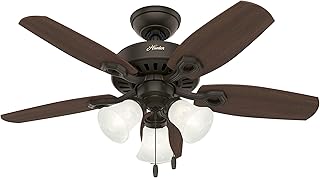
Hunter Builder 42-Inch in New Bronze
The old-school choice, and still a smart one: five blades, pull chain, standard mount, bulbs included, and Hunter’s motor reputation behind it. No pairing, no app, no firmware — if you want a fan that a future homeowner can service without hunting down a discontinued remote, this is it.
Sofucor 42-Inch Smart Ceiling Fan
Alexa and Google Assistant support puts this ahead if you already run a voice-controlled house, and the five ABS blades keep the assembly light enough to hang solo. Six speeds and a reversible quiet DC motor cover the practical side, so the smart features feel like a bonus rather than the whole pitch.
POCHFAN 42-Inch Flush Mount in Brushed Nickel
Brushed nickel is the finish that disappears into most modern fixtures, and this hugger design is aimed squarely at rooms with 8-foot ceilings. Six speeds, dimmable light, reversible motor, ETL listed — a clean, unfussy install for a low-clearance space.
Frequently Asked Questions
Is a 42-inch fan big enough for my room?
A 42-inch fan suits rooms up to roughly 144 square feet — think 12×12 bedrooms, home offices, dining nooks, and covered porches. Larger open spaces need 52 inches or more, or two smaller fans placed to overlap their airflow.
Do I need a special box to hang a ceiling fan?
Yes. Standard light fixture boxes are not rated for the dynamic load of a spinning fan. You need a fan-rated box marked “acceptable for fan support,” ideally braced to a joist or fitted with an expanding bar hanger.
Why does my fan wobble after installation?
Almost always one of three things: blade arm screws not fully seated, the mounting bracket not tight to the box, or a bent blade arm from shipping. Tighten everything, then use a blade balancing kit if a slight wobble remains.
Which direction should the blades turn?
Counterclockwise in summer pushes air down for a cooling breeze. Clockwise on low in winter pulls air up and pushes warm ceiling air down the walls without creating a draft. Reversible DC models switch this from the remote.
Final Thoughts
For most rooms, the 42-Inch Reversible DC Motor fan with 3CCT dimming is the best balance of quiet operation, useful light control, and indoor/outdoor flexibility. If your ceiling is under 8 feet, the Fanbulous low-profile model earns its spot with app control and a memory function that actually saves you fiddling. And if you’d rather skip electronics entirely and install something that will still be serviceable in fifteen years, the Hunter Builder in New Bronze is the honest, no-nonsense pick.