Key takeaways
- Lumens versus spread: Raw output means little if all of it lands in one hot circle. Multi-head designs like the 3-head 21000-lumen and 4-head 32000-lumen models let you fan the beams wide, which matters far more than the number on the box when you are lighting a whole two-car bay.
- Stand height and stability: Look for a telescoping range that clears your head, roughly 48 to 72 inches. Wide-splay legs with rubber feet keep the light upright when an extension cord snags, and a foldable tripod matters if the light rides in a truck bed between jobs.
- Color temperature control: Selectable CCT is worth paying for. Around 3000K reads well for wood finishing and staining, while 5000K to 6500K gives you honest color for electrical work, paint matching, and photographing progress shots.
- Cord length and power draw: A 16-foot cord means one fewer extension in the daisy chain. Also check total wattage against your circuit — a 280W four-head unit plus a table saw on the same 15-amp run will trip a breaker mid-cut.
- Ingress protection rating: IP65 handles rain and hose spray; IP66 adds resistance to stronger jets and blowing grit. If your light lives outdoors on a framing job or in a dusty woodshop, IP66 is the safer buy.
What's inside
Anyone who has tried to hang a door, cut crown molding, or trace a wiring fault under a single bare bulb knows the real enemy of good work is not darkness — it is shadow. Your own body blocks the light exactly where you need it, clamp lights slide off whatever you hooked them to, and headlamps leave you squinting at glare bouncing off fresh drywall. A tripod work light solves this by putting broad, high output illumination above eye level and behind you, so the shadow falls away from the cut line instead of across it.
This guide looks at six tripod-mounted LED work lights that hold up to actual shop and job site abuse: garage rebuilds, basement framing, driveway brake jobs, and late-season deck builds after the sun quits. We compare real usable brightness against claimed lumens, look at how each stand behaves on uneven ground, and flag which models earn their keep for a weekend maker versus a full remodel crew.
As an Amazon Associate we earn from qualifying purchases.


🛒 Best Price Today on Amazon
Prime members get fast, free shipping on everything above, plus member-only deals. New members get a 30-day free trial — cancel anytime.
How to Choose a Work Light With Stand (2026)
- Lumens versus spread: Raw output means little if all of it lands in one hot circle. Multi-head designs like the 3-head 21000-lumen and 4-head 32000-lumen models let you fan the beams wide, which matters far more than the number on the box when you are lighting a whole two-car bay.
- Stand height and stability: Look for a telescoping range that clears your head, roughly 48 to 72 inches. Wide-splay legs with rubber feet keep the light upright when an extension cord snags, and a foldable tripod matters if the light rides in a truck bed between jobs.
- Color temperature control: Selectable CCT is worth paying for. Around 3000K reads well for wood finishing and staining, while 5000K to 6500K gives you honest color for electrical work, paint matching, and photographing progress shots.
- Cord length and power draw: A 16-foot cord means one fewer extension in the daisy chain. Also check total wattage against your circuit — a 280W four-head unit plus a table saw on the same 15-amp run will trip a breaker mid-cut.
- Ingress protection rating: IP65 handles rain and hose spray; IP66 adds resistance to stronger jets and blowing grit. If your light lives outdoors on a framing job or in a dusty woodshop, IP66 is the safer buy.
The Best Work Light With Stand (2026)s Reviewed
21000-Lumen 3-Head LED Work Light with Tripod
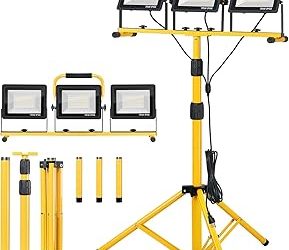
The 48-to-72-inch adjustable stand and 360-degree rotating heads make this the most versatile all-rounder here, easily bounced off a ceiling for soft fill or aimed straight down a hallway. IP66 sealing and a straightforward build mean it shrugs off sawdust and the occasional rainstorm without fuss.
32000LM 3x100W Floodlight with Telescoping Stand
Three 100W heads plus true three-mode CCT switching between 3000K, 5000K, and 6500K make this the pick for anyone doing finish work where color accuracy actually matters. The 16.4-foot cord and 43.7-to-65.4-inch stand cover most garage and interior jobs without extra hardware.
21000-Lumen Work Light with Individual Head Switches
Independent switches per head are a genuinely useful feature — run one head for detail work, all three for demo, and stretch your circuit capacity accordingly. The foldable tripod packs down small enough to stash behind the shop door.
50000-Lumen 3-Head Tripod Work Light
This is the daylight-replacement option, built for large outdoor spaces like driveways, roof decks, and open framing where you need to flood everything at once. The IP65 rating is a notch below the others, so keep it out of sustained downpours.
Zetunlo 21000-Lumen Tripod Worklight
A solid value entry with the same 16-foot cord and IP66 sealing as pricier models, and it earns points for a stand that stays planted on gravel and packed dirt. Good first tripod light if you are building out a home shop on a budget.
Frequently Asked Questions
Are corded work lights better than rechargeable ones?
For stationary shop and job site work, yes. Corded plug-in models like these deliver consistent full brightness for as long as you need it, while battery lights dim as charge drops and rarely sustain 20,000-plus lumens for a full workday.
Will these trip a household breaker?
A 280W four-head light draws roughly 2.3 amps at 120V, so the light alone is fine. Problems start when you share a 15-amp circuit with a compressor, miter saw, or space heater — plan your outlets before you plug in.
Can I use a tripod work light for video or photography?
They work for rough fill lighting, especially models with selectable color temperature. Expect some hard shadows though, since these are floodlights, not diffused panels — bounce them off a wall or white sheet for softer results.
How do I keep the tripod from tipping?
Splay the legs fully, keep the head height as low as the task allows, and run the cord out along one leg rather than across the work area. Sandbags over the feet help on windy outdoor sites.
Final Thoughts
For most home shops and DIY remodels, the 21000-Lumen 3-Head Tripod Work Light hits the best balance of height range, weatherproofing, and price. Step up to the 32000LM 3x100W model if selectable color temperature matters for finish work, or the 50000-Lumen 3-Head unit when you need to light an entire driveway or open frame at once.