Key takeaways
- Confirm the base and globe size first: Nearly all North American vanity bars take E26 medium screw bases, and G25 refers to a roughly 3.1-inch round globe. Unscrew one bulb, measure the diameter, and check for “E26” stamped on the metal. G16.5 and G30 exist too, and a G30 in a tight three-light bar will crowd the shade.
- Match color temperature to the task, not the trend: 5000K daylight is the honest choice for makeup application and grooming because it renders skin tone closest to natural outdoor light. 2700K warm white flatters the room and pairs better with brass or wood, but it shifts reds and can make you overcorrect. 4000K splits the difference and works well in shared family bathrooms.
- Treat CRI 85+ as your minimum: Color Rendering Index measures how faithfully a bulb reproduces color against a reference source. Below 80 and you get that flat, gray-skin look. CRI 85+ is where things start looking accurate, and it’s the single spec that separates a good vanity bulb from a cheap one.
- Read lumens, ignore watt equivalents: “40W equivalent” is marketing shorthand with a lot of slack in it. Look for actual lumen output. For a three-bulb bar, 450 to 500 lumens per bulb lands around 1,400 total, which suits most bathrooms. Larger vanities or double sinks benefit from 600 lumens and up.
- Verify dimmability before you buy: Non-dimmable LEDs on a dimmer circuit will flicker, buzz, or fail early. If you have a dimmer switch, buy a bulb rated dimmable and expect to spend a little more. If you’re on a standard toggle switch, non-dimmable is fine and saves money.
What's inside
Swapping vanity bulbs looks like a five-minute job until you flip the switch and your bathroom turns into either a dim cave or an interrogation room. I’ve pulled more globes out of a three-light bar than I care to admit, mostly because the spec that actually matters — color rendering — is buried at the bottom of the listing while wattage equivalents hog the headline. A 60W-equivalent bulb with mediocre CRI will still leave you guessing whether your foundation matches your neck, and a warm bulb over a mirror you use for shaving reads muddy no matter how many lumens it pushes.
This guide covers the globes I’d actually thread into a vanity fixture, based on what matters when you’re standing at the mirror rather than reading a box. We’ll walk through base sizing, the difference between 2700K and 5000K in a small tiled room, why CRI 85+ is the floor and not the ceiling, and when dimmability is worth the extra spend. Every pick below is an E26 G25 globe, so if your existing bulbs screw into a standard medium socket, they’ll drop right in.
As an Amazon Associate we earn from qualifying purchases.



🛒 Best Price Today on Amazon
Prime members get fast, free shipping on everything above, plus member-only deals. New members get a 30-day free trial — cancel anytime.
How to Choose a Light Bulb For Vanity (2026)
- Confirm the base and globe size first: Nearly all North American vanity bars take E26 medium screw bases, and G25 refers to a roughly 3.1-inch round globe. Unscrew one bulb, measure the diameter, and check for “E26” stamped on the metal. G16.5 and G30 exist too, and a G30 in a tight three-light bar will crowd the shade.
- Match color temperature to the task, not the trend: 5000K daylight is the honest choice for makeup application and grooming because it renders skin tone closest to natural outdoor light. 2700K warm white flatters the room and pairs better with brass or wood, but it shifts reds and can make you overcorrect. 4000K splits the difference and works well in shared family bathrooms.
- Treat CRI 85+ as your minimum: Color Rendering Index measures how faithfully a bulb reproduces color against a reference source. Below 80 and you get that flat, gray-skin look. CRI 85+ is where things start looking accurate, and it’s the single spec that separates a good vanity bulb from a cheap one.
- Read lumens, ignore watt equivalents: “40W equivalent” is marketing shorthand with a lot of slack in it. Look for actual lumen output. For a three-bulb bar, 450 to 500 lumens per bulb lands around 1,400 total, which suits most bathrooms. Larger vanities or double sinks benefit from 600 lumens and up.
- Verify dimmability before you buy: Non-dimmable LEDs on a dimmer circuit will flicker, buzz, or fail early. If you have a dimmer switch, buy a bulb rated dimmable and expect to spend a little more. If you’re on a standard toggle switch, non-dimmable is fine and saves money.
The Best Light Bulb For Vanity (2026)s Reviewed
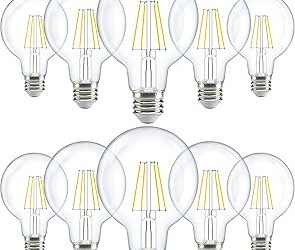
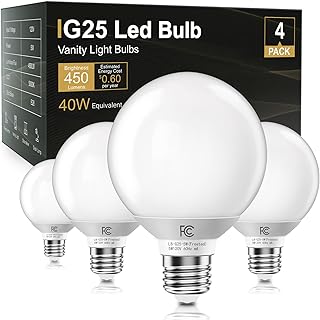
TJOY G25 LED Globe Bulbs, 40W Equivalent 5000K
A solid baseline pick with 450 lumens and CRI 85+ at 5000K, which is the combination I’d recommend for anyone doing detail work at the mirror. UL listing and a four-pack count mean you can do a three-light bar with a spare in the drawer.
G25 LED Globe Bulbs, 60W Equivalent 5000K
Steps up the brightness for larger bathrooms or fixtures mounted higher above the mirror where light falls off before it reaches your face. Same daylight rendering and CRI 85+, just with more output to work with.
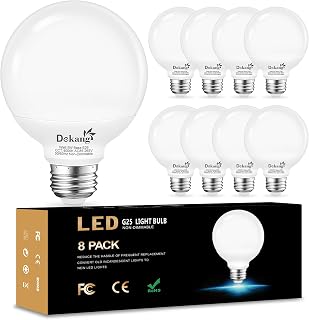
8 Pack LED Vanity Bulbs, 4000K Natural Daylight
The 4000K temperature is the sweet spot if 5000K feels clinical to you but warm white feels too yellow to trust. At 5W and 500 lumens across eight bulbs, this is the value play for a double vanity or if you’re relamping two bathrooms at once.
Brtstiun G25 LED Vanity Bulbs, 40W Equivalent 5000K
Best efficiency-to-output ratio in this group: 600 lumens from 6W is genuinely bright for a 40W-equivalent claim. Worth a look if your fixture only holds two bulbs and you need each one working harder.
Vanity Globe Bulbs, 40W Equivalent 2700K Warm White
For powder rooms and guest baths where ambiance beats accuracy, this warm white globe keeps CRI 85+ so colors still hold up reasonably well. Skip it if the mirror is your primary makeup station.
Frequently Asked Questions
How many lumens do I need for a bathroom vanity?
Aim for roughly 1,200 to 1,700 total lumens across the fixture. Divide by your bulb count: three sockets means 450 to 550 lumens each, which is exactly why most G25 vanity bulbs land in that range.
Is 5000K too harsh for a bathroom?
It can feel cool against warm tile or wood, but it’s the most accurate light for makeup and shaving. If the room reads sterile, try 4000K instead of dropping all the way to 2700K.
Can I mix color temperatures in one fixture?
Don’t. Mismatched Kelvin values in a single bar create visible color casts across your face and are immediately noticeable in photos. Replace all bulbs in a fixture at the same time with the same spec.
Why do my new LED bulbs flicker?
Almost always a non-dimmable bulb on a dimmer switch, or an older dimmer that can’t handle low-wattage LED loads. Either swap to a dimmable bulb like the 9W soft white option or replace the dimmer with an LED-compatible model.
Final Thoughts
For most bathrooms, the TJOY 40W-equivalent 5000K set is the straightforward answer — accurate color, right brightness, no surprises. If you’re relamping more than one fixture, the 8-pack 4000K bulbs deliver better value with a slightly softer tone, and anyone running a dimmer circuit should go with the dimmable 9W soft white globes rather than fighting flicker.