Key takeaways
- Match CFM to room size: The working rule is 1 CFM per square foot, with a minimum of 50 CFM. An 80 CFM fan covers most standard bathrooms; go to 110–130 CFM for larger rooms, high ceilings, or enclosed shower stalls where steam lingers.
- Read the sone rating, not the marketing: Sones measure perceived loudness. Anything at 1.0 sones or below reads as genuinely quiet — roughly refrigerator-hum territory. Cheap units in the 3–4 sone range are the ones people stop using because they’re unpleasant.
- Check installation access first: If you have no attic above the bathroom, prioritize models designed for below-ceiling installation. Retractable or adjustable mounting brackets also save real headache when joist spacing doesn’t cooperate with the housing dimensions.
- Decide on humidity sensing: A built-in humidistat runs the fan automatically until moisture drops, which matters most in shared or guest bathrooms where nobody remembers the switch. It does require thinking through your wiring, so plan the circuit before you cut.
- Look at the light spec seriously: Lumens and color temperature deserve as much attention as airflow. Selectable CCT (3CCT or 5CCT) lets you tune between warm and daylight, and 1000+ lumens is where a bathroom stops feeling like a hallway closet.
What's inside
Anyone who has stood on a ladder at 9pm with a drywall saw in one hand and a fan housing in the other knows the truth: bathroom ventilation is one of those jobs that looks trivial on paper and gets complicated fast. The old builder-grade unit rattles like a coffee can full of bolts, the light output is somewhere between “dim” and “sad,” and the mirror still fogs over for twenty minutes after a shower. Meanwhile moisture is quietly working its way into the paint, the grout, and eventually the framing. Swapping in a modern combo unit fixes all of it at once — airflow, lighting, and noise — usually in a single afternoon.
The catch is that spec sheets have gotten crowded. CFM ratings, sone numbers, selectable color temperature, humidity sensing, attic access requirements, duct diameter — it adds up quickly, and picking wrong means either an underpowered fan or a housing that won’t fit the joist bay you actually have. This guide breaks down the units worth installing in 2026, with attention to the details that matter once you’re up in the ceiling: retrofit-friendly brackets, no-attic-access designs, wiring layout, and whether the light is genuinely good enough to shave by.
As an Amazon Associate we earn from qualifying purchases.


🛒 Best Price Today on Amazon
Prime members get fast, free shipping on everything above, plus member-only deals. New members get a 30-day free trial — cancel anytime.
How to Choose a Bathroom Ceiling Fans With Light (2026)
- Match CFM to room size: The working rule is 1 CFM per square foot, with a minimum of 50 CFM. An 80 CFM fan covers most standard bathrooms; go to 110–130 CFM for larger rooms, high ceilings, or enclosed shower stalls where steam lingers.
- Read the sone rating, not the marketing: Sones measure perceived loudness. Anything at 1.0 sones or below reads as genuinely quiet — roughly refrigerator-hum territory. Cheap units in the 3–4 sone range are the ones people stop using because they’re unpleasant.
- Check installation access first: If you have no attic above the bathroom, prioritize models designed for below-ceiling installation. Retractable or adjustable mounting brackets also save real headache when joist spacing doesn’t cooperate with the housing dimensions.
- Decide on humidity sensing: A built-in humidistat runs the fan automatically until moisture drops, which matters most in shared or guest bathrooms where nobody remembers the switch. It does require thinking through your wiring, so plan the circuit before you cut.
- Look at the light spec seriously: Lumens and color temperature deserve as much attention as airflow. Selectable CCT (3CCT or 5CCT) lets you tune between warm and daylight, and 1000+ lumens is where a bathroom stops feeling like a hallway closet.
The Best Bathroom Ceiling Fans With Light (2026)s Reviewed
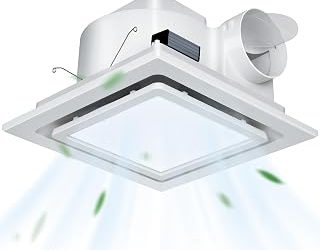
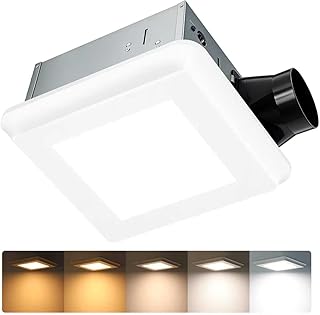
130 CFM Bathroom Exhaust Fan with Light & Humidity Sensor, 5CCT
This is the pick for larger bathrooms or anywhere steam refuses to clear — 130 CFM at 1.0 sones is an unusually good airflow-to-noise ratio, and the humidity sensor handles the shutoff for you. The adjustable mounting and 5CCT selectable light make it flexible enough for both new cuts and retrofits.
Panasonic WhisperFit FV-0511VFL1
Panasonic’s shallow-profile WhisperFit remains the reference standard for tight ceiling cavities, with a Pick-A-Flow selector letting you set 50, 80, or 110 CFM at install time. The dimmable LED and genuinely durable motor justify the premium if you want a fan you install once and forget about.
AUPU 3CCT Fan with Humidity Sensor
Energy Star and HVI certification plus a 0.8 sone rating puts this among the quietest options here, and the retractable bracket is a legitimate time-saver when you’re working solo between joists. Selectable 50/80/110 CFM means one unit covers most bathroom sizes.
AHAWILL 8″ Ultra Quiet Fan, 80 CFM
An 8-inch footprint with 1000 lumens and 5CCT dimming makes this the tidiest fit for standard bathrooms up to about 80 square feet. At 1.0 sones it disappears into the background, and ETL certification means it will pass inspection without argument.
Fitop 130 CFM Fan with Light
The headline feature is no attic access required, which is exactly what you want when the bathroom sits below another room. You trade a little quiet for it at 1.5 sones, but 130 CFM and 1100 lumens from a single ceiling opening is a strong trade for most retrofits.
Frequently Asked Questions
How much CFM do I actually need?
Multiply your bathroom’s square footage by one for rooms under 100 sq ft, with 50 CFM as the floor. For larger rooms, add 50 CFM per toilet, shower, or tub, and another 100 for a jetted tub. Ceilings above eight feet warrant sizing up.
Can I install one of these without attic access?
Yes, if you choose a model built for it. Units like the Fitop pair are designed to be assembled and wired entirely from below the ceiling. Conventional housings expect you to secure brackets to joists from above, which is not realistic in a first-floor bathroom under a bedroom.
Do I need a licensed electrician?
If you’re replacing an existing fan on an existing circuit, it’s a reasonable DIY job with the breaker off and a voltage tester in hand. New circuits, GFCI requirements, or humidity-sensor wiring that needs a separate switched leg are worth a pro’s time — and check your local code either way.
Where should the duct terminate?
Outside, always — through a roof cap or sidewall vent, never into the attic or soffit. Use rigid or semi-rigid duct where you can, keep the run short and sloped away from the fan, and insulate any section passing through unconditioned space to prevent condensation dripping back down.
Final Thoughts
For most bathrooms, the AUPU with its 0.8 sone rating, selectable CFM, and retractable bracket is the best balance of performance and install-day sanity. If your ceiling cavity is shallow or you want the longest-lived motor here, the Panasonic WhisperFit FV-0511VFL1 is the safe long-term buy. And when there’s no attic above you, the Fitop 130 CFM model solves a problem the others simply can’t.