Key takeaways
- Sweep versus table size: Measure your table, not your room. A 20–30 inch fan suits a four-seat table in a breakfast nook; a six-to-eight seater under a 12×14 ceiling wants 42–52 inches so airflow reaches the end chairs.
- Clearance math: Blades need at least seven feet of floor clearance and 18 inches from the nearest wall. On an 8-foot ceiling, flush mount or low-profile is the only honest option. Sloped ceilings need a canopy rated for the pitch, so check before you cut power.
- Light quality over light quantity: Dining light should flatter food. Look for 3000K warm white as a minimum setting, full dimming range, and a diffuser or crystal element that scatters glare instead of putting a hot spot on the table.
- Motor type: DC motors pull roughly 60 percent less power, offer six speeds instead of three, and reverse for winter updraft. They are also noticeably quieter at speeds one and two, which is what you actually use during dinner.
- Install reality check: Confirm your box is fan-rated (not a standard light box), that the downrod length matches your ceiling, and that any app or remote pairing happens before you hoist the canopy. Retractable-blade models are heavier than they look, so plan a second set of hands.
What's inside
Hanging a fan over a dining table is a different problem than hanging one over a couch. You are working with a fixed focal point, a table everyone looks at, and a ceiling height that rarely cooperates. Standard 52-inch fans with big downrods eat headroom and throw shadows across plates. Meanwhile a lot of “fandelier” style fixtures look right but move barely enough air to justify the wiring.
I have pulled down and rehung enough of these to know what matters: blade sweep versus room size, how the light diffuses at table height, whether the DC motor actually runs quiet at low speed, and how forgiving the mounting hardware is when your junction box is not perfectly centered. Below are six fixtures worth your Saturday afternoon, plus a rundown of the specs that decide whether you love or resent your choice.
As an Amazon Associate we earn from qualifying purchases.


🛒 Best Price Today on Amazon
Prime members get fast, free shipping on everything above, plus member-only deals. New members get a 30-day free trial — cancel anytime.
How to Choose a Dining Room Ceiling Fan With Light (2026)
- Sweep versus table size: Measure your table, not your room. A 20–30 inch fan suits a four-seat table in a breakfast nook; a six-to-eight seater under a 12×14 ceiling wants 42–52 inches so airflow reaches the end chairs.
- Clearance math: Blades need at least seven feet of floor clearance and 18 inches from the nearest wall. On an 8-foot ceiling, flush mount or low-profile is the only honest option. Sloped ceilings need a canopy rated for the pitch, so check before you cut power.
- Light quality over light quantity: Dining light should flatter food. Look for 3000K warm white as a minimum setting, full dimming range, and a diffuser or crystal element that scatters glare instead of putting a hot spot on the table.
- Motor type: DC motors pull roughly 60 percent less power, offer six speeds instead of three, and reverse for winter updraft. They are also noticeably quieter at speeds one and two, which is what you actually use during dinner.
- Install reality check: Confirm your box is fan-rated (not a standard light box), that the downrod length matches your ceiling, and that any app or remote pairing happens before you hoist the canopy. Retractable-blade models are heavier than they look, so plan a second set of hands.
The Best Dining Room Ceiling Fan With Light (2026)s Reviewed
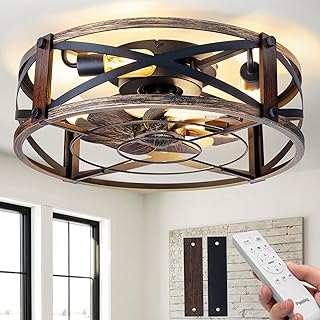
Passky 20″ Caged Low Profile Fandelier
The caged frame keeps this thing visually tight, which matters when it hangs three feet above a table in a small dining nook. Six speeds, a reversible DC motor, and a 1/2/4-hour timer give you real control, and the low-profile body preserves headroom on standard 8-foot ceilings without a downrod.
48″ Rose Gold Crystal Fandelier
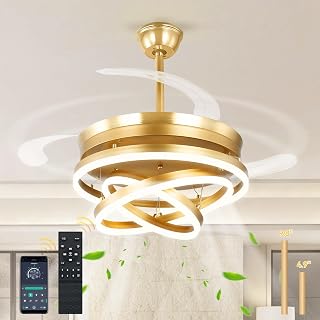
This is the pick if the fan needs to read as a chandelier first. The crystal element genuinely diffuses the dimmable LED rather than just decorating it, so light lands soft on the table, and the 48-inch sweep still moves enough air for a mid-sized dining room.
52″ Flush Mount Farmhouse Fan
Five reversible blades in a vintage finish, three separate light heads, and a flush-mount body that gives you full sweep without stealing clearance. Best value here for larger open dining spaces where you need real air movement, not decorative rotation.
30″ Retractable Ceiling Fan, Brushed Nickel
Blades retract into the housing when the fan is off, so it reads as a clean flush-mount light fixture most of the day. The 3000K–6500K tunable range is the standout: warm for dinner, cool white when the table becomes a homework desk.
addlon 24″ Low Profile Fandelier
The widest airflow of the compact group thanks to blade pitch, and the only one here with app control plus a memory function that restores your last speed and color temperature. Quiet enough at low speed that conversation across the table is unaffected.
Frequently Asked Questions
How high should a dining room fan hang above the table?
Aim for 30 to 36 inches between the table surface and the bottom of the fixture on a standard ceiling. Higher and you lose light focus; lower and blades enter sightlines. Keep at least seven feet of clearance from the floor in walkways.
Can I install one on an existing light-only junction box?
No. Standard boxes are rated for static loads, not the torque and vibration of a spinning motor. You need a fan-rated box anchored to a joist or a listed brace bar. This is a 20-minute swap from the attic and non-negotiable for safety.
Are retractable-blade fans as effective as fixed blades?
They move slightly less air per watt because blade area and pitch are constrained by the retraction mechanism. In a dining room where you want gentle circulation rather than a wind tunnel, the tradeoff is usually worth the cleaner look.
Do I need a wall switch, or is the remote enough?
The remote handles daily use, but keep the wall switch on a constant hot line so the fixture always has power. Wiring a fan to a dimmer switch will damage the motor, so if your box has one, replace it with a standard toggle.
Final Thoughts
For most dining rooms, the 52-inch flush mount farmhouse fan delivers the best balance of airflow, light output, and headroom for the money. If your space leans formal, the 48-inch rose gold crystal fandelier gives you chandelier presence with functional air movement, while the addlon 24-inch is the smart compact choice for nooks and low ceilings where app control and memory settings earn their keep.