Anchoring a floating shelf into a concrete wall or bolting a workbench to a garage slab teaches you fast that a standard drill/driver is the wrong tool. Without percussion, a masonry bit just polishes the aggregate, generating heat and dust while the hole barely deepens. Buyers end up burning through bits, stalling motors, and wondering whether the problem is the drill, the bit, or their technique — usually it’s the first one.
This guide sorts through the cordless hammer drills worth putting on your bench in 2026, from budget-friendly hammer drill kits that handle brick and block to a true SDS rotary hammer for repeated anchor work in cured concrete. I’ve focused on the specs that actually change how a hole gets cut: impact rate, chuck quality, torque, and battery capacity. Whether you’re mounting cabinets in a basement or setting furniture legs into a patio slab, there’s a match below.
Our top picks



As an Amazon Associate we earn from qualifying purchases at no extra cost to you.
🛒 Best Price Today on Amazon
Prime members get fast, free shipping on everything above, plus member-only deals. New members get a 30-day free trial — cancel anytime.
How to Choose a Cordless Hammer Drill For Concrete (2026)
- Hammer drill vs. rotary hammer: A hammer drill vibrates a spinning chuck forward against the material — great for brick, block, mortar, and thin slab work. An SDS rotary hammer uses a piston to strike the bit directly, which is what you want for anchors in poured, cured concrete or anything past a half-inch diameter.
- Impact rate (IPM/BPM): Numbers in the 27,000–36,000 range signal a fast, aggressive percussion cycle. Higher blows per minute generally means quicker progress through masonry, though blow energy matters more than raw count on true rotary hammers.
- Chuck construction: Insist on a 1/2″ all-metal keyless chuck. Plastic-bodied chucks lose their grip once vibration and concrete dust work into the jaws, and a slipping masonry bit will chew itself into scrap in seconds.
- Torque and speed range: 440–550 in-lbs is plenty for masonry bits under an inch. A two-speed gearbox matters just as much: low gear for big bits and driving lag screws, high gear for fast, clean holes in block.
- Battery strategy: Hammer mode drains packs quickly, so a 4.0Ah battery beats a 2.0Ah for sustained work. If you already own a 20V platform, a bare tool or compatible-battery model saves real money.
The Best Cordless Hammer Drill For Concrete (2026)s Reviewed
DCK 20V Brushless Hammer Drill (KDJZ05-13)
With 36,000 BPM, 531 in-lbs, an all-metal keyless chuck, and a 4.0Ah pack in the box, this is the most complete masonry kit here for the money. The 22+1+1 clutch gives you fine control when you switch from drilling anchors to driving furniture hardware without swapping tools.
DEWALT 20V MAX SDS Rotary Hammer (DCH273B)
If your project list includes repeated anchor holes in cured concrete, this is the correct tool — the SDS-Plus piston mechanism cuts through slab material that stalls conventional hammer drills. It ships bare, so budget for a battery, but DEWALT owners get a serious capability upgrade for very little.
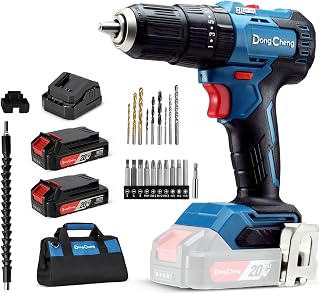
Dong Cheng 20V Brushless Impact Drill
A two-battery kit with 443 in-lbs and 27,000 IPM makes this a practical all-day choice for brick walls and block, and the metal chuck holds masonry bits securely under vibration. The 20+1+1 clutch and brushless motor put it well ahead of comparably priced brushed drills.
CRAFTSMAN V20 Cordless Hammer Drill Kit (CMCD711C2)
The most approachable entry point for occasional masonry work, arriving with two batteries and a charger so you can start immediately. It handles brick, mortar, and light block competently — just don’t expect it to keep pace on a long run of concrete anchors.
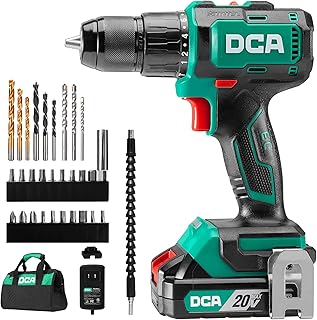
DCA 20V Brushless Hammer Drill (ADJZ2055i)
Compact enough for cabinet backs and tight corners while still delivering 492 in-lbs and 27,000 IPM through an all-metal chuck. The 2.0Ah battery is the limiting factor, so a spare pack is a smart addition if you’re drilling more than a handful of holes.
Frequently Asked Questions
Can a regular hammer drill really drill into concrete?
Yes, for holes up to roughly 1/2″ in decent conditions, provided you use a carbide-tipped masonry bit and moderate, steady pressure. For deeper holes, larger diameters, or hard aggregate, an SDS rotary hammer will finish in a fraction of the time.
Do I need a special bit?
Always. Standard twist bits dull instantly on concrete. Use carbide-tipped masonry bits in a keyless chuck, or SDS-Plus bits in a rotary hammer — the shanks are not interchangeable.
Why is my drill making dust but no progress?
Usually the hammer function isn’t engaged, or the bit is dull. Confirm the mode selector is on the hammer icon, then back the bit out periodically to clear dust from the hole so the carbide tip keeps contacting fresh material.
Are bare-tool models worth buying?
If you already own compatible 20V batteries, absolutely — you’re skipping the cost of packs you don’t need. Just verify platform compatibility before ordering.
Final Thoughts
For most DIY makers tackling shelving, workbenches, and furniture anchoring in masonry, the DCK KDJZ05-13 delivers the best balance of percussion power and included battery capacity. Choose the DEWALT DCH273B if cured concrete anchors are a regular part of your work, and the CRAFTSMAN CMCD711C2 if you want a dependable, budget-conscious kit for occasional projects.