Key takeaways
- Size it to the table, not the room: Aim for a fixture roughly half to two-thirds the width of your table’s shortest side. A round 24″ chandelier suits a 42–48″ round table; long rectangular tables want a linear or two-tier fixture, not a compact orb fighting for attention in the middle.
- Nail the drop height before you cut anything: Bottom of the fixture should sit 30–34″ above the tabletop with 8-foot ceilings, adding about 3″ per extra foot of ceiling. Buy something with a genuinely adjustable rod or chain so you can fine-tune on the ladder instead of guessing from the box.
- Check the junction box rating and total weight: Anything past about 15 lbs needs a fan-rated or fixture-rated box with proper bracing — a plastic box with drywall anchors will not hold a loaded crystal chandelier. Weigh the decision honestly before you buy, since retrofitting a brace bar through a finished ceiling means cutting drywall.
- Count the bulbs and plan the dimming: Twelve E12 sockets at 40W equivalent each is a lot of glare over a dinner plate. Pick warm-white LEDs in the 2700K range and pair the fixture with a compatible dimmer; verify the fixture is dimmable before you assume it is.
- Weigh assembly time realistically: Crystal fixtures often ship as a frame plus a bag of hundreds of hanging pieces, which is an evening of work at the kitchen table. If you want it up in twenty minutes, look for fixtures explicitly labeled no-assembly-required.
What's inside
Hanging a chandelier over a dining table sounds simple until you’re standing on a ladder with a junction box in one hand, a canopy plate in the other, and no idea whether the fixture you bought is going to look proportional once it’s up. Most buyer regret comes down to two things: a diameter that’s wrong for the table, and a chain length that leaves the shades either grazing foreheads or floating uselessly near the ceiling. Neither problem shows up in product photos, which are almost always shot in rooms with nine-foot ceilings and a table twice the size of yours.
This guide is written from the ladder’s perspective. I’ve pulled six fixtures that install cleanly with standard tools, cover the range from industrial glass to layered crystal, and give you real control over drop height. For each one I’ll flag what the wiring is like, whether assembly is a chore, and what size table it actually suits — so you can order once and be eating dinner under it the same weekend.
As an Amazon Associate we earn from qualifying purchases.


🛒 Best Price Today on Amazon
Prime members get fast, free shipping on everything above, plus member-only deals. New members get a 30-day free trial — cancel anytime.
How to Choose a Dining Room Chandelier (2026)
- Size it to the table, not the room: Aim for a fixture roughly half to two-thirds the width of your table’s shortest side. A round 24″ chandelier suits a 42–48″ round table; long rectangular tables want a linear or two-tier fixture, not a compact orb fighting for attention in the middle.
- Nail the drop height before you cut anything: Bottom of the fixture should sit 30–34″ above the tabletop with 8-foot ceilings, adding about 3″ per extra foot of ceiling. Buy something with a genuinely adjustable rod or chain so you can fine-tune on the ladder instead of guessing from the box.
- Check the junction box rating and total weight: Anything past about 15 lbs needs a fan-rated or fixture-rated box with proper bracing — a plastic box with drywall anchors will not hold a loaded crystal chandelier. Weigh the decision honestly before you buy, since retrofitting a brace bar through a finished ceiling means cutting drywall.
- Count the bulbs and plan the dimming: Twelve E12 sockets at 40W equivalent each is a lot of glare over a dinner plate. Pick warm-white LEDs in the 2700K range and pair the fixture with a compatible dimmer; verify the fixture is dimmable before you assume it is.
- Weigh assembly time realistically: Crystal fixtures often ship as a frame plus a bag of hundreds of hanging pieces, which is an evening of work at the kitchen table. If you want it up in twenty minutes, look for fixtures explicitly labeled no-assembly-required.
The Best Dining Room Chandelier (2026)s Reviewed
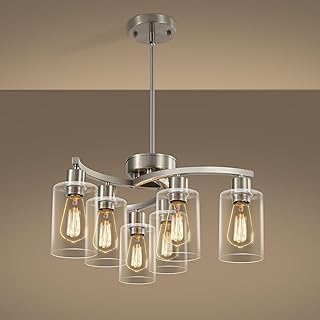
CNRATYE 6-Light Brushed Nickel Chandelier
Six clear glass shades on a brushed nickel frame give you an industrial-modern look that reads bright rather than heavy, and the adjustable-height rods make dialing in the drop over a table straightforward. Wiring is standard single-circuit with a generous lead, so it’s an easy swap for an existing box — just budget a few minutes to align the shades evenly once it’s hung.
12-Light Sputnik Chandelier, Gold and Black
The 11″ to 52″ adjustable range is the standout here — that’s rare flexibility, and it means the same fixture works in a low-ceilinged breakfast nook or a stairwell. Mid-century sputnik arms make a strong statement, so treat it as the room’s focal point and keep the bulbs low-wattage and warm to avoid a wall of exposed glare.
Siljoy Rectangular Gold Crystal Chandelier
At 35.4″ long with two tiers of K9 raindrop crystal, this is the right geometry for a rectangular six- or eight-seat table where a round fixture would look undersized. Sixteen E12 sockets and true dimmability give you real range from soft dinner light to full brightness — plan on an hour or so hanging crystal, and check your junction box rating first.
10-Light 24″ Crystal Chandelier, Black and Gold
Five tiers of crystal in a 24″ round footprint, with a flush-mount option that makes it a genuinely good choice for ceilings under eight feet where a hanging fixture won’t fit. The black-and-gold frame keeps it from reading overly traditional, and the tiered layering throws pleasant light without needing high-wattage bulbs.
Modern Black Crystal 5-Light Chandelier
This one splits the difference between farmhouse and industrial: matte black frame, crystal accents, and adjustable height that suits a small table or a kitchen island. Five lights is a sensible count for a 36–48″ table — enough illumination without overwhelming a modest dining space.
Frequently Asked Questions
How high should a chandelier hang over a dining table?
Leave 30 to 34 inches between the tabletop and the bottom of the fixture with standard 8-foot ceilings. Add roughly 3 inches for every additional foot of ceiling height. Sit down at the table and check sightlines across it before you shorten the chain permanently.
Do I need an electrician to install one?
If you’re replacing an existing fixture on a switched box, this is a normal DIY job: kill the breaker, confirm with a non-contact tester, match hot-to-hot, neutral-to-neutral, ground-to-ground. Call a pro if there’s no box in the ceiling, the box isn’t fixture-rated for your fixture’s weight, or you find cloth-wrapped wiring with no ground.
Can I put a chandelier on a dimmer switch?
Yes, provided the fixture is rated dimmable and you’re using dimmable LED bulbs on an LED-compatible dimmer. Mismatched dimmers cause flicker and buzz. A leading-edge dimmer built for incandescent loads is the usual culprit when a new LED chandelier misbehaves.
How long does crystal chandelier assembly actually take?
Plan on 45 minutes to two hours for a multi-tier crystal fixture, depending on the number of pieces. Lay everything out on a padded surface, assemble the frame fully, then hang the crystal after the fixture is mounted so you’re not lifting the full weight. Fixtures marketed as no-assembly-required, like the 6-light black farmhouse option, skip this entirely.
Final Thoughts
For most rectangular dining tables, the Siljoy rectangular gold crystal chandelier gets the proportions right and gives you dimming control that genuinely changes how the room feels at night. If your ceiling is low or you want maximum installation flexibility, the 12-light adjustable sputnik covers an unusually wide drop range, while the 10-light 24″ black-and-gold crystal fixture with its flush-mount option is the smart pick for tight overhead clearance.