Key takeaways
- Swing over throat: A “10-inch” press means 5 inches from chuck center to column, so the widest board you can center a hole in is 10 inches. For furniture work — table aprons, cabinet sides, chair legs — 10 to 12 inches gives you real breathing room. An 8-inch machine handles rails, stiles, and small parts fine but will fight you on panel work.
- Quill travel: This is how deep the bit plunges in one pull. Two inches is workable; three is noticeably better when you’re boring for dowels or drilling through thick stock. Short travel means repositioning mid-hole, which introduces the exact wandering you bought the press to avoid.
- Speed control method: Stepped pulleys are cheap and reliable but mean opening the belt cover between changes. Variable-speed dials let you slow down for a Forstner bit in hardwood or speed up for a small twist bit in pine without stopping. If you switch bit types often, the dial earns its keep.
- Cast iron mass: Weight is your friend here. A cast iron head and base absorb vibration instead of transmitting it into the workpiece, which shows up directly in cleaner hole walls and less bit chatter. Stamped-steel construction at the same price is a step backward.
- Table tilt and adjustment: A table that tilts a full 45 degrees in both directions handles angled joinery and compound holes. Just as important: a rack-and-pinion crank for height changes rather than loosening a clamp and hoping the table doesn’t drop on your knuckles.
The first time you try to drill a straight hole through a 2×4 with a handheld drill, you learn something humbling: your wrists lie to you. That hole wanders. And when you’re building a bookcase where dowels have to line up across four shelves, or drilling shelf-pin holes that need to sit at exactly the same depth, “close enough” turns into a wobbly cabinet. A drill press fixes the problem by taking your hands out of the equation entirely — the quill travels perpendicular to the table whether you’re having a good day or not.
The tricky part is that drill press pricing spans from under a hundred dollars to well over a thousand, and the specs on the listing page rarely tell you which machines actually hold a bearing straight. Below I’ve pulled together benchtop models that punch above their price bracket, with notes on what each one does well and where the compromises land. I’ve also included a buying checklist based on the specs that actually change your results at the bench, plus answers to the questions that come up most from folks setting up a first shop.
Our top picks



As an Amazon Associate we earn from qualifying purchases at no extra cost to you. Ratings are shown as listed on Amazon.
🛒 Best Price Today on Amazon
Prime members get fast, free shipping on everything above, plus member-only deals. New members get a 30-day free trial — cancel anytime.
How to Choose a Drill Press For The Money (2026)
- Swing over throat: A “10-inch” press means 5 inches from chuck center to column, so the widest board you can center a hole in is 10 inches. For furniture work — table aprons, cabinet sides, chair legs — 10 to 12 inches gives you real breathing room. An 8-inch machine handles rails, stiles, and small parts fine but will fight you on panel work.
- Quill travel: This is how deep the bit plunges in one pull. Two inches is workable; three is noticeably better when you’re boring for dowels or drilling through thick stock. Short travel means repositioning mid-hole, which introduces the exact wandering you bought the press to avoid.
- Speed control method: Stepped pulleys are cheap and reliable but mean opening the belt cover between changes. Variable-speed dials let you slow down for a Forstner bit in hardwood or speed up for a small twist bit in pine without stopping. If you switch bit types often, the dial earns its keep.
- Cast iron mass: Weight is your friend here. A cast iron head and base absorb vibration instead of transmitting it into the workpiece, which shows up directly in cleaner hole walls and less bit chatter. Stamped-steel construction at the same price is a step backward.
- Table tilt and adjustment: A table that tilts a full 45 degrees in both directions handles angled joinery and compound holes. Just as important: a rack-and-pinion crank for height changes rather than loosening a clamp and hoping the table doesn’t drop on your knuckles.
The Best Drill Press For The Money (2026)s Reviewed
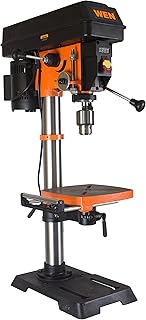
WEN 12-Inch Benchtop Drill Press (DP1263V)
This is the one I’d point most furniture builders toward — the 6.2-amp variable-speed motor and 12-inch swing cover nearly everything a hobby shop throws at it, and the cast iron head keeps runout in check under load. The laser crosshair is more useful for rough positioning than final layout, but the LED work light genuinely helps when you’re squinting at a punch mark in a dim garage.
BUCKTOOL 10-Inch Bench Drill Press
A 3/4 HP motor in a 10-inch benchtop frame is generous, and it shows when you’re hogging out 1-inch Forstner holes in maple without the belt slipping. The five-speed pulley setup means manual changes, but the cast iron base and tilting table make this a serious little machine for the footprint.
8″ Benchtop Drill Press with 3.1A Motor
The sweet spot for small shops and apartment workbenches — five speeds from 620 to 3,100 RPM handle wood and light metal, and the cast iron head keeps things steadier than the price suggests. The 8-inch swing is the real limit, so plan on this for parts rather than panels.
Mini Bench Drill Press
Built for precision at small scale: jewelry, model work, PCB drilling, inlay. The dual power supply modes and low noise make it livable on a desk, but don’t expect it to bore mortises or handle anything approaching structural hardwood.
BLACK+DECKER 12V MAX Drill & Home Tool Kit (BDCDD12PK)
Not a drill press, and worth being clear about that — this is the 60-piece cordless kit that complements one. Pilot holes on-site, driving screws during glue-up, pulling assemblies apart: the press handles accuracy, this handles everything else.
Frequently Asked Questions
Is a benchtop drill press enough for furniture building?
For most home furniture work, yes. A 10- or 12-inch benchtop model handles dowel joinery, shelf pins, hardware mortises, and angled leg holes. You’d only need a floor-standing press for tall workpieces where the head can’t get high enough above the table.
What speed should I use for wood?
Generally, larger bits want slower speeds. Small twist bits in softwood are happy at 2,000+ RPM, while a 1-inch Forstner in hardwood should run closer to 500 RPM to avoid burning. If the bit smokes or the wood scorches, slow down before you push harder.
How do I check if a new press is accurate?
Chuck a known-straight rod and lower it near the table, then rotate the spindle by hand and watch for wobble. Also check that the table sits square to the quill with a small engineer’s square — factory tables often need a slight adjustment out of the box.
Do I need a drill press vise?
For metal, absolutely — a spinning workpiece is genuinely dangerous. For wood, a vise or clamped fence is still worth having, especially with Forstner and hole-saw bits that grab hard as they exit.
Final Thoughts
If you’re building furniture and want one machine that won’t need replacing in two years, the WEN 12-Inch DP1263V is the most complete package for the money — variable speed plus real swing capacity is a hard combination to beat at this price. The BUCKTOOL 10-Inch is the pick if bench space is tight but you still want torque for large bits, and the 8″ Benchtop Drill Press with the 3.1A motor is a sensible entry point that will handle small-parts joinery well beyond what its price tag implies.