Key takeaways
- Swing and throat depth: A 10-inch machine reaches 5 inches from column to bit center; a 12-inch reaches 6. That extra inch decides whether you can bore a hole in the middle of a 12-inch-wide drawer front without flipping the workpiece and hoping your layout lines still align.
- Quill travel: Two inches is workable, 3.2 inches is liberating. Deep travel lets you drill through 8/4 stock in one pull instead of resetting the table halfway down, which is where alignment errors sneak in.
- Speed range and how you change it: Forstner bits in maple want roughly 500 RPM; a 1/16-inch bit in brass wants 3,000. Stepped-pulley machines cover that range for less money, variable-speed dials cover it without opening the belt cover. Decide how often you’ll switch.
- Table tilt and support: A table that pivots 0–45 degrees turns angled dowel holes and splayed chair legs into a setup instead of a jig-building project. Check for a rack-and-pinion height crank too — lifting a cast table by hand while holding a workpiece gets old fast.
- Cast iron mass where it counts: Weight in the head and base is what kills chatter. A machine that flexes under a 1-inch bit will leave a ragged, out-of-round hole no matter how accurate the spindle is.
Freehand drilling is the quiet saboteur of home furniture projects. You clamp a shelf standard to a cabinet side, lean into the trigger, and the bit wanders two degrees off plumb. Multiply that across sixteen shelf-pin holes and the whole carcass reads crooked even though every cut was square. Dowel joints go slack, threaded inserts sit at a tilt, and hardware that should disappear into the design suddenly announces itself. A drill press fixes the geometry problem at the source, but plenty of makers put off buying one because they assume a real column machine means a floor-standing beast and a four-figure invoice.
It doesn’t. The benchtop category has quietly gotten good, and the sweet spot for furniture work sits well under the price of a decent track saw. This guide covers what actually matters in a budget drill press — quill travel, table tilt, runout, speed range — and reviews five machines that earn a spot on a home shop bench. Whether you’re boring shelf pins in plywood, counterboring bed bolts in hardwood, or drilling brass escutcheons for a restoration, there’s a machine here sized to the job.
Our top picks


As an Amazon Associate we earn from qualifying purchases at no extra cost to you. Ratings are shown as listed on Amazon.
🛒 Best Price Today on Amazon
Prime members get fast, free shipping on everything above, plus member-only deals. New members get a 30-day free trial — cancel anytime.
How to Choose a Low Cost Drill Press (2026)
- Swing and throat depth: A 10-inch machine reaches 5 inches from column to bit center; a 12-inch reaches 6. That extra inch decides whether you can bore a hole in the middle of a 12-inch-wide drawer front without flipping the workpiece and hoping your layout lines still align.
- Quill travel: Two inches is workable, 3.2 inches is liberating. Deep travel lets you drill through 8/4 stock in one pull instead of resetting the table halfway down, which is where alignment errors sneak in.
- Speed range and how you change it: Forstner bits in maple want roughly 500 RPM; a 1/16-inch bit in brass wants 3,000. Stepped-pulley machines cover that range for less money, variable-speed dials cover it without opening the belt cover. Decide how often you’ll switch.
- Table tilt and support: A table that pivots 0–45 degrees turns angled dowel holes and splayed chair legs into a setup instead of a jig-building project. Check for a rack-and-pinion height crank too — lifting a cast table by hand while holding a workpiece gets old fast.
- Cast iron mass where it counts: Weight in the head and base is what kills chatter. A machine that flexes under a 1-inch bit will leave a ragged, out-of-round hole no matter how accurate the spindle is.
The Best Low Cost Drill Presses (2026) Reviewed
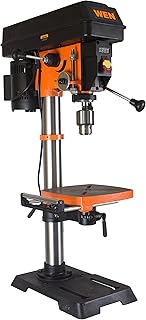
WEN 12-Inch Benchtop Drill Press (DP1263V)
The 12-inch swing and 6.2-amp variable-speed motor make this the most capable machine in the group for furniture-scale parts, and dialing RPM without touching the belt is a genuine workflow upgrade when you’re alternating between brad points and hole saws. The laser crosshair and LED are nice extras, but the cast iron head and deep quill travel are what justify the buy.
SKIL 6.2 Amp 10 In. 5-Speed Drill Press (DP9505-00)
SKIL’s fit and finish is a step above most machines at this price — the depth stop reads clearly, the table locks without drift, and the laser alignment is calibrated well enough to actually trust. A strong pick if you want a machine that feels dialed in out of the box rather than one you tune for a weekend.
BUCKTOOL 10-Inch Bench Drill Press
The 3/4 HP motor and heavy cast iron base give this one noticeably more composure in hardwood than its footprint suggests, and the tilting table handles angled work without shop-made fixtures. Five speeds cover wood and light metal comfortably.
8-Inch Benchtop Drill Press, 3.1A Motor
A 620–3,100 RPM spread and a 0–45° tilting, height-adjustable table in a compact 8-inch package — ideal if bench space is the real constraint. The 3.1-amp motor asks you to take lighter passes in thick stock, but for shelf pins, hinge cups, and hardware holes it’s plenty.
Mini Bench Drill Press
Dual power supply modes and genuinely low noise make this the right tool for inlay, jewelry-scale brass, and small-part work where a full-size machine feels clumsy. Treat it as a precision instrument, not a production drill.
Frequently Asked Questions
Is a benchtop drill press accurate enough for furniture joinery?
Yes, with one caveat: check spindle runout by chucking a known-straight rod and watching the tip as you spin it by hand. Anything under about 0.005 inch is fine for dowels, shelf pins, and hardware. Add a shop-made wooden auxiliary table with a replaceable insert and your tearout drops noticeably.
Do I need variable speed, or are five steps enough?
Five steps covers the realistic range for wood and soft metals. Variable speed earns its premium if you switch bit sizes constantly or drill a lot of metal, where landing on the exact RPM extends bit life.
What size chuck should I look for?
A 1/2-inch keyed chuck is standard here and handles nearly every woodworking bit. For very small bits, add a separate 1/32–1/8 inch precision chuck rather than fighting the jaws on the stock one.
Do I have to bolt it to the bench?
Bolt it or clamp it. These machines are top-heavy, and a large Forstner bit grabbing in figured wood can walk the whole base. Bolting also measurably reduces vibration and improves hole quality.
Final Thoughts
For most home furniture shops the WEN DP1263V is the strongest overall value — the 12-inch swing and variable speed handle real casework without compromise. The SKIL DP9505-00 is the pick if refinement and out-of-box accuracy matter more than raw capacity, and the BUCKTOOL 10-inch splits the difference with serious cast iron heft for the money.