Key takeaways
- Pressure you can dial down: Somewhere between 1300 and 1900 PSI at the nozzle is the sweet spot for paint. Look for multiple nozzle tips or an adjustable lance rather than a single fixed setting, and treat the “max PSI” figure as a ceiling, not a target.
- Flow rate does the rinsing: GPM carries dirt away; PSI just breaks it loose. Anything at or above roughly 1.7 GPM rinses noticeably faster and leaves fewer spots, which matters more than an extra few hundred PSI on the box.
- Foam delivery method: A detachable foam cannon gives thick, clinging suds that dwell long enough to soften road film. Onboard soap tanks are convenient for driveway work but tend to produce thin, runny lather that slides off before it does anything.
- Hose length and stability: Twenty-five feet of hose plus a stable base means you park the unit once and walk the car. Short hoses force you to reposition mid-wash, which is when units tip over and inlet fittings get stressed.
- Serviceable hardware: Brass or steel quick-connects, a metal wand, and a replaceable inlet filter separate a machine you keep for a decade from one you replace in two seasons. Check that spare O-rings and nozzles are actually available before you buy.
Anyone who has spent a Saturday with a bucket, two mitts, and a garden hose knows the frustration: grit stays wedged in panel gaps, brake dust bakes onto wheel faces, and the rinse water sheets off before it takes the dirt with it. A pressure washer solves that, but the machines built to blast a mossy driveway are the same ones that will strip a clear coat or force water past a door seal if you get careless. Detailing asks for something different — controllable pressure, honest foam, and enough hose to walk a whole vehicle without dragging the unit behind you.
This guide comes from the perspective of someone who actually wrenches, builds, and cleans their own gear. We looked at flow rate over headline PSI, how well the soap systems atomize, whether the wand and quick-connects survive repeated use, and how each unit handles being hauled in and out of a garage a few hundred times. Below are the electric pressure washers worth your money in 2026, plus a short primer so you can judge any model on the shelf yourself.
Our top picks




As an Amazon Associate we earn from qualifying purchases at no extra cost to you. Ratings are shown as listed on Amazon.
🛒 Best Price Today on Amazon
Prime members get fast, free shipping on everything above, plus member-only deals. New members get a 30-day free trial — cancel anytime.
How to Choose a/an Electric Pressure Washer For Detailing (2026)
- Pressure you can dial down: Somewhere between 1300 and 1900 PSI at the nozzle is the sweet spot for paint. Look for multiple nozzle tips or an adjustable lance rather than a single fixed setting, and treat the “max PSI” figure as a ceiling, not a target.
- Flow rate does the rinsing: GPM carries dirt away; PSI just breaks it loose. Anything at or above roughly 1.7 GPM rinses noticeably faster and leaves fewer spots, which matters more than an extra few hundred PSI on the box.
- Foam delivery method: A detachable foam cannon gives thick, clinging suds that dwell long enough to soften road film. Onboard soap tanks are convenient for driveway work but tend to produce thin, runny lather that slides off before it does anything.
- Hose length and stability: Twenty-five feet of hose plus a stable base means you park the unit once and walk the car. Short hoses force you to reposition mid-wash, which is when units tip over and inlet fittings get stressed.
- Serviceable hardware: Brass or steel quick-connects, a metal wand, and a replaceable inlet filter separate a machine you keep for a decade from one you replace in two seasons. Check that spare O-rings and nozzles are actually available before you buy.
The Best Electric Pressure Washer For Detailing (2026)s Reviewed
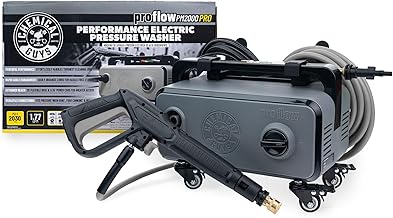
Chemical Guys PM2000 PRO
Built by a detailing company for detailing work, and it shows in the details that usually get cut: a genuine 25-foot hose, 1.77 GPM of flow, and a 14.5-amp motor that holds pressure steady while you work a panel. If you want one machine tuned for vehicles rather than adapted to them, start here.
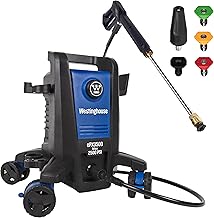
Westinghouse ePX3500
The most capable all-rounder of the group, pairing 1.76 max GPM with a pro-style steel wand and a five-nozzle set that covers everything from wheel wells to fence rails. Anti-tipping geometry is a genuinely useful feature when you are yanking a hose around a vehicle rather than working in a straight line.
Westinghouse ePX3100v
Essentially the ePX3500’s better-behaved sibling for paint work: same 1.76 GPM flow, a gentler 2100 PSI ceiling, and a detachable foam cannon included rather than a soap tank. The integrated carry handle makes it the easy pick if your washer lives on a shelf between weekends.
Sun Joe SPX3000
A long-running favorite that earns its reputation through dual onboard detergent tanks and a five-tip quick-connect system, letting you switch from soap to rinse without unpacking anything. Its 2030 PSI PWMA rating is honest, real-world output — refreshing in a category full of optimistic numbers.
Hiclean 2100 PSI
The compact, budget-friendly option that still ships with the parts that matter: foam cannon, turbo tip, and fan nozzle. Pressure is modest and the build is lighter than the Westinghouse units, but for apartment garages and occasional weekend washes it covers the job without fuss.
Frequently Asked Questions
Will a pressure washer damage my paint?
Not if you use a 25- or 40-degree tip, keep at least 12 inches of standoff, and never let a turbo nozzle near a body panel. Damage almost always comes from a narrow tip held too close, or from blasting an existing chip and lifting the edge.
Do I need a separate foam cannon?
For proper contact washing, yes. Onboard soap tanks apply detergent through a low-pressure nozzle and produce thin lather, while a cannon mixes soap with air and water into suds that cling long enough to lift grit before your mitt touches the paint.
Can I run one off a rain barrel or bucket?
Most consumer electric units need pressurized inlet water and will cavitate or burn out their pump if fed from a static tank. Unless the manual explicitly supports gravity or siphon feed, connect it to a standard spigot.
What maintenance do these actually need?
Rinse the inlet screen after every few uses, store nozzles somewhere they will not collect grit, and drain the pump before freezing weather — or run pump antifreeze through it. Clogged tips and frozen pumps account for most premature failures.
Final Thoughts
If detailing is the main job, the Chemical Guys PM2000 PRO is the most purpose-built choice, with the hose length and flow rate to wash a full vehicle from one parking spot. The Westinghouse ePX3500 is the smarter buy if that same machine also has to handle siding and driveways, while the ePX3100v hits the best balance of paint-safe pressure, included foam cannon, and easy storage for most home garages.