Our Top Picks
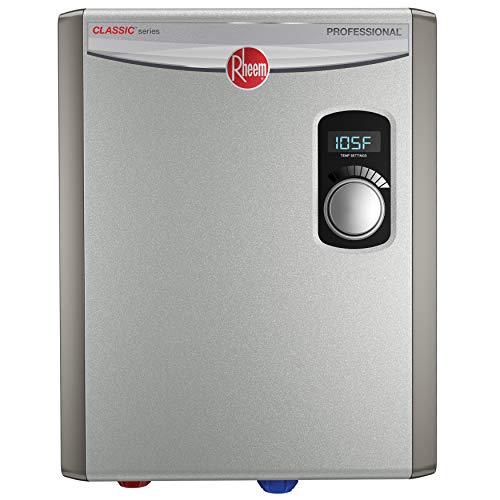 Rheem 18kW 240V Tankless Electric Water HeaterSmall18.5 x 14.5 x 3.5 Inches14.78 poundsCheck on Amazon
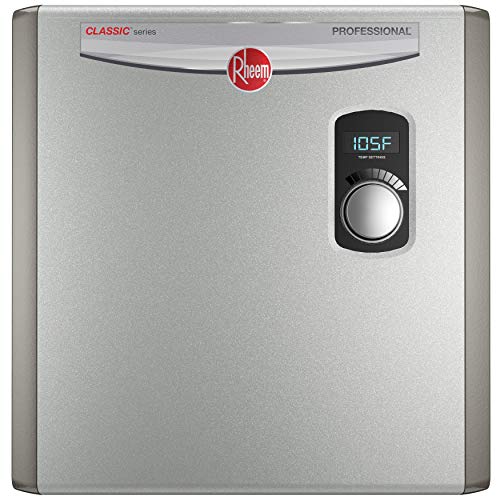 Rheem RTEX-24 24kW 240V Electric Tankless Water Heater18.25 x 14.5 x 3.5 Inches17.8 PoundsCheck on Amazon
 Rheem RTG Series 7.0 GPM Natural Gas Tankless7.0 GPM (Standard)10.27 x 13.5 x 24.2 inches46.5 poundsCheck on Amazon
 Tankless Small Water Heater Electric 120V 29.2Amp3.5kW6.5 x 6.5 x 7.8 Inches3.1 poundsCheck on Amazon
The best tankless water heater for a whole house is a properly sized gas or high-amperage 240V electric unit, while the smallest 120V models only suit a single sink. Among these ten listings you will find a condensing gas unit, a non-condensing gas unit, several electric whole-house models from 11 kW to 24 kW, and four small plug-in style heaters. Titles quote flow rates, wattages and efficiency claims that are seller figures, and two of the listings look like near-duplicates of each other. Check the manual and your own wiring or gas supply before you pick one.
Top picks at a glance
Rheem 18kW 240V Tankless Electric Water Heater, Gray


As an Amazon Associate we earn from qualifying purchases. Product prices and availability are accurate as of the date/time indicated.

110V Tankless Water Heater Electric, 3000W Tankless Electric Water Heater Instant, Under Sink Water Heater with Digital Display, On Demand Hot Water Heaters Electric for Kitchen Washin Bathroom.


As an Amazon Associate we earn from qualifying purchases. Product prices and availability are accurate as of the date/time indicated.
Rheem RTEX-24 24kW 240V Electric Tankless Water Heater, Gray


As an Amazon Associate we earn from qualifying purchases. Product prices and availability are accurate as of the date/time indicated.

18kW Tankless Water Heater Electric, NOVIEEX 240V 3s Instant Hot Water Heater, Flow Rate Max 4.9 GPM, Supply for 2-3 Points, Indoor Installation, Ideal for Apartment, Garage, Salon, Bathroom, Kitchen


As an Amazon Associate we earn from qualifying purchases. Product prices and availability are accurate as of the date/time indicated.
Rheem RTG Series 7.0 GPM Natural Gas Tankless Water Heater Indoor | 160,000 BTUs High Efficiency On Demand, Continuous Hot Water | Non-Condensing


As an Amazon Associate we earn from qualifying purchases. Product prices and availability are accurate as of the date/time indicated.
Tankless Small Water Heater Electric 120V 29.2Amp, ThermoMate 3500W On Demand Instant Hot Water Heater with Temperature Display for Kitchen Bathroom Sink Faucet, ETL Certified


As an Amazon Associate we earn from qualifying purchases. Product prices and availability are accurate as of the date/time indicated.

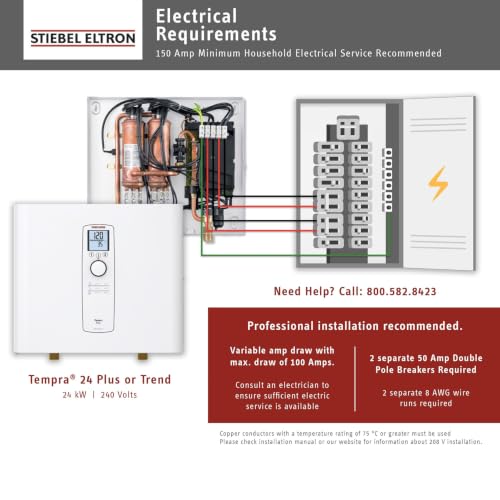
Stiebel Eltron Tempra 24 Trend Electric Tankless Water Heater, 24kW, 240V | Made in Germany; 2x50A breakers, 100A draw; On-demand hot water; Eco design; Energy+cost savings up to 34% in whole-home use




As an Amazon Associate we earn from qualifying purchases. Product prices and availability are accurate as of the date/time indicated.
| Model | Key point from the title | Price tier | Best for |
|---|---|---|---|
| Rinnai RX199iN Condensing | 11.1 GPM, 199k BTU, natural gas or propane | Premium | Large households with gas service |
| Rheem RTG Series 7.0 GPM | 160,000 BTU, natural gas, non-condensing, indoor | Premium | Mid-size homes on natural gas |
| Stiebel Eltron Tempra 24 Trend | 24 kW, 240V, 2x50A breakers, 100A draw | Mid-range | Warm-climate whole-home electric |
| Rheem RTEX-24 | 24 kW, 240V electric | Mid-range | Whole-home electric with strong panel |
| Rheem 18 kW 240V | 18 kW, 240V electric | Mid-range | Smaller homes or 1-2 bathrooms |
| NOVIEEX 18 kW | 240V, max 4.9 GPM claim, 2-3 points | Mid-range | Garage, salon or apartment |
| Rheem 11 kW Multi Fixture | 11 kW, 240V electric | Mid-range | Low-demand or warm-inlet use |
| ThermoMate 3500W | 120V, 29.2 A, ETL listed | Budget | One bathroom or kitchen sink |
| xwdzswgs 3000W (B0FTCMVRY3) | 110V, digital display, under-sink | Budget | Hand washing point of use |
| xwdzswgs 3000W (B0DQY3FPGW) | 110V, digital display, under-sink | Budget | Same as above, near-duplicate |
What is changing in this category
Tankless heaters have moved from a niche upgrade to a mainstream option, and the market now splits into three clear groups. Gas models, including condensing designs that recover extra heat from exhaust, aim at whole-house demand and tend to be the choice where natural gas or propane is already available. Whole-home electric models avoid venting but ask a lot of the electrical panel. Compact 120V units sit at the bottom and are generally meant for one tap rather than a whole house.
Several broad shifts are worth knowing. Buyers are paying more attention to the supply side, meaning gas line size, venting and breaker capacity, because the cost of upgrading those can exceed the price of the heater itself. Electric options now include digital displays and temperature control, which are useful but do not change the underlying power limit. Marketplaces also carry many look-alike small heaters from sellers with little brand history, so reading the specification line and certifications carefully matters more than it used to.
Expectations are also becoming more realistic. Marketing phrases like endless hot water describe continuous operation, not unlimited simultaneous use, and winter groundwater can lower real flow noticeably. Treat any single flow figure in a title as a best-case number from the seller.
How we picked these
This roundup is built from the titles and descriptions of ten listings, published specifications, manufacturer documentation and buyer reviews. We grouped them by fuel and capacity so the comparison is fair: gas against gas, whole-home electric against whole-home electric, and point-of-use against point-of-use. Nobody on the team used or measured these units. Any figure not in a title is labeled as an estimate with its assumptions, and anything we could not confirm is marked check the listing.
The ten listings, one by one
Rinnai RX199iN Condensing Smart Sense
The title states a condensing design, 11.1 GPM, 199k BTU, support for natural gas or propane, indoor or outdoor placement and the phrases Smart Sense and endless hot water. It is the largest gas listing here and the most expensive. It suits a large household with several bathrooms and an existing gas supply that can feed a 199k BTU appliance. Picture two showers running while the dishwasher fills: that is the type of overlap this class targets.
Pros
- Highest BTU and flow claim in the set.
- Condensing design is typically positioned as more efficient than non-condensing.
Cons
- Premium price before venting, gas line and installation costs.
- Larger gas demand may require a bigger gas pipe.
Who should skip it: a small household with one bathroom will likely be paying for capacity it never uses, and a home without gas service would face the cost of running a new line. In those cases a smaller gas unit or an electric model may be more sensible.
Check the listing for the venting material, condensate drain requirements, electrical needs, warranty terms and whether the unit ships with the fuel conversion you need. Ask before buying: can my gas meter and line supply this appliance alongside everything else on the system?
Rheem RTG Series 7.0 GPM Natural Gas
This listing says natural gas, indoor, 160,000 BTUs, 7.0 GPM, high efficiency, continuous hot water and non-condensing. That last word matters: a non-condensing unit generally uses a different, often more heat-tolerant vent than a condensing one, and the title is plain about it. It suits a mid-size home with two or three bathrooms where the household rarely runs more than two fixtures at once.
A scenario: a family of four with a shower, a kitchen tap and a washing machine in use during the morning rush. A 7 GPM claim is a best-case number, and the practical flow depends on your incoming water temperature.
Pros
- Clear title: fuel, BTU, flow and condensing type are all stated.
- Lower price than the Rinnai in this set.
Cons
- Natural gas only per the title, so propane homes should look elsewhere.
- Indoor listing means venting and clearances must be planned.
Who should skip it: propane households, since the title lists natural gas only, and anyone who wants the extra efficiency of a condensing design. A home with no practical vent path may also find installation costly.
Check the listing for vent type, gas line size and warranty. Ask: does my existing flue route work, or is a new vent run required?
Stiebel Eltron Tempra 24 Trend
The title gives 24 kW, 240V, made in Germany, two 50A breakers, 100A draw, on-demand hot water, eco design and savings of up to 34% in whole-home use. The savings and made-in claims are marketing statements, and the 100A draw is the fact to focus on. This is a whole-home electric option for a house with a strong electrical service and generally a mild climate, where incoming water is not very cold.
Imagine a sunbelt home with two bathrooms and a 200A panel: a 24 kW heater may fit, but the breakers, wire and available capacity still need an electrician’s confirmation.
Pros
- Large output for an electric model.
- Title spells out the breaker and current requirement.
Cons
- Heavy electrical demand may force a panel upgrade.
- Savings figure is a seller claim, not a promise for your house.
Who should skip it: homes with a small 100A service, or in cold northern regions where incoming water is very cold and a 24 kW electric unit can run short. The up-to-34% figure also depends on what you are comparing it against, so treat it cautiously.
Check the listing for dimensions, wire gauge and temperature range. Ask: does my panel have 100A of real spare capacity?
Rheem RTEX-24 24kW
The title is short: 24kW, 240V, electric tankless, gray. At the same stated power as the Stiebel, it competes for the same house type, and the short title leaves most details to the product page. It suits someone who already knows their panel can support a 24 kW appliance and wants a familiar brand name from a major heater maker.
Pros
- Same 24 kW class as the Stiebel at a similar price tier.
- Simple spec line is easy to compare.
Cons
- The title says little beyond power and voltage.
- Same large panel requirement as other 24 kW electrics.
Who should skip it: buyers who want a detailed title to compare against, or anyone whose panel is already near capacity. If you are choosing between this and the Stiebel, line up the manufacturer flow charts side by side.
Check the listing for amperage, flow rating, minimum water pressure and recommended wire gauge. Ask: what flow does this unit deliver at my winter incoming water temperature?
Rheem 18kW 240V Tankless Electric
Listed as 18kW, 240V electric, gray, this model sits one step below the 24 kW units. It is a plausible fit for a small house, a one- or two-bathroom home in a milder climate, or a detached garage workshop. At 18 kW the current draw works out to about 75 amps at 240V, which is simple arithmetic, not a listing claim.
Pros
- Lower electrical demand than 24 kW models.
- Established manufacturer name.
Cons
- Limited output for cold winter groundwater.
- Sparse title; details must come from the page.
Who should skip it: large families, cold-climate homes and anyone expecting two showers at once. In those cases 18 kW is likely to be borderline, and a 24 kW electric or a gas model fits better.
Check the listing for flow rate and breaker size. Ask: will this keep up when two fixtures open at once in January?
NOVIEEX 18kW 240V Instant
This listing claims 18 kW, 240V, a 3-second start, flow rate up to 4.9 GPM, supply for two to three points, and indoor installation for an apartment, garage, salon, bathroom or kitchen. A flag: at 18 kW, delivering 4.9 GPM would give only a small temperature rise, so that number reads as a theoretical maximum, not a comfortable shower flow. Treat it as a seller claim.
Pros
- Lower price tier than the Rheem 18 kW with similar stated power.
- Multi-use wording suits workshops and small commercial spaces.
Cons
- Less established brand; certification and support details are unclear in the title.
- Flow claim is ambitious for the stated power.
Who should skip it: buyers who want a well-known brand with a long support record, and anyone who needs a proper shower flow. Because the listing leans on bold claims, confirm the certifications and warranty before you commit.
Check the listing for safety certifications such as UL or ETL, warranty and customer service. Ask: what temperature rise does the maker publish at a realistic flow?
Rheem 11kW Multi Fixture
The title says 11kW, 240V, multi fixture. Eleven kilowatts is a modest figure for an electric whole-house heater, so this model fits low-demand situations: a small apartment, a guest bath, or a house in a warm region. Using the same arithmetic as above, about 46 amps at 240V.
Pros
- Lowest electrical demand among the 240V models here.
- Lower price than the larger Rheem units.
Cons
- Likely to struggle with cold inlet water and more than one fixture.
- The phrase multi fixture should not be read as full whole-house capacity.
Who should skip it: any home with more than one bathroom in regular use, or a cold climate. An 11 kW heater is a niche product, and it is easy to buy one that disappoints in winter.
Check the listing for the published flow at different temperature rises. Ask: is one shower the most I will ever run?
ThermoMate 3500W 120V Small Heater
The title says 120V, 29.2 amps, 3500W, with a temperature display, for a kitchen or bathroom sink faucet, and ETL certified. This is a point-of-use heater, not a whole-home appliance. It suits a distant kitchenette or a hand-washing sink. A 29.2 amp load is substantial for a household circuit, so a dedicated circuit and an electrician’s advice are sensible.
Pros
- ETL certification stated in the title.
- Budget price with temperature display.
Cons
- Not enough for a shower.
- High current for a 120V plug-in setup.
Who should skip it: anyone expecting hot showers, or a renter who cannot modify a circuit. It also does not replace a whole-home system, no matter how the title phrases the benefits.
Check the listing for hardwiring versus plug options and installation details. Ask: can my circuit handle roughly 30 amps safely?
xwdzswgs 3000W Under-Sink (B0FTCMVRY3)
This is a 110V, 3000W under-sink electric heater with a digital display, aimed at kitchen, bathroom or washing use. It is a budget convenience product for one tap, such as a utility sink in a garage. Our honest view is that it only makes sense when low flow is acceptable.
Pros
- One of the lowest prices in the group.
- Small size for tight spaces.
Cons
- Little-known brand; support and certification need checking.
- Not a shower solution.
Who should skip it: anyone who wants a shower, or who needs documented certification and a known support channel. The title does not state a testing mark, so ask the seller.
Check the listing for safety certification, plug type and manual. Ask: is a trickle of warm water enough for this tap?
xwdzswgs 3000W Under-Sink (B0DQY3FPGW)
This listing has nearly the same title, brand, power and price as the previous one. We read it as a near-duplicate or a variant of the same product. If you are comparing the two, ask the seller what differs, and do not count them as two independent options. Use cases are identical: a single sink where modest flow is acceptable.
Pros
- Same budget price and compact design as its twin.
- Digital display noted in the title.
Cons
- Gives you no extra choice over the other listing.
- Same questions about certification and support.
Who should skip it: buyers who cannot tell what separates this listing from the other one. If the seller cannot explain the difference, choose a unit with a clearer record, such as the ThermoMate.
Check the listing for any difference in model number, plug or hose fittings. Ask: what is actually different about this version?
Buying guide
Pick the fuel first
Natural gas and propane models deliver the highest flow and are the usual choice for whole houses, but they need venting, a correctly sized gas line and installation by a qualified professional following the manufacturer’s instructions and local codes. Electric whole-home models avoid venting and combustion, yet they can demand 75 to 100 amps or more, which often means a panel upgrade. Small 120V units are for one tap only.
Understand flow and temperature rise
A heater’s rated GPM is only meaningful at a stated temperature rise. A unit that delivers 5 GPM when water enters at 70°F may deliver far less when it enters at 40°F. Look for a flow chart in the documentation rather than relying on the title.
Condensing versus non-condensing
Condensing gas models extract extra heat from exhaust and typically use plastic venting, while non-condensing models need metal venting designed for hotter exhaust. Condensing units also produce acidic condensate that needs a drain. The Rinnai listing here is condensing; the Rheem gas listing is non-condensing.
Safety, scale and maintenance
Gas appliances can produce carbon monoxide if poorly vented, so use a working carbon monoxide alarm. Electric appliances should be on correctly sized breakers and wire. Hard water builds scale, so plan on periodic flushing as described in the manual. If your old unit is a tank model, our guide on how to flush a water heater shows why sediment matters, and a noisy tank is often explained in why a water heater pops. For cold regions, see how to winterize a water heater before freezing weather.
Water quality, pressure and location
Hard water leaves scale on heat exchangers and heating elements, which reduces flow and efficiency over time. Check your local water report, and consider a softener if hardness is high. Low incoming water pressure can prevent a unit from firing, since many heaters need a minimum flow before the burner or elements engage. Location matters too: an exterior or unheated garage install risks freezing, so check the freeze-protection information in the manual and plan for drainage.
Total cost, not just the sticker price
Add the heater, the vent kit or breakers, wire, shutoff valves, permits and labor. A budget electric unit may look cheap until you add a new sub-panel, while a pricier gas unit can come out ahead if the gas line and vent are already in place. Ask installers for written quotes before you buy, and keep the manufacturer’s documentation for warranty claims.
Tankless versus tank, in plain terms
A tank heater keeps a set volume hot all day and can deliver a lot of water quickly, but the reserve can run out and standby heat loss is a constant background cost. A tankless unit has no reserve, so it can run for as long as you need, yet it is limited by its peak output and a cold start means waiting for hot water to reach the tap. Tankless units are also compact and can be wall-mounted, which frees floor space. Neither choice is automatically cheaper over the long run, because installation, fuel prices and maintenance all enter the equation. If your household has predictable, back-to-back demand, tankless fits well; if demand is a sudden burst of several fixtures at once, check the sizing very carefully.
Another point is the cold-water sandwich: when you pause a shower briefly, cold water already in the pipe can arrive between the hot bursts. Some units add small internal buffers or recirculation options, while others do not, so read the manual if this will bother you.
Worked example: sizing by temperature rise
Assumptions: incoming water 50°F, target 105°F, so a 55°F rise. One kilowatt delivers about 3,412 BTU per hour, and heating a gallon of water by one degree needs about 8.34 BTU, which gives the common shortcut flow (GPM) = BTU per hour / (500 x rise). We assume 100% efficiency for electric and treat everything as an estimate.
| Spec concept | What to look for | Why it matters |
|---|---|---|
| 24 kW electric | Est. 81,900 BTU/h gives about 3.0 GPM at a 55°F rise | Roughly one shower plus a little extra |
| 18 kW electric | Est. 61,400 BTU/h gives about 2.2 GPM | One efficient shower at this rise |
| 11 kW electric | Est. 37,500 BTU/h gives about 1.4 GPM | A low-flow shower or a sink |
| 3,000 to 3,500 W plug-in | Est. 0.4 GPM at the same rise | Hand washing only |
| Gas 160,000 BTU (assume 80% efficient) | Est. 4.6 GPM | Two fixtures at once is plausible |
| Gas 199,000 BTU condensing (assume 92%) | Est. 6.7 GPM | Large households |
The gap between a 2 GPM shower and a 4.9 GPM claim is why the small and mid electric numbers in titles should be read with caution. A typical efficient shower uses roughly 2 GPM, and a kitchen tap about 1 to 1.5 GPM, though your fixtures may differ.
Mistakes buyers make
- Ignoring the cold-season rise. Sizing for summer groundwater leaves you short in winter.
- Underestimating the electrical bill of installation. A 24 kW unit can need a panel upgrade that costs more than the heater.
- Treating a point-of-use heater as whole-home. The 3,000 W units here suit one sink.
- Skipping the vent plan. Condensing and non-condensing gas units use different vent materials.
- Counting duplicate listings as choice. Two similar titles can be the same product.
- Doing gas or high-voltage work alone. Hire a qualified professional and follow local codes.
Verdict by use case
- Large gas household: the Rinnai RX199iN is the high-capacity pick, if your gas supply can feed it.
- Mid-size gas home: the Rheem RTG 7.0 GPM costs less and the title is clear.
- Whole-home electric, mild climate: the Stiebel Eltron Tempra 24 or Rheem RTEX-24, provided the panel can handle it.
- Small home, garage or salon: the Rheem 18 kW is the more established choice; the NOVIEEX 18 kW costs less but needs more checking.
- Low demand: the Rheem 11 kW.
- One sink only: the ThermoMate has clearer certification, and the xwdzswgs pair is the cheapest.
Frequently asked questions
Is a tankless water heater better than a tank model?
Neither is better for every home. A tankless unit heats water as it flows, so it takes less floor space and does not hold a reserve that can run out, but it needs enough gas or electrical capacity to heat a full flow. A tank model stores hot water and can be simpler to install in an older house. Compare your peak demand, fuel and wiring before choosing.
Can I install a tankless water heater myself?
Gas and high-amperage electric units involve gas lines, venting, large breakers and heavy-gauge wire, and mistakes can cause fire, carbon monoxide exposure or scalding. Have a qualified plumber or electrician install them, pull any required permits, and follow the manufacturer’s instructions and local codes. Small plug-in or under-sink units still need an appropriate circuit, so read the listing and manual first.
How do I size a tankless water heater?
Add up the flow rate of the fixtures you expect to run at the same time, in gallons per minute, then work out the temperature rise between your incoming water and the temperature you want. Divide the heater’s output by that rise to see the flow it can really deliver. Cold climates and winter groundwater lower the achievable flow, so size for the coldest season.
Do electric tankless heaters need special wiring?
Whole-home electric models draw very large currents, often well beyond what a typical panel has spare, and may need multiple double-pole breakers and thick copper wire. Smaller 120V under-sink units draw less but still pull a lot for a single outlet. A licensed electrician should confirm the panel capacity and circuit before you buy.
Does a tankless heater give endless hot water?
Only up to its rated flow. A unit keeps heating as long as water runs, so it will not empty like a tank, but if you open more fixtures than it can handle, the temperature drops or the flow falls. Marketing phrases such as endless hot water describe continuous operation, not unlimited simultaneous demand.
How often does a tankless water heater need maintenance?
Gas and condensing models generally need periodic descaling or flushing, especially in hard-water areas, plus inlet screen checks and vent inspection. Electric units have fewer parts but can still scale up. Follow the schedule in the manufacturer’s documentation, and consider a water softener if your water is hard.