Our Short List of 3
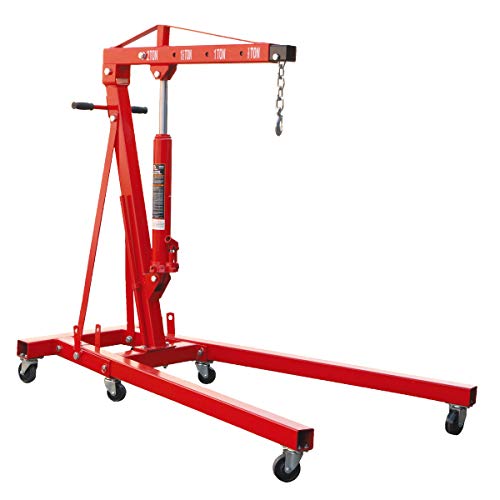
- Capacity: 2 ton (4,000 lb), shortest boom position
- Boom positions: 4, from 0.5 ton to 2 ton
- Hydraulic ram: 8 ton long ram
- Casters: 6 swivel wheels

- Capacity: 2 ton (4,000 lb), shortest boom position
- Boom positions: 4; 2 ton, 1.5 ton, 1.25 ton and 1.125 ton by length
- Lift range: 1 to 84-1/4 in
- Load leveler: Included, 1,500 lb capacity

- Model: 2-1 EHL
- Capacity: 2 ton (4,400 lb), shortest boom position
- Boom positions: 6, telescoping
- Hydraulic pump: 8 ton
All 5 Picks at a Glance
| Product | Specs | Action |
|---|---|---|
| 1. Torin BIG RED T32001 Foldable Engine Hoist — the long-running default |
| Check price on Amazon |
| 2. Strongway Hydraulic Engine Hoist with Load Leveler (NT32002) — the honest capacity table |
| Check price on Amazon |
| 3. VEVOR Hydraulic Engine Hoist with Leveler (2-1 EHL) — leveler included, folds small |
| Check price on Amazon |
 4. Dragway Tools 2 Ton Folding Hydraulic Engine Hoist (LD-E03012) — the plain, heavy value pick |
| Check price on Amazon |
 5. TUFFIOM 2 Ton Folding Hydraulic Engine Crane (CRANE-G33001972) — the lightest frame here |
| Check price on Amazon |
Our Top Picks
An engine hoist, also sold as a shop crane or cherry picker, is the rolling frame and hydraulic ram that lifts an engine clear of its bay and carries it across the garage floor. It does one job: get the engine out and set it down somewhere safe. That somewhere is usually an engine stand, and the two tools are not interchangeable. This site already covers engine stands, the bolt-on cradles that hold a bare block at bench height while you rebuild it. A stand cannot lift anything out of a car, and a hoist is a clumsy thing to rebuild on, because the load hangs from a chain and swings. Buy the hoist to move the engine, then hand it over to a stand for the work.
The five cranes below are all folding hydraulic models in the 2-ton class, covering nearly every car and light truck pull in a home garage. They differ in the details that decide whether a pull feels calm or sketchy: capacity at full boom extension, whether a leveler is in the box, caster material, and how honestly the maker publishes the numbers.
Disclosure: As an Amazon Associate, we earn from qualifying purchases made through links on this page, at no extra cost to you.
How to Choose an Engine Hoist
Read the capacity at the boom position you will actually use. The headline figure on every box, 2 tons on all five cranes here, is only true at the shortest boom setting. Each step outward trades capacity for reach, and at the longest position most 2-ton cranes are down to roughly a quarter of the headline, around 1,000 lb. A dressed engine with its transmission attached commonly weighs 400 to 700 lb, and reaching the middle of the bay usually means a longer position. Match the load to the number for that position, not the number on the box.
A load leveler is close to mandatory. Engines rarely come out level. The transmission end hangs low, the assembly has to tilt to clear the core support, then tilt back to land on a stand. A leveler hangs between hook and engine and lets you crank that tilt in small amounts instead of re-rigging chains mid-lift. Two cranes below include one. If yours does not, budget for one before the first pull, and check its capacity against your engine and transmission weight.
Chains, slings and lift points must be sized for the load. Use the chain or sling supplied with the crane, or a replacement with a working load limit above the weight of the load, never a length of hardware-store chain with no grade marking. Bolt lift brackets to proper points, typically head bolt holes or the factory lift eyes, with bolts fully engaged. A bracket held by two threads of a short bolt is the weakest link in the rig, however strong the crane.
Folding legs save the crane, pins save you. The legs fold up so the frame stands in a corner. Before any lift, the legs come back down and every pin and bolt must be fully seated and locked. A leg resting in place but not pinned can fold under a side load at the worst moment. Make the pin check routine, every time.
Casters decide how the crane behaves on your floor. All five cranes roll on six swivel casters, but the wheel material matters. Steel wheels roll easily under load and shrug off abuse, yet they can skate on smooth sealed concrete and transmit every crack into the frame. Poly wheels are kinder to coated floors and quieter. Either way, small wheels hang up on expansion joints, cracks and the lip of a driveway apron, right when a swinging load makes a sudden stop hardest to handle. Sweep the roll path first, and favour larger casters on rough floors.
Test the ram before you trust it. A healthy ram lifts smoothly and holds the load without sinking when you stop pumping. A ram that creeps down, weeps oil at the seals or feels spongy has air in the system or worn seals, and needs bleeding or a seal kit before it lifts an engine. Pump the unloaded boom up, leave it raised during prep, and confirm it has not dropped. The release valve should lower the load slowly; a valve that dumps it in a rush is a defect, not a quirk.
Never work under a hanging engine. A hoist is a lifting device, not a support device. Keep every part of your body out from under the load, move the engine at its lowest practical height, and get it onto a stand or a sturdy bench as soon as it clears the bay. An engine should spend its hanging minutes travelling, not being wrenched on.
The 5 Best Engine Hoists
1. Torin BIG RED T32001 Foldable Engine Hoist — the long-running default
- Capacity: 2 ton (4,000 lb), shortest boom position
- Boom positions: 4, from 0.5 ton to 2 ton
- Hydraulic ram: 8 ton long ram
- Casters: 6 swivel wheels
The T32001 is the pattern most home garages end up with: a 2-ton folding crane with a four-hole adjustable boom, an 8-ton long ram and six swivel wheels under a heavy-gauge steel frame. The boom positions run from half a ton at the longest reach to the full 2 tons pulled in short. A gripped handle at the back of the mast makes it easier to push and steer than cranes you shove by the column. Nothing about it is unusual, and that is the point: the design has been sold for years, so pins, casters and seal kits are easy to find. No leveler is included, so add one if you do not already own one.
2. Strongway Hydraulic Engine Hoist with Load Leveler (NT32002) — the honest capacity table
- Capacity: 2 ton (4,000 lb), shortest boom position
- Boom positions: 4; 2 ton, 1.5 ton, 1.25 ton and 1.125 ton by length
- Lift range: 1 to 84-1/4 in
- Load leveler: Included, 1,500 lb capacity
Strongway publishes what most makers leave on a decal: the capacity at every boom length. At the longest of its four settings, 55-11/16 inches out, this crane is still good for 1-1/8 tons, more than double what many 2-ton cranes allow at full reach — the margin an engine-and-transmission pull needs. The lift range runs from 1 inch to 84-1/4 inches on a 6-ton long ram, the six casters are solid steel at 3-1/2 inches, and a 1,500 lb leveler is included. The maker states the crane meets ASME PASE 2019 safety standards.
3. VEVOR Hydraulic Engine Hoist with Leveler (2-1 EHL) — leveler included, folds small
- Model: 2-1 EHL
- Capacity: 2 ton (4,400 lb), shortest boom position
- Boom positions: 6, telescoping
- Hydraulic pump: 8 ton
VEVOR bundles the two pieces most buyers purchase together: a 2-ton folding crane and a 1,500 lb engine leveler, driven by an 8-ton hydraulic pump. The boom telescopes through six positions, giving finer steps between reach and capacity than the four-position booms above. Six swivel casters move the 157 lb frame. The storage story is the strong suit: with legs folded and boom retracted, the maker puts the footprint at roughly 24 by 24 inches, small enough to stand in the corner of a single-car garage.
4. Dragway Tools 2 Ton Folding Hydraulic Engine Hoist (LD-E03012) — the plain, heavy value pick
- Model: LD-E03012
- Capacity: 2 ton, shortest boom position
- Boom positions: Not published
- Chain: 12 in forged steel chain, 5/16 in hook
Dragway Tools sells the same classic pattern with no bundle and no extras: a thick-steel 2-ton crane on six rotating wheels, with a 12-inch forged steel chain and a 5/16-inch hook in the box. At about 165 lb it is a substantial frame; check every fastener against the parts list before assembly, as the packing draws complaints. The maker does not publish a per-position capacity table in its listing data, so read the figures stamped on the boom when the crane arrives and plan around the number at your chosen position.
5. TUFFIOM 2 Ton Folding Hydraulic Engine Crane (CRANE-G33001972) — the lightest frame here
- Model: CRANE-G33001972
- Capacity: 2 ton (4,400 lb), shortest boom position
- Boom: Telescopic; per-position figures not published
- Load leveler: Not included
This red TUFFIOM crane covers the same 2-ton ground with a telescopic boom, folding outrigger legs and a hook, at 127.9 lb, the lightest of the five. That lower weight is a real convenience for a crane that gets folded, rolled into a corner and dragged back out a few times a year, and it makes one-person assembly less of a wrestle. The trade is the usual one: a lighter frame asks more discipline about the basics, keeping loads low while travelling and staying inside the capacity at your boom position. No per-position boom table is published and no leveler is included, so read the boom decal and add a leveler before your first pull.
Comparison Table
| Crane | Capacity | Boom positions | Leveler included | Weight |
|---|---|---|---|---|
| Torin BIG RED T32001 | 2 ton | 4 | No | Not published |
| Strongway NT32002 | 2 ton | 4 | Yes, 1,500 lb | Not published |
| VEVOR 2-1 EHL | 2 ton | 6 | Yes, 1,500 lb | 157.1 lb |
| Dragway Tools LD-E03012 | 2 ton | Not published | No | About 165 lb |
| TUFFIOM CRANE-G33001972 | 2 ton | Not published | No | 127.9 lb |
FAQ
Is a 2-ton hoist enough for an engine and transmission together?
Almost always, yes, provided you check the right number. A dressed engine with the transmission attached usually runs 400 to 700 lb. Every crane here lifts that easily at its shorter boom settings, and most manage it at full reach, but the longest position on a typical 2-ton crane is often limited to about 1,000 lb, so confirm the figure for your chosen position first.
Do I really need a load leveler?
For a straight lift of a bare engine, you can manage without one. For the far more common job, an engine and transmission that must tilt nose-up to clear the bay and then level out to meet a stand, the leveler turns a two-person wrestling match into a one-person crank adjustment.
Can I leave an engine hanging on the hoist overnight?
No. Hydraulic seals are not a support system, and a slow internal leak can lower the load without warning. Set the engine on a stand, a bench or a tire stack. If a ram will not hold a test load steady during prep, it needs bleeding or seals before it lifts anything heavy.
Why does my hoist struggle to roll with an engine on it?
Usually the floor, not the crane. Small casters stop at expansion joints, cracks and debris, and a load swinging on a chain multiplies the effort. Sweep the path, keep the engine low, and push slowly from the mast handle. On rough concrete, larger steel casters cope better than small poly wheels.
What is the difference between an engine hoist and an engine stand?
The hoist lifts and moves the engine; the stand holds it still for work. A hoist carries the load on a chain from a boom, right for the minutes of travel between car and bench and wrong for hours of wrenching. A stand bolts to the block and rotates it for access. Most swaps need both.
Conclusion
For most home garages, the Strongway NT32002 is the easiest crane to recommend: it publishes capacity at every boom length, keeps an unusually high figure at full reach, and includes the leveler you would otherwise buy next. The VEVOR 2-1 EHL runs it close, with the same included leveler, six boom positions and the smallest folded footprint here. The Torin T32001 and Dragway Tools LD-E03012 suit buyers who already own a leveler, and the TUFFIOM is the pick when a lighter frame matters most. Whichever crane you choose, the habits decide the outcome: match the load to the boom position, pin the legs, test the ram, and never let the engine hang longer than the trip across the floor.
More from Amazon
Programs that pair well with the guide above. Offers and eligibility are set by Amazon and may change.
A free business account with business pricing and bulk-buying tools for work, shop or home office.
Create a business accountFree shipping on eligible items, Prime Video and more. Eligible new members can start with a free trial.
Start a Prime free trialAudiobooks and podcasts to listen to on the go. Eligible new members can start with a free trial.
Try Audible freeAd-free music streaming. Eligible new subscribers can start with a free trial.
Try Music Unlimited freeAs an Amazon Associate we earn from qualifying purchases.