Key takeaways
- Weight and hand: For seat pans that take daily sitting, look for a thicker faux linen or a tight jacquard. Lightweight decor cotton feels lovely on the roll and pills out within a season on a chair you use every night.
- Stretch versus yardage: Slipcovers need four-way stretch to hug a rounded seat without bunching. Reupholstery fabric should have almost no give, since stretch fights you when you’re pulling toward a staple line.
- Cleanability, honestly assessed: Machine-washable covers are the easy win. If you’re gluing yourself to real yardage, check whether it takes a fabric protector spray well before you commit six chairs to it.
- Measure with waste built in: Add four to six inches past the seat edge on every side for wrap and staple room. Buying one extra yard costs less than reordering mid-project and getting a different dye lot.
- Texture that hides sins: Flat, dark solids show every crumb and pet hair. A subtle slub, tweed, or 3D jacquard breaks up the surface visually and buys you a few days between cleanings.
What's inside
Anyone who has knelt beside a dining chair with a staple gun in one hand and a phone flashlight in the other knows the real problem isn’t the reupholstering. It’s the fabric decision that came before it. Pick something too thin and your staples chew through the weave at the corners. Pick something too stiff and you’ll fight it around every curve of the seat pan. Meanwhile, the chairs that don’t need reupholstering at all just need a cover that survives spaghetti night and a cat who has opinions about textiles.
This guide splits the difference between the two camps: upholstery yardage for people who plan to strip and staple, and stretch slipcovers for people who want a fix by dinnertime. I’ve focused on weight, weave, washability, and how each material actually behaves when you’re pulling it taut over foam. Here’s what’s worth your money in 2026.
As an Amazon Associate we earn from qualifying purchases.



How to Choose a Fabrics For Dining Chairs (2026)
- Weight and hand: For seat pans that take daily sitting, look for a thicker faux linen or a tight jacquard. Lightweight decor cotton feels lovely on the roll and pills out within a season on a chair you use every night.
- Stretch versus yardage: Slipcovers need four-way stretch to hug a rounded seat without bunching. Reupholstery fabric should have almost no give, since stretch fights you when you’re pulling toward a staple line.
- Cleanability, honestly assessed: Machine-washable covers are the easy win. If you’re gluing yourself to real yardage, check whether it takes a fabric protector spray well before you commit six chairs to it.
- Measure with waste built in: Add four to six inches past the seat edge on every side for wrap and staple room. Buying one extra yard costs less than reordering mid-project and getting a different dye lot.
- Texture that hides sins: Flat, dark solids show every crumb and pet hair. A subtle slub, tweed, or 3D jacquard breaks up the surface visually and buys you a few days between cleanings.
The Best Fabrics For Dining Chairs (2026)s Reviewed
Washable Stretch Seat Slipcovers, Set of 6
These are the pragmatist’s choice: a six-pack of stretch seat covers that go on in about a minute each and come off for a normal wash cycle. The breathable knit doesn’t trap heat during long meals, and the elastic edge grips well enough that you won’t be tugging them straight between courses.
TinaKim Thick Chair Upholstery Fabric
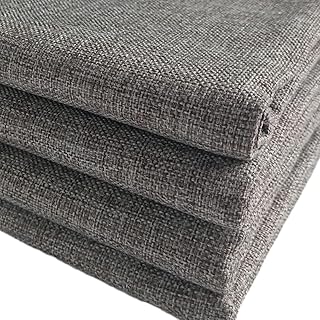
This is genuine upholstery-weight faux linen, and the difference shows the moment you tension it over foam. Two yards at 57 inches wide covers roughly four standard drop-in seats with wrap allowance, and the flaxen colorway reads warm without going yellow under LED bulbs.
Faux Linen Needlework Fabric, 3.3 Yards
The best value per yard here if you’re doing a full set of six chairs in one go. It’s slightly softer than the TinaKim, so I’d back it with a layer of muslin on chairs that get heavy use, but the grey-blue is a genuinely good neutral that plays well with oak and walnut.
LaSilk Premium Upholstery Fabric by the Yard
Sold single-yard, which makes it ideal for a one-chair repair or a test swatch before you commit to the whole dining set. The thickened weave takes staples cleanly at the corners, and the navy is deep and even, with no obvious weave-through when stretched.
Smiry Waterproof Seat Covers, Set of 4
The waterproof backing is the headline feature and it earns its place: spilled wine beads up rather than soaking into your foam. Note there are no rear covers, so these suit seat-only protection on chairs where you like the existing backrest.
Frequently Asked Questions
How much fabric do I need per dining chair?
For a standard drop-in seat, plan on about half a yard of 57-inch-wide fabric per chair, plus extra if the pattern needs centering. Measure across the widest point of the seat, then add four to six inches on each side for wrapping and stapling.
Can I use regular cotton instead of upholstery fabric?
You can, but it won’t last. Quilting cotton has a much lower thread count and abrasion rating, so it thins at the front edge where your legs rub. If you love a cotton print, back it with fusible interfacing or a duck cloth underlayer.
Do stretch chair covers slip around during use?
Quality ones don’t, provided you match the size to your seat. The elastic hem should sit under the seat lip, not on it. If a cover creeps, a couple of upholstery twist pins tucked underneath solve it permanently.
What’s the most pet-friendly option?
A 3D jacquard like the Promindfly covers, since the raised texture resists snagging from claws better than a flat weave and disguises hair between vacuums. Anything with a loose loop or boucle structure will catch nails, so skip those with cats in the house.
Final Thoughts
If you’re actually reupholstering, the TinaKim thick faux linen is the one I’d reach for first, with the LaSilk single yard as a smart way to test the color on one chair before buying for six. And if you want your dining room fixed this afternoon instead of this weekend, the Smiry waterproof seat covers handle real-life spills better than anything else on this list.