Anyone who actually works in their garage knows the specific misery of a 38-degree shop: the cordless drill batteries sag, wood glue refuses to tack, spray finishes bloom cloudy, and your hands stop taking fine measurements about twenty minutes in. Most people reach for the cheap 1500W plug-in unit they already own, discover it can barely warm a single stall, and end up wearing a coat indoors all winter. The problem isn’t willpower, it’s physics. A standard 120V outlet caps out around 5,100 BTU, and an uninsulated two-car garage with a leaky overhead door will shed that faster than the heater makes it.
This guide is written from the perspective of someone who has mounted these things to joists, pulled 10/2 to a subpanel, and lived with the results through a few winters. Below you’ll find picks that span hardwired 240V workhorses, plug-in 240V portables, and radiant quartz units for spot heating a single bench. I’ve flagged what each one actually needs from your electrical system, because that detail decides more purchases than any spec sheet number.
Our top picks
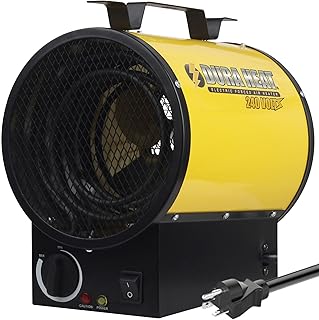


 Wall-Mounted Space Heater with ECO Thermostat and
- ECO Energy-Saving Thermostat Mode: This wall-mounted heater features…
- Remote Control & LED Display: Comes with a…
- Three Oscillation Angles for Wide Coverage: This indoor…
As an Amazon Associate we earn from qualifying purchases at no extra cost to you.
🛒 Best Price Today on Amazon
Prime members get fast, free shipping on everything above, plus member-only deals. New members get a 30-day free trial — cancel anytime.
How to Choose a Garage Electric Space Heater (2026)
- Match voltage to your panel first: A 5000W heater needs a dedicated 240V circuit on a 30A breaker with 10-gauge wire; 7500W typically wants 40A and 8-gauge. Check for open double-pole slots in your panel before you check reviews, or budget for an electrician.
- Size by heat loss, not square footage: Rough math: an uninsulated 20×20 garage needs roughly 40-50 BTU per square foot, an insulated one closer to 20-25. A 5000W unit delivers about 17,000 BTU, which comfortably handles one insulated bay and struggles with two bare ones.
- Fan-forced vs. radiant: Fan-forced units heat the whole air volume and are the right call for finishing, glue-ups, or curing epoxy. Radiant quartz warms objects and bodies directly, which is better for a single workstation in a big drafty space where heating all that air is pointless.
- Mounting clearances and airflow direction: Ceiling and wall units need documented clearance from combustibles, and you want the discharge angled across the floor, not blasting into the back of your head at the bench. Measure joist spacing and door track travel before committing to a spot.
- Controls that save money: A real digital thermostat with a remote and a timer means the shop is 60 degrees when you walk out after dinner instead of running all day. Overheat protection and ETL or UL listing are non-negotiable in a space full of sawdust and solvents.
The Best Garage Electric Space Heaters Reviewed (2026)
NewAir 240V Portable Garage Heater
This is the one to buy if you already have a 240V receptacle for a welder or compressor, because it plugs in rather than requiring hardwiring and you can wheel it toward whatever project you’re standing over. Industrial build, simple controls, and genuinely useful for renters or anyone unwilling to open the panel.
Comfort Zone 5000W Ceiling Mounted Garage Heater
A no-nonsense hardwired unit with three heat settings that gets you out of the floor space entirely, which matters when you’re maneuvering sheet goods or a car. It’s the straightforward choice for a standard insulated two-car garage, and the ETL listing plus overheat cutoff cover the safety basics without adding cost you don’t need.
5000W 240V Fan-Forced Heater with Remote and Digital Thermostat
The 1-9 hour timer and remote are the features you’ll actually appreciate on a January morning, letting you bring the shop up to temperature from the kitchen. Rated for around 500 square feet, it’s well matched to a single insulated bay and mounts either wall or ceiling depending on where your wiring lands.
TEMPWARE 7500W Hardwired Garage Heater
This is the heavy hitter for three-car garages, pole barns, and shops with high ceilings or minimal insulation, where a 5000W unit would just run continuously and lose. Plan on a 40A circuit and heavier wire, but you get a 12-hour timer, digital thermostat, and remote to manage that capacity intelligently.
Shinic 1500W Radiant Quartz Heater with Work Light
Runs on standard 120V, which makes it the practical pick when a 240V circuit isn’t happening, and the 90-degree rotation lets you aim warmth at the bench or the car bay. The built-in work light is a legitimately smart touch for anyone crouched under a vehicle, though don’t expect it to raise the ambient temperature of a whole garage.
Frequently Asked Questions
Can I plug a garage heater into a regular outlet?
Only 120V models, and even then it should be its own 15A or 20A circuit with no extension cord. Anything above 1500W requires 240V, either through a dedicated receptacle or hardwired to the panel.
Do I need an electrician?
If you’re comfortable pulling cable and landing a double-pole breaker, hardwiring these units is within reach for a competent DIYer. That said, permits and inspection requirements vary by jurisdiction, and homeowner insurance claims have been denied over unpermitted circuits, so verify local code first.
How much does it cost to run?
Multiply kilowatts by your electric rate: a 5000W heater at 15 cents per kWh runs about 75 cents an hour at full output. A thermostat cuts real-world cost substantially because the unit cycles rather than running flat out.
Is electric or propane better for a garage?
Electric wins for anyone doing finishing work or spending long hours in the space, since there’s no combustion byproduct, no moisture dumped into the air, and no tank to swap. Propane makes sense only for occasional use in spaces with no electrical capacity and good ventilation.
Final Thoughts
For most insulated two-car garages, the Comfort Zone 5000W ceiling unit is the sensible default: hardwired, out of the way, and correctly sized. Step up to the TEMPWARE 7500W if you’re heating a larger or poorly insulated shop, and grab the Shinic radiant quartz if you need warmth at the bench tomorrow without touching your electrical panel.