Key takeaways
- Mounting geometry: Flip the unit over before you buy and count the anchor points. Four pre-drilled holes with at least 6 inches of spread let you hit a stud, a drawer bottom, or a shelf cleat with lag bolts. A single cable loop is a convenience feature, not an anchor — braided steel cable cuts with bolt cutters in seconds.
- Reader quality over reader count: Capacitive fingerprint sensors that store 20-plus prints let you enroll the same thumb at five angles, which is what actually gets you a first-try unlock at 3 a.m. Register each finger multiple times during setup rather than adding more fingers.
- Interior dimensions, measured for real: A full-size polymer frame with an optic mounted needs about 9 x 6.5 x 2.5 inches of clear space. Manufacturer interior figures often include the foam. Pull the foam, measure again, and account for a spare magazine standing on edge.
- Power redundancy: USB-C rechargeable cells are convenient until they die silently. Look for units with AA backup or an external emergency port, plus mechanical override keys you store somewhere that isn’t the nightstand drawer.
- Silent mode and light control: Beeps and bright LEDs are fine for a range bag and terrible for a bedroom. A true silent unlock with a dim interior light is the setup you want if you share the room or need to move without announcing it.
What's inside
Anyone who has fumbled in the dark for a keyhole knows the core tension of bedside firearm storage: the safe has to open in under two seconds for you, and never for anyone else. Most buyers end up with a box that solves one half of that equation. Cheap biometric readers reject a sleep-creased thumb three times in a row. Cable-tethered lock boxes slide off the nightstand when yanked. Steel gauge gets advertised in millimeters that sound impressive until you pry at a seam with a flathead and watch the door lip flex.
This guide comes from the mounting-hardware side of the problem. I looked at how these units actually attach to furniture, whether the pre-drilled holes line up with real nightstand construction, how the charging cords route without getting pinched by the drawer, and how the electronics behave when the batteries drift low. Below are six bedside safes worth building into your setup, plus the spec details that separate a genuine deterrent from a locked-looking drawer.
As an Amazon Associate we earn from qualifying purchases.


🛒 Best Price Today on Amazon
Prime members get fast, free shipping on everything above, plus member-only deals. New members get a 30-day free trial — cancel anytime.
How to Choose a Gun Safe For Nightstand (2026)
- Mounting geometry: Flip the unit over before you buy and count the anchor points. Four pre-drilled holes with at least 6 inches of spread let you hit a stud, a drawer bottom, or a shelf cleat with lag bolts. A single cable loop is a convenience feature, not an anchor — braided steel cable cuts with bolt cutters in seconds.
- Reader quality over reader count: Capacitive fingerprint sensors that store 20-plus prints let you enroll the same thumb at five angles, which is what actually gets you a first-try unlock at 3 a.m. Register each finger multiple times during setup rather than adding more fingers.
- Interior dimensions, measured for real: A full-size polymer frame with an optic mounted needs about 9 x 6.5 x 2.5 inches of clear space. Manufacturer interior figures often include the foam. Pull the foam, measure again, and account for a spare magazine standing on edge.
- Power redundancy: USB-C rechargeable cells are convenient until they die silently. Look for units with AA backup or an external emergency port, plus mechanical override keys you store somewhere that isn’t the nightstand drawer.
- Silent mode and light control: Beeps and bright LEDs are fine for a range bag and terrible for a bedroom. A true silent unlock with a dim interior light is the setup you want if you share the room or need to move without announcing it.
The Best Gun Safe For Nightstand (2026)s Reviewed
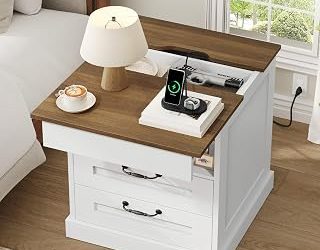
FTOP Biometric Clock Safe with 3-in-1 Wireless Charging
This one earns its footprint by replacing three objects — clock, charging pad, and safe — which is exactly the kind of consolidation a cramped nightstand needs. The humidity and temperature readout is genuinely useful if you store a carry gun overnight in a humid climate, and the drawer action stays smooth as long as you mount it on a flat, level surface rather than a warped tabletop.
BILLCONCH Biometric Safe with Interior Light and USB Charging
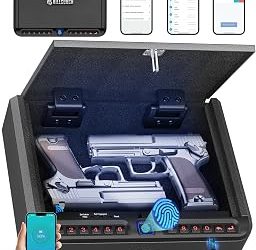
A clean, no-nonsense build with the three-way access setup done right: fingerprint, PIN, and a proper mechanical key override. The interior light and silent mode make it the pick for shared bedrooms, and the internal USB port means one cable serves both the safe and a phone.
Quick Access Mounted Drop-Down Nightstand Safe
The drop-down design is the smartest use of dead space in this roundup — it bolts under a nightstand, bed frame rail, or desk lip and swings the contents into your hand at seated height. Budget 20 minutes for installation and use the included hardware into solid wood, not particleboard, or the whole advantage disappears.
BILLCONCH Smart Gun Safe with App Access (Burgundy Red)
Four access methods including app control, which is either redundancy or one more thing to fail depending on your temperament — but the fingerprint reader is fast enough that the app stays a backup. The burgundy finish reads as furniture rather than equipment, which matters if you’d rather the box not announce itself.
Biometric Pistol Safe for 2-3 Handguns
The most flexible option here: carbon steel body, stealth mode, security cable, and enough interior room for a pair of compacts plus magazines. It moves easily between nightstand, closet shelf, and vehicle console, though the portability that makes it versatile also means anchoring is non-negotiable.
Frequently Asked Questions
Are biometric safes reliable enough for emergency access?
Modern capacitive sensors are, provided you enroll properly. Register your primary thumb at five or six rotations, wipe the sensor monthly, and test-open once a week. Every unit here also keeps a PIN and physical key as fallbacks.
How do I anchor a safe to a nightstand that isn’t solid wood?
Particleboard won’t hold lag bolts under load. Add a hardwood backer board inside the cabinet, clamp and glue it, then bolt through both layers. Alternatively, run the bolts down through the nightstand top into a steel plate underneath.
Do these meet child-access prevention requirements?
Locking storage satisfies most state child-access laws, but requirements vary and some specify certified locking devices. Check your state statute and your insurer’s language before relying on any single product.
Should I keep a firearm loaded in a bedside safe?
That’s a personal decision governed by local law and your household. If you do, use a safe with a defined interior that holds the firearm in a consistent orientation, and never store it where the trigger contacts foam edges or hardware.
Final Thoughts
For most bedrooms, the BILLCONCH Biometric Safe with Interior Light hits the best balance of solid construction, three-way access, and quiet operation. The FTOP clock safe is the pick if your nightstand is already crowded and you want the charging pad and environmental readout built in, while the Quick Access Drop-Down mount is the one to build into your setup if you want the safe out of sight entirely and don’t mind reaching for a drill.