Anyone who has tried to slice a 1/8″ basswood sheet on a full-size cabinet saw knows the problem: the blade is too aggressive, the guard gets in the way, and the offcut vanishes into the dust port before you can grab it. Miniature work — dollhouse trim, drawer dividers, marquetry banding, model railroad benchwork, custom inlay for a side table — needs a saw scaled to the material, not one you have to fight into submission.
This guide covers the small benchtop saws that actually earn a spot on a crowded workbench. I’ve focused on the things that matter once the novelty wears off: whether the motor bogs down mid-cut, whether the table stays flat, whether the fence returns to the same spot twice in a row, and whether the included blades are worth keeping. Below are the models worth your money in 2026, plus what to check before you buy.
Our top picks


![Mini Table Saw for Crafts[Dual 795 Motors & Switches] Max 200W/12,000RPM/26mm Adjustable Height Table Saw with Accessories.Gift for Men and Women's Creating Handmade Gifts,Exploring Hobbies](https://m.media-amazon.com/images/I/71sGFH6lRdL._AC_UL320_.jpg)

As an Amazon Associate we earn from qualifying purchases at no extra cost to you.
🛒 Best Price Today on Amazon
Prime members get fast, free shipping on everything above, plus member-only deals. New members get a 30-day free trial — cancel anytime.
How to Choose a/an Hobby Table Saw (2026)
- Motor and speed range: Single-motor units around 96W handle balsa, basswood, and thin ply comfortably. Dual-motor designs pushing 200W give you headroom for hardwood strips and acrylic without stalling. Variable speed is not a gimmick here — plastics melt at high RPM, and dialing back the blade keeps the kerf clean.
- Cut depth you’ll actually use: Most of these top out between 1/2″ and 26mm. Measure your typical stock before deciding. If you mostly cut 3mm ply and 6mm hardwood, a 1/2″ capacity is plenty and you’ll appreciate the smaller footprint.
- Table flatness and material: Aluminum alloy tables resist warping and give you a slick surface for pushing small parts. Stamped steel or plastic decks flex under hand pressure, which shows up as inconsistent thickness on ripped strips.
- Fence and miter adjustment: A fence that locks square and repeats is the difference between usable parts and firewood. Check for angle adjustment on the blade or table if you plan on beveled joints or coped molding profiles.
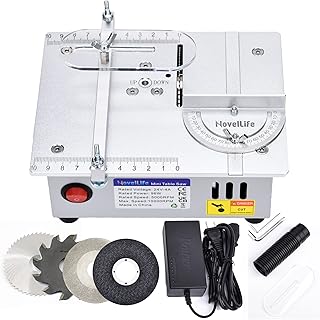
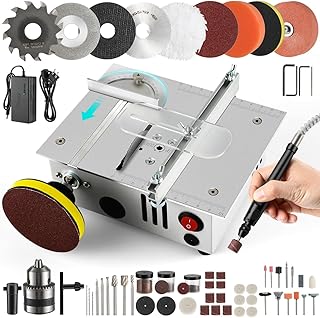
- Accessories and expandability: Some units include a chuck, sanding disc, or engraving collet, turning the saw into a small multi-tool station. Extra blades matter too — a fine-tooth HSS blade for wood plus a slitting disc for PCB and acrylic covers most hobby work.
The Best Hobby Table Saw (2026)s Reviewed
RTOVZON 7-Speed Portable Hobby Saw
The aluminum alloy deck is the standout here — it stays flat under hand pressure, which is exactly what you want when you’re feeding 2mm veneer past the blade. Four included blades and seven speed settings make it a sensible first saw for someone moving from a razor knife to powered cuts.
MXBAOHENG Mini Table Saw S3
A precision-first design with a 1/2″ adjustable cut depth and a genuinely usable seven-speed supply, so you can slow it down for styrene and speed it up for hardwood strips. The fence holds its setting well, which makes batch-cutting identical parts far less tedious.
Dual 795 Motor Mini Table Saw (200W)
Two 795 motors and independent switches push this to 200W and 12,000 RPM with 26mm of height adjustment — the most capable option here for small hardwood and thicker acrylic. If you’ve stalled a lighter saw before, this is the upgrade that solves it.
MXBAOHENG 96W 7-Speed Precision Saw
The included chuck and sanding disc turn this into a compact three-in-one station, handy when bench space is tight and you’d rather not own three separate tools. At 96W it’s tuned for wood, plastic, and PCB work rather than heavy stock.
Mini Hobby Bench Saw with 63mm HSS Blade (R2)
A straightforward, no-frills bench saw with an adjustable power supply and a 63mm HSS circular blade that cuts cleanly in softwoods. It’s the budget-conscious pick for model builders who need accurate straight cuts and nothing more.
Frequently Asked Questions
Can a hobby table saw cut hardwood?
Yes, within limits. Thin strips of maple, walnut, or oak up to about 1/4″ cut fine on the higher-wattage models, especially the dual-motor units. Take shallow passes, keep the feed rate slow, and let the blade clear its chips rather than forcing the stock.
Do I need a dust collection setup?
These saws produce fine dust rather than chips, and most have no dust port. A small shop vac positioned behind the blade catches the majority of it. Wear eye protection regardless — small offcuts can kick back at speed.
How do I get consistent strip widths?
Cut all your strips in one session without moving the fence. If you must reset it, use a digital caliper against the blade body rather than trusting the printed scale, which on saws in this class is a rough reference at best.
What blade should I use for acrylic and PCB?
A fine-tooth or slitting blade at reduced speed. High RPM melts acrylic and leaves a gummy edge that fuses behind the blade. For fiberglass PCB, expect faster blade wear and keep a spare on hand.
Final Thoughts
For most hobbyists, the MXBAOHENG Mini Table Saw S3 hits the best balance of precision and price, while the RTOVZON 7-Speed is a strong starting point thanks to its flat aluminum table and four-blade kit. If you regularly push into hardwood or thicker acrylic, step up to the dual 795 motor 200W saw — the extra power and 26mm cut height will keep it relevant as your projects grow.