Key takeaways
- Track type: H-type (Halo-compatible) is the most common in North American homes and gives you the widest choice of replacement heads later. Fixed-head kits with a proprietary rail are simpler to hang but lock you into that manufacturer, so decide up front whether you want to expand or swap heads down the road.
- Rail length vs. head count: Measure your run, then aim for roughly 18–24 inches of spacing between heads. A 13-foot rail with 12 heads suits a long galley or a double-island layout; a 24-inch bar with four heads is right for a sink wall or a coffee station.
- Bulb base and replaceability: E26 heads take standard screw-in bulbs you can buy anywhere, which is a real advantage in a kitchen where grease and heat shorten lamp life. GU10 gives you tighter, more controlled beams. Integrated LED heads look sleekest but mean replacing the whole head at end of life.
- Color temperature and CRI: Stick to 3000K for warm wood and brass, 4000K for a neutral working light, and 5000K only if you want a distinctly clinical look. CRI 90+ is worth paying for at a prep surface — it’s the difference between seeing whether the chicken is actually cooked and guessing.
- Dimming and wiring reality: Confirm the kit is dimmable and that your existing dimmer is LED-rated, or you’ll chase flicker for weeks. Also check whether the canopy can land on your existing junction box, and whether the kit ships with the mounting hardware for drywall versus a joist.
What's inside
Most kitchens are lit by a single ceiling fixture parked dead center, which means every time you stand at the counter your own shoulders throw a shadow across the cutting board. Under-cabinet strips help, but they leave the island, the sink wall, and that awkward corner by the pantry in a murky gray zone. Track lighting solves the geometry problem: one circuit, one mounting run, and a handful of heads you can aim exactly where the work happens.
I’ve wired more of these than I care to count, in rentals with plaster ceilings and in new builds with open joists. This guide covers what actually matters when you’re the one on the ladder with a voltage tester in your teeth: track type, head count versus rail length, bulb base compatibility, and the finish details that make a budget kit look intentional. Below are the kits worth your Saturday, plus the specs I check before anything comes out of the box.
As an Amazon Associate we earn from qualifying purchases.



🛒 Best Price Today on Amazon
Prime members get fast, free shipping on everything above, plus member-only deals. New members get a 30-day free trial — cancel anytime.
How to Choose Kitchen Track Lighting (2026)
- Track type: H-type (Halo-compatible) is the most common in North American homes and gives you the widest choice of replacement heads later. Fixed-head kits with a proprietary rail are simpler to hang but lock you into that manufacturer, so decide up front whether you want to expand or swap heads down the road.
- Rail length vs. head count: Measure your run, then aim for roughly 18–24 inches of spacing between heads. A 13-foot rail with 12 heads suits a long galley or a double-island layout; a 24-inch bar with four heads is right for a sink wall or a coffee station.
- Bulb base and replaceability: E26 heads take standard screw-in bulbs you can buy anywhere, which is a real advantage in a kitchen where grease and heat shorten lamp life. GU10 gives you tighter, more controlled beams. Integrated LED heads look sleekest but mean replacing the whole head at end of life.
- Color temperature and CRI: Stick to 3000K for warm wood and brass, 4000K for a neutral working light, and 5000K only if you want a distinctly clinical look. CRI 90+ is worth paying for at a prep surface — it’s the difference between seeing whether the chicken is actually cooked and guessing.
- Dimming and wiring reality: Confirm the kit is dimmable and that your existing dimmer is LED-rated, or you’ll chase flicker for weeks. Also check whether the canopy can land on your existing junction box, and whether the kit ships with the mounting hardware for drywall versus a joist.
The Best Kitchen Track Lighting (2026) Reviewed
VANoopee 12-Light Kit, 13FT Rails (Black)
This is the one I reach for when a room needs real coverage rather than a token fixture — 12 dimmable heads at 800 lumens each across two long rails, with CRI 90+ and five selectable color temperatures set at the head. The H-type track means you can relocate or add heads later, and the black finish hides fingerprints better than any brushed nickel I’ve installed.
VANoopee 6-Light Kit, 6.6FT Rails (White)
Same well-sorted electronics and CRI 90+ output as its larger sibling, scaled to a single rail that suits an average kitchen or a long hallway. The white finish is the smart pick on a white ceiling because the track visually disappears and your eye reads only the light.
AUQUEE 8-Light Matte Black Track
Eight rotatable heads on one bar gives you dense, evenly spaced light for a wide counter run, and the matte black powder coat is genuinely flat rather than semi-gloss. Note that GU10 bulbs aren’t included, which is actually a plus — you choose your own beam angle and color temperature instead of tossing whatever shipped in the box.
KEESFU 6-Light Industrial Track
The chunkier cylinder shades read more industrial than the slim modern heads, which suits exposed brick, open shelving, and darker cabinet colors. Heads rotate cleanly and hold their aim, and the six-light layout covers a standard kitchen without crowding the ceiling.
LED 4-Light Kit, 24.8″ Black
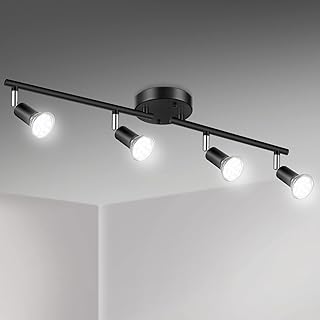
A compact four-head bar that’s ideal for a sink wall, a laundry nook, or replacing a single dated flush mount without cutting new holes. Ships with 5000K GU10 LEDs, so if you want something warmer, budget for four replacement bulbs at the same time.
3-Light Farmhouse Island Track
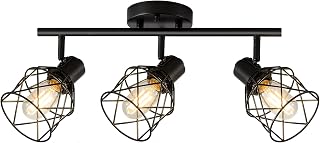
The E26 sockets are the real story here — screw in Edison-style bulbs and you get farmhouse character with an adjustable, aimable head, which is rare in that style. Three heads is enough over an island or a breakfast bar, not enough for whole-room lighting.
Frequently Asked Questions
Can I install track lighting myself?
If you’re replacing an existing ceiling fixture, yes — kill the breaker, verify with a non-contact tester, transfer the three wires to the canopy, and anchor into a joist or use rated drywall anchors. Running a new circuit or adding a box where none exists is electrician territory in most jurisdictions.
How far from the wall should the track run?
Set the rail about 24 to 30 inches out from the face of your upper cabinets. Any closer and the heads wash the cabinet doors instead of the countertop; any farther and you’ll be aiming heads at a steep angle that puts light in your eyes.
Will track lighting alone light my whole kitchen?
In a small or mid-size kitchen, a well-placed 6- to 8-head run usually does the job. Larger rooms and islands do better with two runs, or one track plus dedicated pendants over the island.
Do these work with smart dimmers?
Dimmable LED kits generally play well with modern LED-rated smart dimmers, but check the dimmer’s minimum load — a small four-head kit may draw too few watts for older units to control smoothly. When in doubt, choose a dimmer with an adjustable low-end trim.
Final Thoughts
For most kitchens, the VANoopee 6-Light 6.6FT kit hits the sweet spot on output, color quality, and installation simplicity, while the VANoopee 12-Light 13FT kit is the answer for long galleys and open-plan spaces that need two runs. If you’re after character over coverage, the 3-Light Farmhouse Island Track with its standard E26 sockets lets you choose the bulb and set the mood yourself.