Key takeaways
- Climate match: HDPE ignores humidity swings and freeze-thaw entirely, which makes it the default in coastal, lakeside, or hard-winter zones. Wood earns its place in dry climates or under real cover.
- Frame and top as separate decisions: Hybrid builds are common now — polywood or acacia slats over wrought iron or powder-coated steel. Inspect the frame finish and the fastener type, because that junction is where corrosion starts, not the surface you eat off.
- Honest maintenance budget: Acacia wants oiling once or twice a year to hold its color; skip it and you get silver-gray patina, which is fine if that’s the plan. HDPE wants a bucket of soapy water. Decide which chore you’ll actually do.
- Umbrella hole and grommet: A pre-cut hole saves you a hole saw and a prayer. Check the diameter against your pole — 1.7″ is the common spec — and confirm there’s a cap so rain isn’t funneling into the table structure.
- Assembly reality: Multi-box deliveries and bench-inclusive sets mean more bolts. Look for pre-drilled joinery and stated per-seat weight ratings around 300 lb, and set aside real time rather than a spare twenty minutes.
What's inside
Anyone who has hauled a warped patio table to the curb knows the real question isn’t style, it’s substrate. Wood movement, powder-coat chalking, screw holes weeping rust down a leg — these are material failures, and they show up on a predictable schedule depending on what you bought. Most shoppers pick a look first and inherit the maintenance calendar that comes with it, which is backwards.
This guide flips the order. I’ve spent enough weekends sanding gray off acacia and re-torquing hardware on steel frames to have opinions about which materials earn their keep in which climates. Below are the tables and sets worth your money in 2026, sorted by what they’re actually made of, plus the selection criteria I’d use if I were buying tomorrow.
As an Amazon Associate we earn from qualifying purchases.


🛒 Best Price Today on Amazon
Prime members get fast, free shipping on everything above, plus member-only deals. New members get a 30-day free trial — cancel anytime.
How to Choose a Material For Outdoor Dining Table (2026)
- Climate match: HDPE ignores humidity swings and freeze-thaw entirely, which makes it the default in coastal, lakeside, or hard-winter zones. Wood earns its place in dry climates or under real cover.
- Frame and top as separate decisions: Hybrid builds are common now — polywood or acacia slats over wrought iron or powder-coated steel. Inspect the frame finish and the fastener type, because that junction is where corrosion starts, not the surface you eat off.
- Honest maintenance budget: Acacia wants oiling once or twice a year to hold its color; skip it and you get silver-gray patina, which is fine if that’s the plan. HDPE wants a bucket of soapy water. Decide which chore you’ll actually do.
- Umbrella hole and grommet: A pre-cut hole saves you a hole saw and a prayer. Check the diameter against your pole — 1.7″ is the common spec — and confirm there’s a cap so rain isn’t funneling into the table structure.
- Assembly reality: Multi-box deliveries and bench-inclusive sets mean more bolts. Look for pre-drilled joinery and stated per-seat weight ratings around 300 lb, and set aside real time rather than a spare twenty minutes.
The Best Material For Outdoor Dining Table (2026)s Reviewed
SERWALL 84″ HDPE Rectangular Dining Table
At 84 inches this is the one to buy if you host, and HDPE means you can leave it out through a full winter without the annual refinishing ritual. The wood-grain texturing reads convincingly from a few feet away, and the pre-cut umbrella hole is placed sensibly for a six-to-eight seat layout.
MFSTUDIO 61″ Metal Table with Polywood Top
A smart hybrid: wrought iron does the structural work while the polywood slats handle the weather, so nothing on the eating surface is going to check or splinter. The 61-inch footprint suits a deck or narrow porch where an 84-inch slab would eat the whole space.
Devoko 6-Person Acacia Wood Dining Table
Genuine acacia with a walnut finish, and it moves indoors without looking like patio furniture that wandered inside. Treat it as a covered-porch or dry-climate table and give it oil each spring, and the grain stays rich rather than fading to driftwood.
Flamaker Acacia Wood Dining Table with Steel Frame
The natural acacia top over a steel base is a sound engineering split — the metal takes the load, the wood takes the compliments. Check the frame’s coating at the welds when it arrives, since that’s the first place moisture will find purchase.
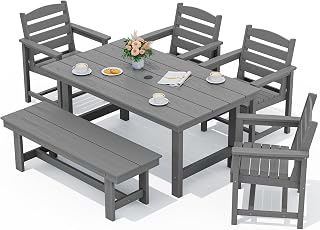
5-Piece HDPE Outdoor Dining Set for 4
A complete four-seat solution in all-weather HDPE, with a 1.7″ umbrella hole and 300 lb per-chair rating that suggests the plastic is doing more than looking the part. The three-box delivery means staged assembly, so clear an afternoon.
Frequently Asked Questions
Is HDPE really better than wood outdoors?
For pure durability, yes. HDPE won’t rot, splinter, or absorb water, and UV inhibitors are compounded into the material rather than sitting on top of it. Wood wins on warmth and repairability — you can sand a scratch out of acacia, not out of plastic.
How long does acacia last outside?
Uncovered and unoiled, expect surface checking within two or three seasons. With annual oil and a cover during the wet months, ten years is realistic. The wood is dense and naturally oily, so the failure mode is cosmetic long before it’s structural.
Does powder-coated steel rust?
Not until the coating is breached, then quickly. Touch up chips with matching enamel as soon as you spot them, and check under the feet where the coating takes the most abuse.
Do I need to cover these in winter?
HDPE, no. Acacia and any steel-framed piece, yes — a breathable cover, not a tarp, since trapped condensation does more damage than snow.
Final Thoughts
If you want to buy once, the SERWALL 84″ HDPE table is the low-maintenance answer for large gatherings, and the SERWALL bench set extends that same logic to a full seating package. For a smaller footprint with a bit more visual warmth, the MFSTUDIO polywood-and-iron hybrid splits the difference intelligently.