Key takeaways
- Compare five MIDI keyboards for a home studio desk, from compact 25-key pad controllers to a full-size 49-key board, with the key specs that matter.
A MIDI keyboard makes no sound of its own. It sends note and control data to the software instruments inside your recording software, so the keyboard you choose shapes how fast ideas move from your head into a track. For a home office desk that doubles as a small studio, the decision is mostly about fit: how much desk space you can give up, whether you play with two hands or program beats one pad at a time, and how much practical control you want over sounds and mixes.
This guide compares five controllers across three sizes. Two compact 25-key models lead the list for tight desks, a 37-key and a 32-key model add playing range without taking over the workspace, and a 49-key board covers players who want full-size keys above everything else.
Disclosure: As an Amazon Associate, we earn from qualifying purchases made through links on this page, at no extra cost to you.
How to Choose a MIDI Keyboard
Key count and key size. A 25-key controller suits beat making, bass lines and simple melodies, and it leaves room for a computer keyboard and mouse. Mini and slim keys keep the footprint small but feel cramped for piano-style parts. If you play chords with both hands, look at 37 keys or more, and choose full-size keys if your fingers are used to a piano or synth.
Pads and practical controls. Backlit pads are the fastest way to finger-drum and trigger samples, and they matter most for hip hop, electronic and pop production. Knobs and faders map to filter cutoffs, effects and mixer levels in your software, so you spend less time drawing automation with a mouse. Pitch and modulation wheels, or touch strips that do the same job, add expression to synth and string parts.
Modes and software integration. Scale modes lock the keys to one musical scale so every note fits the song, chord modes play full chords from a single key, and a built-in arpeggiator turns held notes into patterns. These helpers speed up writing, especially for producers who do not read music. Also check the bundled software: most controllers include a lite version of a recording program plus a library of sounds, which can carry a new setup a long way.
Connections. Nearly every model here runs on USB bus power, so one cable carries data and power. A 5-pin MIDI output lets a controller drive hardware synths and sound modules without a computer. A sustain pedal input is worth having even if you add the pedal later, and a USB-C port is easier to live with than older connectors when you move between laptops.
The 5 Best MIDI Keyboards
1. Akai Professional MPK Mini MK3

The MPK Mini MK3 packs the classic MPC workflow into a controller that fits beside a laptop. Its eight backlit pads are velocity sensitive, support two banks for sixteen sounds, and include Note Repeat and Full Level for rolling hi-hats and snares. Eight assignable knobs sit above the pads, and a four-way thumbstick handles pitch bend and modulation. The Gen 2 keybed feels firmer than the older model, an OLED screen shows pad and knob assignments as you work, and the built-in arpeggiator helps turn single notes into patterns. At under two pounds it is the easiest pick here to carry between rooms, and the bundled software suite covers drums, synths and effects for a first setup.
Specs
- Keys: 25 velocity-sensitive synth-action mini keys
- Pads: 8 backlit velocity-sensitive MPC pads, 2 banks
- Controls: 8 assignable knobs, 4-way thumbstick, OLED display, arpeggiator
- Connections: USB bus power, sustain pedal input
- Dimensions: Not published
- Weight: 1.65 lb
2. Arturia MiniLab 3

The MiniLab 3 is built for producers who want knobs and faders as much as keys and pads. Alongside eight RGB pads it offers eight encoders and four faders, a layout that suits mixing and sound design from the desk. Two touch strips replace wheels for pitch and modulation, the arpeggiator and chord mode help build parts quickly, and a small display confirms settings as you change them. It connects over USB-C and adds a 5-pin MIDI output, which is rare at this size and lets it control hardware gear as well. The included Analog Lab Intro library brings more than 500 presets that map to the controls automatically, so the board feels useful within minutes of setup.
Specs
- Keys: 25 velocity-sensitive slim keys
- Pads: 8 RGB backlit pads, 2 banks
- Controls: 8 encoders, 4 faders, 2 touch strips, arpeggiator, chord mode
- Connections: USB-C, 5-pin MIDI out, sustain pedal input
- Dimensions: 14 x 8.7 x 2 in
- Weight: 3.3 lb
3. Novation Launchkey 37 MK4
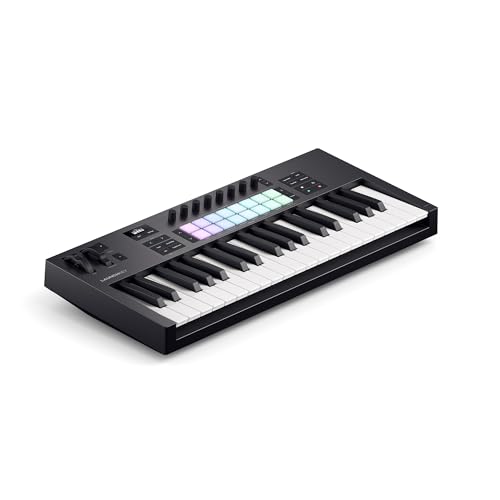
The Launchkey 37 MK4 gives you three octaves of full-size keys while staying narrow enough for a shared desk. Sixteen velocity-sensitive pads handle drums and clip launching, and eight continuous encoders adjust software parameters with clear feedback from the screen. Its strongest tools are the built-in modes: Scale Mode keeps your playing in key, Chord Mode builds chords from single notes, and the arpeggiator includes generative patterns that suggest new ideas. Deep integration with major recording programs means the pads and knobs map themselves for popular software, and a 5-pin MIDI output plus sustain input cover hardware connections. Choose this one if you play parts with both hands but cannot spare the width of a 49-key board.
Specs
- Keys: 37 full-size synth-action keys
- Pads: 16 velocity-sensitive pads
- Controls: 8 encoders, Scale Mode, Chord Mode, arpeggiator, display screen
- Connections: USB-C, 5-pin MIDI out, sustain pedal input
- Dimensions: Not published
- Weight: Not published
4. M-Audio Keystation 49 MK3

The Keystation 49 MK3 takes the opposite approach: almost everything goes into the keys. You get 49 full-size velocity-sensitive keys, pitch and modulation wheels, a volume fader and octave buttons, and nothing else competing for panel space. That simplicity makes it a strong fit for piano practice, lessons and playing software instruments where expression comes from your hands rather than knobs. It connects by USB and also carries a 5-pin MIDI output for hardware sound modules, plus a sustain pedal input for proper piano technique. The included software bundle adds a recording program and virtual instruments, so it works as a complete first keyboard for a spare-room studio.
Specs
- Keys: 49 full-size velocity-sensitive synth-action keys
- Pads: None
- Controls: Pitch wheel, modulation wheel, volume fader, octave buttons
- Connections: USB, 5-pin MIDI out, sustain pedal input
- Dimensions: Not published
- Weight: Not published
5. Native Instruments Komplete Kontrol M32

The Komplete Kontrol M32 stretches a compact frame to 32 micro keys, giving you more range than the 25-key models while keeping a slim profile for shallow desks. Eight touch-sensitive knobs control the sound you are browsing, two touch strips handle pitch and modulation, and an OLED display shows preset names as you scroll the Komplete library. Smart Play features add scale, chord and arpeggiator tools, and the board maps deeply to Komplete and Maschine software, with preset browsing done from the hardware itself. It suits producers already invested in Native Instruments sounds who want a small controller that feels like part of that system rather than a generic board.
Specs
- Keys: 32 velocity-sensitive synth-action micro keys
- Pads: None
- Controls: 8 touch-sensitive knobs, 2 touch strips, OLED display, Smart Play modes
- Connections: USB bus power, sustain pedal input (TRS)
- Dimensions: 18.7 x 6.6 x 2.0 in
- Weight: 2.2 lb
Comparison Table
| Product | Keys | Pads | Standout controls | Connections |
|---|---|---|---|---|
| Akai MPK Mini MK3 | 25 mini | 8 | Thumbstick, Note Repeat | USB, pedal input |
| Arturia MiniLab 3 | 25 slim | 8 | 4 faders, touch strips | USB-C, MIDI out, pedal input |
| Novation Launchkey 37 MK4 | 37 full-size | 16 | Scale and Chord modes | USB-C, MIDI out, pedal input |
| M-Audio Keystation 49 MK3 | 49 full-size | None | Pitch and mod wheels | USB, MIDI out, pedal input |
| NI Komplete Kontrol M32 | 32 micro | None | Touch knobs, preset browsing | USB, pedal input |
FAQ
How many keys do I need on a MIDI keyboard?
For beat making and simple melodies, 25 keys are enough and save the most desk space. If you play chords or piano parts with two hands, 37 keys feel far less limiting, and 49 keys suit practice and lessons.
Does a MIDI keyboard make sound on its own?
No. A MIDI keyboard sends data to software instruments on your computer or to a hardware sound module. You listen through your recording software, headphones or speakers connected to your computer or audio interface.
Are mini keys harder to play than full-size keys?
They take some adjustment. Mini and slim keys work well for bass lines, melodies and programming, but wide chord shapes and piano technique feel more natural on the full-size keys of the Launchkey 37 MK4 or Keystation 49 MK3.
Do I need pads on my MIDI keyboard?
Pads help most if you finger-drum, trigger samples or launch clips. If you mainly play keys, a pad-free board like the Keystation 49 MK3 or Komplete Kontrol M32 puts the space and money into the keybed instead.
Will these keyboards work with my recording software?
Yes. All five are class-compliant USB controllers that work with major programs such as Ableton Live, Logic Pro, FL Studio and GarageBand, and each includes bundled software to get a first project going.
Conclusion
Pick the MPK Mini MK3 if pads and portability lead your workflow, or the MiniLab 3 if you want faders and a MIDI output in the same small footprint. The Launchkey 37 MK4 is the balanced middle ground, with full-size keys, sixteen pads and helpful playing modes. Players who care about the keybed above all should take the Keystation 49 MK3, while Komplete users get the tightest software fit from the M32. Match the key count to your desk first, then let pads and controls settle the rest.
More from Amazon
Programs that pair well with the guide above. Offers and eligibility are set by Amazon and may change.
A free business account with business pricing and bulk-buying tools for work, shop or home office.
Create a business accountFree shipping on eligible items, Prime Video and more. Eligible new members can start with a free trial.
Start a Prime free trialAudiobooks and podcasts to listen to on the go. Eligible new members can start with a free trial.
Try Audible freeAd-free music streaming. Eligible new subscribers can start with a free trial.
Try Music Unlimited freeAs an Amazon Associate we earn from qualifying purchases.