Key takeaways
- Compare the best thermal cameras for finding drafts, leaks and hot circuits, from FLIR and TOPDON phone attachments to HIKMICRO and UNI-T handhelds.
A thermal camera turns heat into a picture, and around a home office that picture answers questions your eyes cannot. It shows cold air slipping past window frames, radiators heating in patches, breakers running hot, and damp drywall hiding slow leaks. Each fault is invisible in normal light, and each costs money or comfort until found.
The five cameras below fall into two families: handheld units from HIKMICRO and UNI-T with their own screens and batteries, and phone attachments from TOPDON, FLIR and Seek Thermal that borrow the screen and storage of a smartphone. Between them there is a pick for Android, one for current iPhones, and one for older iPhones.
Disclosure: As an Amazon Associate, we earn from qualifying purchases made through links on this page, at no extra cost to you.
How to Choose a Thermal Camera
Pick the form factor first. A handheld camera is a complete tool: screen, battery, storage and buttons in one body. A phone attachment is far smaller and leans on the phone for its display, app and memory, which simplifies sharing but ties the camera to one connector type.
Judge the native sensor, not the headline number. Many listings lead with a software-upscaled output size, while the sensor captures fewer pixels. Native resolution decides the real detail: 160 x 120 covers whole walls and doors, 256 x 192 separates individual breakers, pipes and studs, and 320 x 240 holds up on small, distant parts.
NETD tells you how faint a difference the camera can show. It is the smallest temperature gap, in millikelvin, that the sensor turns into a visible shade change. Lower is better: under 40 mK picks out gentle patterns such as missing insulation or moisture in a ceiling, while 70 mK still handles clear faults such as hot connections. At 25 Hz the picture also stays smooth while you sweep a room; sub-9 Hz cameras step.
Match the temperature range to the work. Building checks live between -20 and 150 degrees C: cold bridging, heating pipes, underfloor loops. Electrical and mechanical checks run hotter, so a ceiling of 400 or 550 degrees C covers motors, bearings and loaded wiring. Accuracy here is typically plus or minus 2 degrees C or 2 percent.
Field of view and focus set the working distance. A wide view, around 50 degrees or more, takes in a full wall from a few steps back. A narrow view near 32 degrees magnifies distant targets. An adjustable focus ring pays off on close work such as circuit boards.
Check emissivity control and measurement tools. Shiny metal fools thermal cameras, because it reflects heat from the room instead of showing its own. Adjustable emissivity, or material presets, keeps readings on pipes and appliances believable. Spot meters, point tracking and alarms speed up every scan.
Think about power, storage and the app. The handhelds below run about six hours per charge and store images internally or on a card. Attachments sip power from the phone or carry a small cell of their own. Before ordering one, confirm your phone connector, the supported models, and that the app runs on your phone software.
The 5 Best Thermal Cameras
1. HIKMICRO B10 Thermal Imaging Camera

The B10 is the most complete handheld here for general home and office work. Its 256 x 192 sensor feeds a 3.2 inch screen, and SuperIR processing lifts saved images to 320 x 240. A 2 MP visible camera sits beside the thermal sensor, with fusion and picture-in-picture modes that line a hot or cold patch up with the wall that produced it. Sensitivity under 40 mK and a 25 Hz refresh give a smooth, detailed picture while you walk a room, and spot presets cover most checks without menu digging. The body is sealed to IP54, survives drops of 2 m, and adds an LED work light for dark corners.
Specs
- Model: B10 (HM-TP51-3AQF/W-B10)
- IR resolution: 256 x 192 native, 320 x 240 SuperIR output
- Thermal sensitivity (NETD): under 40 mK
- Frame rate: 25 Hz
- Temperature range: -20 to 550 degrees C (-4 to 1022 degrees F)
- Accuracy: plus or minus 2 degrees C or 2 percent
- Visual camera: 2 MP
- Field of view: 37.2 x 50 degrees
- Storage: 16 GB built in
- Battery: Li-ion, about 6 hours per charge
- Protection: IP54, drop tested to 2 m
2. TOPDON TC001 Thermal Imaging Camera for Android

The TC001 plugs into the USB-C port of an Android phone or tablet and gives it a 256 x 192 native sensor, the same pixel count as the two handhelds here. TISR processing raises the output to 512 x 384, and the 25 Hz refresh keeps the picture fluid while you pan a room. It also works with Windows computers through the TCView app. At 30 g it adds almost nothing to a pocket, and it draws just 0.35 W from the host device. Two limits matter: there is no iPhone support at all, and TOPDON does not publish a field of view figure for this model.
Specs
- Model: TC001 (TC001-US)
- IR resolution: 256 x 192 native, up to 512 x 384 with TISR
- Thermal sensitivity (NETD): under 40 mK
- Frame rate: 25 Hz
- Temperature range: -20 to 550 degrees C (-4 to 1022 degrees F)
- Accuracy: plus or minus 2 degrees C or 2 percent
- Connector: USB-C (Android, Windows via TCView)
- Field of view: not published
- Weight: 30 g
3. FLIR ONE Pro Thermal Imaging Camera for iOS (USB-C)
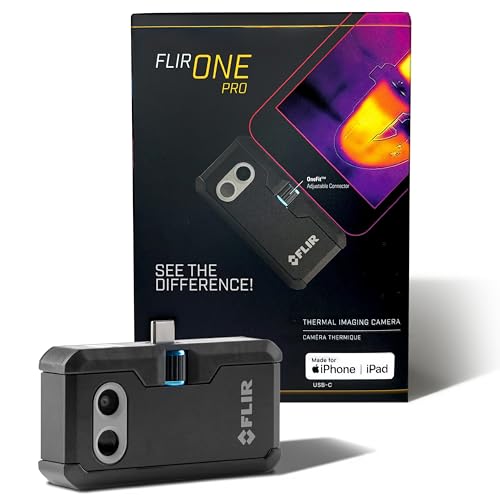
This version of the FLIR ONE Pro is built for iPhone 15 and newer, with a USB-C plug on an adjustable OneFit connector that fits over many phone cases. Its native sensor is 160 x 120, the lowest count here, but VividIR builds the displayed image to 480 x 360, and MSX embosses edges from the 1440 x 1080 visible camera onto the thermal picture. The measurement kit is strong: up to three spot meters and six regions of interest, plus a range reaching 400 degrees C. Unlike the other attachments, it carries its own battery, good for about an hour and refilled over USB-C in about 40 minutes. The trade-offs are an 8.7 Hz refresh, which steps rather than flows as you move, and 70 mK sensitivity, which renders faint damp patterns with less contrast.
Specs
- Model: FLIR ONE Pro, iOS USB-C version
- IR resolution: 160 x 120 native, up to 480 x 360 with VividIR
- Thermal sensitivity (NETD): 70 mK
- Frame rate: 8.7 Hz
- Temperature range: -20 to 400 degrees C (-4 to 752 degrees F)
- Accuracy: plus or minus 3 degrees C or 5 percent, typical
- Field of view: 50 x 43 degrees
- Connector: OneFit adjustable USB-C, iPhone 15 and newer
- Battery: built in, about 1 hour, 40 minute refill
4. UNI-T UTi260B Thermal Imaging Camera

The UTi260B is the rugged pick of this group, a pistol-grip handheld sealed to IP65 against dust and water jets and drop tested to 2 m, where the B10 stops at IP54. Its 256 x 192 sensor sits behind the widest lens here, 56 x 42 degrees, taking in a whole wall from close quarters, suiting insulation surveys, underfloor heating checks and damp hunting in small rooms. Its screen shows thermal, blending, visible and picture-in-picture modes fed by a 640 x 480 visible camera, with high and low temperature alarms. A 5000 mAh battery runs for six hours or more, and images land on a micro SD card, with a 16 GB card included. At 50 mK, sensitivity sits between the other classes here, and the body is the heaviest of the five.
Specs
- Model: UTi260B
- IR resolution: 256 x 192
- Thermal sensitivity (NETD): 50 mK
- Frame rate: 25 Hz
- Temperature range: -15 to 550 degrees C (5 to 1022 degrees F)
- Accuracy: plus or minus 2 degrees C or 2 percent
- Field of view: 56 x 42 degrees
- Battery: 5000 mAh Li-ion, 6+ hours per charge
- Protection: IP65, drop tested to 2 m
- Storage: micro SD, 16 GB card included
5. Seek Thermal CompactPRO Thermal Imaging Camera for iOS

The CompactPRO carries the sharpest native sensor in this list, 320 x 240, in a tiny housing that plugs into the Lightning port. That pixel count shows its worth on small targets: one component on a board, a single failing connection in a crowded panel, or a distant warm spot that a lower-resolution camera smears into a blob. Seek quotes a detection distance of up to 1,800 feet, helped by the narrow 32 degree field of view. An adjustable focus ring sharpens the picture from 15 cm to long range, which fixed-focus attachments cannot match, and the camera runs on phone power, so there is nothing to charge. Two cautions: it only fits Lightning iPhones and iPads, so USB-C iPhone owners should pick the FLIR above, and Seek does not publish a NETD figure.
Specs
- Model: CompactPRO iOS (LQ-AAA)
- IR resolution: 320 x 240
- Thermal sensitivity (NETD): not published
- Frame rate: under 9 Hz
- Temperature range: -40 to 626 degrees F (-40 to 330 degrees C)
- Field of view: 32 degrees
- Connector: Lightning (iPhone, iPad)
- Included: waterproof carry case
Comparison Table
| Model | Form | Native IR | NETD | Range (degrees C) | Works with |
|---|---|---|---|---|---|
| HIKMICRO B10 | Handheld | 256 x 192 | Under 40 mK | -20 to 550 | Standalone |
| TOPDON TC001 | Attachment | 256 x 192 | Under 40 mK | -20 to 550 | Android USB-C, Windows |
| FLIR ONE Pro (USB-C) | Attachment | 160 x 120 | 70 mK | -20 to 400 | iPhone 15 and newer |
| UNI-T UTi260B | Handheld | 256 x 192 | 50 mK | -15 to 550 | Standalone |
| Seek Thermal CompactPRO | Attachment | 320 x 240 | Not published | -40 to 330 | Lightning iPhones |
FAQ
Can a thermal camera see through walls?
No. A thermal camera reads the temperature of the surface it points at, not the space behind it. What it shows is how hidden problems mark that surface: a cold patch where insulation is missing, a warm trail where a pipe runs, or a cool bloom where water spreads. That evidence shows where to open up or seal first.
Which of these cameras works with an iPhone?
Two of them. The FLIR ONE Pro in this list fits the USB-C port of the iPhone 15 and newer. The Seek Thermal CompactPRO fits older iPhones and iPads that carry a Lightning port. The plugs are not interchangeable, so check your phone port first, and confirm your model on the maker support list.
Is 256 x 192 resolution enough for home and office checks?
For most building work, yes. At 256 x 192 you can separate window frames from walls, pick out single breakers, follow pipes and heating loops, and read the patchy pattern of a failing radiator. Higher counts help on small or distant targets; lower counts still find big faults, with softer edges.
Why do listings show two different resolutions for one camera?
The smaller figure is the native sensor, the count of detector pixels that actually sense heat. The larger figure is the image size after software upscaling, under names like SuperIR, TISR and VividIR. Upscaling smooths pictures, and blended visible detail helps locate a fault, but it cannot invent detail the sensor never captured. Compare cameras on the native figure first.
Do phone thermal cameras need charging?
It depends on the model. The TOPDON TC001 and the Seek Thermal CompactPRO draw all their power from the phone and have no battery of their own, so they are ready whenever the phone is. The FLIR ONE Pro carries a built-in battery that runs for about an hour and refills over USB-C in about 40 minutes.
Conclusion
For one camera that handles nearly every check here, pick the HIKMICRO B10: a 256 x 192 sensor, under-40 mK sensitivity and a long battery, with no phone needed. The UNI-T UTi260B trades pocket size for a wider view and tougher IP65 sealing. The TOPDON TC001 gives Android users handheld-class resolution at attachment size, the FLIR ONE Pro gives current iPhones clear blended pictures and its own battery, and the Seek CompactPRO gives Lightning iPhones the most native pixels. Match the camera to the faults you chase and to the port on your phone.
More from Amazon
Programs that pair well with the guide above. Offers and eligibility are set by Amazon and may change.
A free business account with business pricing and bulk-buying tools for work, shop or home office.
Create a business accountFree shipping on eligible items, Prime Video and more. Eligible new members can start with a free trial.
Start a Prime free trialAudiobooks and podcasts to listen to on the go. Eligible new members can start with a free trial.
Try Audible freeAd-free music streaming. Eligible new subscribers can start with a free trial.
Try Music Unlimited freeAs an Amazon Associate we earn from qualifying purchases.