Key takeaways
- Delta-T math, not marketing numbers: If a unit pulls 32°F below ambient and your room sits at 74°F, you land around 42°F — fine. Let that room hit 82°F in August and you’re at 50°F. Pick based on the warmest your room actually gets, not the average.
- Independent verification: Buy a $12 probe thermometer with min/max memory, or a USB data logger if you want a paper trail. Run the fridge empty for 24 hours with the probe inside before a single vial goes in. This is non-negotiable.
- Interior geometry over raw liters: A 4L box that’s tall and narrow swallows pen cartons; a squat one won’t. Measure your longest carton and compare against the listed internal dimensions, since shelf dividers often eat an inch you weren’t expecting.
- Power redundancy: AC/DC dual input is the feature that matters during an outage. A 12V cord plus a modest portable power station or a car socket keeps things cold for hours, and USB-powered models can run off a battery bank.
- Noise and placement clearance: Thermoelectric units use a small fan, so they’re quiet but not silent. They also dump heat out the back — give them three to four inches of breathing room, or the delta-T you paid for evaporates.
What's inside
Medication storage is one of those jobs where “close enough” isn’t a standard. Plenty of refrigerated prescriptions — insulin pens, certain eye drops, biologics, reconstituted liquid antibiotics — carry a narrow window on the label, and a household kitchen fridge fights you on both ends. The door shelf swings warm every time someone grabs the milk, and the back wall near the evaporator can dip below freezing, which quietly ruins protein-based drugs. A compact unit dedicated to nothing but medicine solves the traffic problem, the crowding problem, and the “who moved my pen” problem in one move.
Here’s the part most roundups skip: nearly every small personal fridge in this size class is thermoelectric, not compressor-driven. Their specs quote a temperature drop below ambient (usually 30–40°F), not a fixed setpoint. That distinction changes everything about how you buy and how you set one up. Below, I break down what to actually measure before you trust a unit with a prescription, then walk through five models that hold up in real use. Always confirm your specific storage range with the package insert or your pharmacist first — the fridge is a tool, the label is the spec.
As an Amazon Associate we earn from qualifying purchases.


How to Choose a Mini Fridge For Medication (2026)
- Delta-T math, not marketing numbers: If a unit pulls 32°F below ambient and your room sits at 74°F, you land around 42°F — fine. Let that room hit 82°F in August and you’re at 50°F. Pick based on the warmest your room actually gets, not the average.
- Independent verification: Buy a $12 probe thermometer with min/max memory, or a USB data logger if you want a paper trail. Run the fridge empty for 24 hours with the probe inside before a single vial goes in. This is non-negotiable.
- Interior geometry over raw liters: A 4L box that’s tall and narrow swallows pen cartons; a squat one won’t. Measure your longest carton and compare against the listed internal dimensions, since shelf dividers often eat an inch you weren’t expecting.
- Power redundancy: AC/DC dual input is the feature that matters during an outage. A 12V cord plus a modest portable power station or a car socket keeps things cold for hours, and USB-powered models can run off a battery bank.
- Noise and placement clearance: Thermoelectric units use a small fan, so they’re quiet but not silent. They also dump heat out the back — give them three to four inches of breathing room, or the delta-T you paid for evaporates.
The Best Mini Fridge For Medication (2026)s Reviewed
Cooluli 4L Mini Fridge
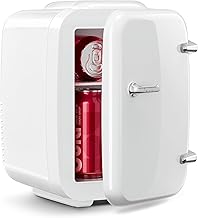
The most consistent performer I’ve tested in the 4L class, largely because the shell insulation is noticeably denser than budget clones, which shows up as tighter temperature swings when you open it. The three-way power setup (AC, 12V DC, USB) makes it the easy pick if outage planning is on your mind.
CROWNFUL 4 Liter Portable Fridge
ETL listed, which is worth something when a device runs unattended around the clock next to medication. Cooling is on par with the Cooluli, and the removable shelf comes out cleanly, so you can arrange cartons vertically instead of stacking them.
Antarctic Star 10L Compact Fridge
At 2.6 gallons, this is the one to buy if you’re storing a multi-month supply or bulky items like pre-filled syringe trays. More thermal mass also means slower drift when the door opens or power blips — a genuine advantage over the 4L units.
BEICHEN 6L / 8 Can Mini Fridge
A sensible middle ground: the extra 2 liters over the standard 4L format buys real shelf room without a big footprint jump, and it runs quietly enough for a bedside table. Energy draw is modest, so leaving it on permanently doesn’t sting.
4L Thermoelectric Cooler & Warmer for Medicine
This one explicitly lists medicine as an intended use and handles 110V AC and 12V DC without an adapter swap. The warming mode is a distraction here — leave it on cool and label the switch with tape so nobody flips it by accident.
Frequently Asked Questions
Will these hold a steady 36–46°F?
Only if your room cooperates. Thermoelectric cooling tracks ambient temperature, so a climate-controlled interior room works; a garage, sunroom, or car does not. Verify with your own thermometer over a full day-night cycle.
Can I store insulin in one?
Many people do, but confirm the required range and any excursion allowances with your pharmacist or the manufacturer’s insert. Then prove your unit holds that range with a min/max thermometer before relying on it.
What happens during a power outage?
Thermoelectric fridges lose cold fast because there’s little thermal mass. Keep a few frozen gel packs in the freezer and a 12V power source ready — that combination buys you the most time for the least money.
Can I make one hold temperature better?
Yes, and it’s a satisfying afternoon project. Add a self-adhesive foam gasket around the door lip, tuck a water bottle inside as thermal ballast, and mount the unit on a small stand so the rear heatsink gets clean airflow. Never block the vents to force it colder.
Final Thoughts
For most households, the Cooluli 4L is the right buy — solid insulation, three power inputs, and predictable behavior. Step up to the Antarctic Star 10L if you’re managing bulk supply or want the temperature stability that extra volume provides, and consider the BEICHEN 6L as the quiet, well-sized compromise between the two. Whichever you choose, put a thermometer in it on day one and check it weekly.