Key takeaways
- Weather rating over marketing: Look for an explicit IP rating or a manufacturer statement of outdoor approval. The Danby carries an IPX4 rating, meaning it shrugs off splashing water from any direction — that’s a tested figure, not a claim. Anything without a rating belongs under a roof at minimum.
- Ambient temperature range: Check the operating envelope, not just the interior setpoint. A unit specced to hold 37–65°F in a 100°F garage is doing real work; indoor-only compressors typically top out around 80–90°F ambient and then run continuously without ever reaching temp.
- Front ventilation for built-ins: If the fridge is going into a cabinet cutout, it must exhaust through the front grille. Rear-vented units need several inches of air gap on all sides, which no framed cabinet provides. Measure your rough opening and add the manufacturer’s clearance before you cut a single board.
- Door and gasket construction: Stainless steel doors resist UV yellowing and won’t sag like plastic frames. Glass doors look sharp but load solar heat, so plan for shade or accept longer compressor cycles. Inspect the gasket — a soft, continuous magnetic seal is what keeps humid air out.
- Capacity in cans, not cubic feet: Manufacturers rate outdoor beverage units by can count because shelf spacing is fixed. A 127-can fridge fits a 15-inch cabinet bay; 180 cans needs a 24-inch opening. Decide your bay width first, then shop the can rating.
What's inside
The moment you drag a standard kitchen mini fridge onto a covered patio, you’ve started a countdown. Indoor compressors aren’t sealed against humidity, their control boards short out after the first blowing rainstorm, and the thermostats simply give up when ambient air climbs past 90°F. I’ve pulled apart two dead dorm fridges that met exactly that fate on a screened porch in Georgia — corroded relay contacts, rusted evaporator fins, wiring insulation gone brittle. The lesson stuck: outdoor duty is a different engineering problem, and the sticker on the box matters more than the cubic footage.
This guide walks through the units I’d actually trust in an outdoor kitchen build, a poolside bar cart, or a garage beer station. I’ve weighted the picks toward genuine weather ratings, ambient temperature range, ventilation clearances that work in a built-in cabinet cutout, and door construction that won’t warp. If you’re framing a cabinet run this spring, pay close attention to the front-venting notes — that single spec decides whether your fridge lives five years or five months.
As an Amazon Associate we earn from qualifying purchases.



How to Choose a Mini Fridge For Outdoors (2026)
- Weather rating over marketing: Look for an explicit IP rating or a manufacturer statement of outdoor approval. The Danby carries an IPX4 rating, meaning it shrugs off splashing water from any direction — that’s a tested figure, not a claim. Anything without a rating belongs under a roof at minimum.
- Ambient temperature range: Check the operating envelope, not just the interior setpoint. A unit specced to hold 37–65°F in a 100°F garage is doing real work; indoor-only compressors typically top out around 80–90°F ambient and then run continuously without ever reaching temp.
- Front ventilation for built-ins: If the fridge is going into a cabinet cutout, it must exhaust through the front grille. Rear-vented units need several inches of air gap on all sides, which no framed cabinet provides. Measure your rough opening and add the manufacturer’s clearance before you cut a single board.
- Door and gasket construction: Stainless steel doors resist UV yellowing and won’t sag like plastic frames. Glass doors look sharp but load solar heat, so plan for shade or accept longer compressor cycles. Inspect the gasket — a soft, continuous magnetic seal is what keeps humid air out.
- Capacity in cans, not cubic feet: Manufacturers rate outdoor beverage units by can count because shelf spacing is fixed. A 127-can fridge fits a 15-inch cabinet bay; 180 cans needs a 24-inch opening. Decide your bay width first, then shop the can rating.
The Best Mini Fridge For Outdoors (2026)s Reviewed
Danby DAR044A6BSLDBO 4.4 Cu.Ft. Outdoor Mini Fridge
This is the only pick here with a published IPX4 rating, and it’s the one I’d install on an uncovered pool deck without hesitation. The Energy Star certification is a genuine bonus on a unit that will run hard through summer, and the 4.4 cubic foot interior handles bottles, platters, and mixers rather than cans alone.
Feelfunn 24 Inch Beverage Refrigerator, 180 Cans
The 37–65°F range is the standout spec — that upper end lets it double as a wine cabinet in cooler months, and the sub-40dB rating means it won’t drone over conversation on a patio. At 24 inches with a stainless door, it slots cleanly into a standard base cabinet run.
Antarctic Star 24 Inch Outdoor Beverage Refrigerator
Antarctic Star’s fast-cooling compressor recovers temperature quickly after the door has been swinging open through a cookout, which is exactly where cheaper units fall apart. The 32–50°F range runs colder than most competitors, making it the better choice if ice-cold beer is the priority over wine storage.
15 Inch Outdoor Beverage Refrigerator with French Door
The French door design is the practical advantage here: half-width doors need far less swing clearance, which matters on a narrow deck or in a tight galley-style outdoor kitchen. It handles 127 cans in a 15-inch footprint and installs built-in or freestanding.
EUHOMY Beverage Refrigerator 15 Inch
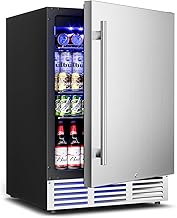
EUHOMY’s 15-inch undercounter unit is the value play for a covered porch or garage bar, with a solid stainless door that hides fingerprints better than glass shows condensation. Keep it under a roof — it’s the least weather-hardened of the group, but the build quality per dollar is hard to beat.
Frequently Asked Questions
Can I use a regular mini fridge outside if it’s under a roof?
You can, but expect a shortened lifespan. Covered spaces still swing through wide humidity and temperature ranges, and indoor compressors aren’t rated for ambient temps above roughly 90°F. If the space is fully enclosed and climate-adjacent, an indoor unit may survive; on an open porch, it won’t.
Do outdoor fridges need a dedicated circuit?
Most draw under 2 amps running, so a dedicated circuit isn’t strictly required. What you do need is a GFCI-protected outdoor receptacle — that’s code, and it’s the difference between a nuisance trip and a genuine shock hazard. Never run one off an extension cord permanently.
How much clearance does a built-in installation need?
Front-venting units typically need only a modest gap at the top and a clear front grille, but check your specific model’s manual. As a rule, cut your opening about a half inch wider and taller than the stated cabinet dimensions to allow for leveling and shimming.
Will an outdoor fridge work in freezing winter temperatures?
Most stop functioning correctly below about 38–50°F ambient because the compressor never gets a signal to cycle. Contents can then freeze or the refrigerant oil can thicken. In cold climates, unplug, clean, and prop the door open for the off-season.
Final Thoughts
For a genuinely exposed installation, the Danby DAR044A6BSLDBO earns the top spot on the strength of its IPX4 rating alone — it’s the unit built for the job rather than adapted to it. If you’re filling a 24-inch cabinet bay under cover, the Feelfunn 180-can offers the widest temperature range and the quietest operation, while the Antarctic Star 24 Inch is the better pick when you want beverages genuinely cold and recovery speed matters more than versatility.