Key takeaways
- Real footprint, not listed capacity: Add at least two inches behind the unit for the compressor and rear coils, plus an inch on each side. If you are framing a surround, build the opening to the fridge’s depth with the door closed, then confirm the door can sweep past your face frame.
- Reversible door hinges: A door that swings the wrong way ruins an otherwise perfect nook. Most compact models let you move the hinge pins to the opposite side, but check that the handle and gasket are symmetrical too, otherwise the swap looks like an afterthought.
- Defrost behavior: Manual-defrost units are cheaper and simpler, but you will be pulling shelves and mopping meltwater a few times a year. Auto-defrost costs a little more up front and saves you the chore, which matters if the fridge is buried in cabinetry.
- Thermostat range and shelf layout: A multi-position dial gives you room to dial in cold cans without freezing produce. Removable glass shelves are worth seeking out; they wipe clean, hold weight, and let you rearrange for tall bottles.
- Noise and efficiency: Compressor hum reads very differently in a bedroom than in a garage. Look for quiet-rated compressors and Energy Star certification, and set the unit on a level, solid surface so vibration does not transmit into your cabinet frame.
What's inside
Anyone who has ever cut a hole in a cabinet run for a beverage fridge knows the freezer compartment is the enemy. It steals a third of the usable interior, frosts over by week three, and turns anything stored on the top shelf into a slushie. For a workshop drink station, a built-in nightstand cooler, or a plywood coffee bar you spent a weekend gluing up, an all-refrigerator layout is simply the better use of a cubic foot.
This guide is written from the perspective of someone who measures twice, checks hinge swing before ordering, and cares about coil clearance. Below you will find the compact no-freezer fridges worth building around in 2026, a checklist for matching one to your space, and answers to the questions that come up once the box is unpacked and the tape measure is out.
As an Amazon Associate we earn from qualifying purchases.


How to Choose a Mini Fridge No Freezer (2026)
- Real footprint, not listed capacity: Add at least two inches behind the unit for the compressor and rear coils, plus an inch on each side. If you are framing a surround, build the opening to the fridge’s depth with the door closed, then confirm the door can sweep past your face frame.
- Reversible door hinges: A door that swings the wrong way ruins an otherwise perfect nook. Most compact models let you move the hinge pins to the opposite side, but check that the handle and gasket are symmetrical too, otherwise the swap looks like an afterthought.
- Defrost behavior: Manual-defrost units are cheaper and simpler, but you will be pulling shelves and mopping meltwater a few times a year. Auto-defrost costs a little more up front and saves you the chore, which matters if the fridge is buried in cabinetry.
- Thermostat range and shelf layout: A multi-position dial gives you room to dial in cold cans without freezing produce. Removable glass shelves are worth seeking out; they wipe clean, hold weight, and let you rearrange for tall bottles.
- Noise and efficiency: Compressor hum reads very differently in a bedroom than in a garage. Look for quiet-rated compressors and Energy Star certification, and set the unit on a level, solid surface so vibration does not transmit into your cabinet frame.
The Best Mini Fridges Without Freezers, Reviewed
Smad 3.2 Cu. Ft. Dorm Fridge
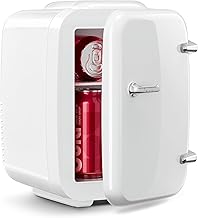
A straightforward, quiet 3.2-cubic-foot box with an adjustable thermostat and a reversible single door, which makes it easy to drop into a tight built-in without redesigning the opening. The energy draw is modest enough to run off a shared circuit in a home office or studio.
Magic Chef 3.2 Cu. Ft. Stainless Mini Fridge
The stainless finish is the draw here, and it plays well against walnut, white oak, or painted MDF if you are wrapping the unit in a custom surround. Interior organization is sensible, and the all-refrigerator design means the full 3.2 cubic feet is actually usable.
COWSAR 4.4 Cu. Ft. Mini Fridge
At 4.4 cubic feet, this is the pick when your build has room to spare and you want genuine grocery capacity rather than a can cooler. Removable glass shelves, a reversible door, and a broad thermostat range make it flexible enough for a bedroom, guest suite, or basement bar.
E-Star 3.3 Cu. Ft. Auto-Defrost Fridge
Auto defrost is the headline feature, and it is the right call for any fridge you plan to install semi-permanently in cabinetry. The glass shelf and reversible door round out a unit designed to be forgotten about, which is exactly what you want from an appliance behind a face frame.
BLACK+DECKER 3.2 Cu. Ft. Compact Refrigerator
Energy Star certification, a chiller compartment for short-term cold storage, and a familiar brand backing make the BCRK32V the safe default recommendation. The stainless-look panel resists fingerprints better than gloss white, which matters in a high-traffic shop or dorm setting.
Frequently Asked Questions
Can I build a cabinet around a mini fridge?
Yes, provided you leave ventilation gaps. Give the rear at least two inches, keep the sides open by an inch, and never seal the top. A toe-kick vent or an open back panel keeps the compressor from working itself to death.
Does a no-freezer fridge get cold enough for food?
Absolutely. All-refrigerator models hold standard refrigeration temperatures, typically in the mid-30s to low-40s Fahrenheit. They simply will not freeze anything, which is the point.
How do I stop the fridge from rattling in a built-in?
Level it first using the adjustable front feet, then check that no part of the cabinet touches the cabinet sides. Adding a felt or rubber pad under the base kills most transmitted vibration.
How long should I wait before plugging it in?
Let the unit stand upright for at least four hours after delivery so the refrigerant and compressor oil settle. Rushing this step is the most common cause of a new fridge that never quite cools right.
Final Thoughts
For most builds, the BLACK+DECKER BCRK32V is the dependable starting point thanks to its Energy Star rating and easy-to-finish stainless look. Choose the E-Star 3.3 if the fridge is going behind cabinetry and you would rather never defrost it by hand, or step up to the COWSAR 4.4 when your opening can accommodate a larger box and you want real shelf space to work with.