Key takeaways
- Measure the enclosure, not the fridge: Take the appliance’s listed dimensions and add at least two inches at the rear and one inch on each side for airflow. Boxing a compressor in tight is the fastest way to shorten its life and raise your energy draw.
- Check the hinge situation: A reversible single door is worth real money in a built-in. Confirm the hinge kit ships in the box and that the handle mounts on both sides, otherwise you will be drilling your own pilot holes.
- Auto defrost versus manual: Freezerless units with auto defrost route condensate to a drip pan over the compressor and evaporate it. Manual-defrost boxes mean scheduled downtime, which is a nuisance in a finished cabinet you cannot easily pull out.
- Shelf material and adjustability: Tempered glass shelves clean up better than wire and support a full growler or a covered casserole. Removable shelves let you clear the whole cavity for tall bottles, which wire racks rarely allow.
- Noise and placement:strong> Compressor hum that disappears in a garage becomes obvious in a bedroom or home office. Decoupling the unit from the framing with rubber feet or a strip of dense foam under the base does more for perceived noise than any spec sheet number.
What's inside
Anyone who has tried to build a beverage station into a cabinet run knows the frustration: nearly every compact fridge on the shelf wastes a third of its interior on a tiny freezer box that frosts over, drips onto the shelf below, and never actually freezes anything properly. You end up with a fridge that holds six cans and a sad ice tray. If you are fitting a unit under a countertop, into a media wall, or behind a plywood face frame you built yourself, that lost cubic footage matters more than a feature you will never use.
This guide covers freezerless compact refrigerators from a builder’s perspective: how much usable interior you actually get, what clearances the compressor needs so you do not cook it inside a tight enclosure, which doors reverse cleanly for awkward corners, and where a two-door model still makes sense. We also flag a couple of larger units worth knowing about if your project ends up growing past the mini-fridge category, which happens more often than people expect once they start cutting plywood.
As an Amazon Associate we earn from qualifying purchases.


How to Choose a Mini Fridge Without Freezer (2026)
- Measure the enclosure, not the fridge: Take the appliance’s listed dimensions and add at least two inches at the rear and one inch on each side for airflow. Boxing a compressor in tight is the fastest way to shorten its life and raise your energy draw.
- Check the hinge situation: A reversible single door is worth real money in a built-in. Confirm the hinge kit ships in the box and that the handle mounts on both sides, otherwise you will be drilling your own pilot holes.
- Auto defrost versus manual: Freezerless units with auto defrost route condensate to a drip pan over the compressor and evaporate it. Manual-defrost boxes mean scheduled downtime, which is a nuisance in a finished cabinet you cannot easily pull out.
- Shelf material and adjustability: Tempered glass shelves clean up better than wire and support a full growler or a covered casserole. Removable shelves let you clear the whole cavity for tall bottles, which wire racks rarely allow.
- Noise and placement:strong> Compressor hum that disappears in a garage becomes obvious in a bedroom or home office. Decoupling the unit from the framing with rubber feet or a strip of dense foam under the base does more for perceived noise than any spec sheet number.
The Best Mini Fridges Without Freezer (2026) Reviewed
E-Star 3.3 Cu Ft Mini Fridge without Freezer
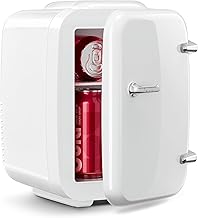
This is the cleanest answer for a bedroom, dorm, or office nook: 3.3 cubic feet of uninterrupted cold space, auto defrost so you are not scraping ice in a built-in cavity, and a reversible single door that swings whichever way your layout demands. The glass shelf wipes down easily, and the flat top gives you a usable surface if you are not enclosing it.
COWSAR 4.4 Cu.Ft Mini Fridge without Freezer
Step up to 4.4 cubic feet and you gain enough height for gallon jugs and tall bottles standing upright, which is the difference between a beverage fridge and an actual second refrigerator. The adjustable thermostat, removable glass shelves, and reversible door make it the more flexible choice for undercounter work, and the black finish disappears behind a dark face frame.
Frigidaire EFR840 Retro Mini Fridge
If you want the mint retro look as a design element rather than something to hide, this 3.2 cubic foot two-door unit earns its place, and the side-mounted bottle opener is a genuinely useful touch on a bar build. Note that it does include a small freezer compartment, so choose it for the aesthetic and the door layout, not for maximum fridge volume.
Antarctic Star Compact Mini Fridge with Freezer
At 2.5 cubic feet this is the smallest footprint here, which makes it the pick when your cavity is already framed and you have no room to negotiate. The separate top compartment keeps the cold zone away from your produce, and the removable shelves help you make the most of a genuinely tight interior.
LRAIN 16 Cu. Ft. French Door Refrigerator
Included for the project that outgrows its brief: if your pantry conversion or garage build has more space than you thought, this frost-free french door unit with an ice maker and bottom freezer drawer covers the full-size job in a stainless look. Worth pricing out before you commit to two mini fridges.
Frequently Asked Questions
Can I build a mini fridge into cabinetry?
Yes, provided you leave a ventilation path. Most compact units exhaust heat out the back and sides, so a fully sealed box will trap it. Cut a vent in the toe kick and another near the top of the cabinet, or leave the back open to the wall cavity.
Do freezerless mini fridges get cold enough for food storage?
They do. Freezerless designs typically hold a steadier temperature than two-door compacts because there is no freezer compartment competing for cold air. Set the thermostat to keep the interior between 35 and 38 degrees Fahrenheit and verify it with an inexpensive appliance thermometer.
How much clearance does the door need to swing?
Plan for the door to open at least 90 degrees, and add the door thickness plus handle projection to your layout drawing. This is where a reversible hinge pays off, since flipping the swing often lets you avoid rebuilding a wall of cabinets.
Can a mini fridge run in an unheated garage?
Compact refrigerators generally want ambient temperatures above roughly 55 degrees to cycle properly. For unheated spaces, a garage-rated appliance such as a convertible upright freezer that can run as a refrigerator, like the 14.0 Cu.Ft. frost-free model, is the more reliable route.
Final Thoughts
For most builds, the E-Star 3.3 Cu Ft is the straightforward pick: all fridge, auto defrost, reversible door, easy to plan around. If your opening allows a bit more depth, the COWSAR 4.4 Cu.Ft buys you real capacity and tall-bottle clearance for a modest increase in footprint. And when the look matters as much as the volume, the Frigidaire EFR840 retro model is the one worth showing off rather than hiding behind a panel.