Key takeaways
- Best for compact storage between jobs: A QuickJack-style portable, frame-engaging lift. Its paired lifting frames can be stored separately, but setup involves positioning them correctly and connecting the hydraulic system.
- Best for brake and wheel work: A low-rise scissor lift or portable frame lift with enough clearance for your specific tasks. Confirm whether the design leaves the wheels free; some scissor lifts support the vehicle beneath the chassis and are not ideal for every wheel-service job.
- Best for regular under-car access: A portable or movable four-post lift, if the garage has enough length, ceiling height, and floor space for ramps and approach.
- Best for an unusually heavy vehicle: A lift rated above the vehicle’s actual operating weight, with compatible lifting points and adequate capacity per ramp or platform. A high headline rating alone does not establish compatibility.
Best Portable Car Lifts for Home Garages
The best portable car lift for a home garage is a four-post lift if you need stable, repeatable parking or maintenance space and have room to keep it assembled; for occasional under-car work in a smaller garage, a scissor-style or QuickJack portable lift is easier to store. Before choosing, check your vehicle’s weight and lifting points, the lift’s usable height, and the clearance your garage needs—not just its advertised capacity.
Portable lifts are not interchangeable. A low-rise scissor lift may raise a car enough for wheels and brakes but leave little room underneath. A four-post lift takes up a permanent parking footprint, yet can be easier to drive onto and useful for storing a second vehicle. “Portable” generally means movable or relocatable, not light enough to carry or simple to set up alone.
Our top picks
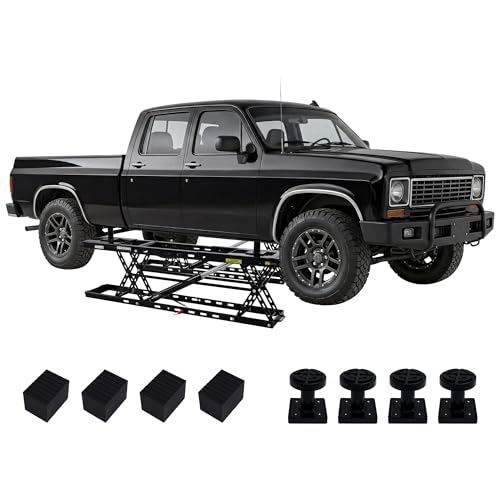


As an Amazon Associate we earn from qualifying purchases at no extra cost to you. Ratings are shown as listed on Amazon.
Quick picks by garage and job
- Best for compact storage between jobs: A QuickJack-style portable, frame-engaging lift. Its paired lifting frames can be stored separately, but setup involves positioning them correctly and connecting the hydraulic system.
- Best for brake and wheel work: A low-rise scissor lift or portable frame lift with enough clearance for your specific tasks. Confirm whether the design leaves the wheels free; some scissor lifts support the vehicle beneath the chassis and are not ideal for every wheel-service job.
- Best for regular under-car access: A portable or movable four-post lift, if the garage has enough length, ceiling height, and floor space for ramps and approach.
- Best for an unusually heavy vehicle: A lift rated above the vehicle’s actual operating weight, with compatible lifting points and adequate capacity per ramp or platform. A high headline rating alone does not establish compatibility.
Compare the main lift types
| Lift type | Typical rated capacity | Typical maximum rise | Storage and setup trade-off | Best fit |
|---|---|---|---|---|
| Portable frame-engaging lift, such as QuickJack | About 5,000–7,000 lb, depending on model | Roughly 18–24 in, depending on model and adapters | Frames store separately; requires careful placement, hydraulic connections, and a suitable power source | Occasional service in a garage where floor space must be reclaimed afterward |
| Low-rise scissor lift | About 6,000–7,000 lb for many home-garage models | Often about 20–30 in | Compact compared with a four-post lift, but the folded unit can still be heavy and awkward to move | Wheel, tire, and lower-body work with limited ceiling height |
| Portable or movable four-post lift | About 7,000–9,000 lb for common hobbyist models | Often about 70–80 in of platform rise | Large assembled footprint; some models use caster kits to move only when unloaded and lowered | Frequent maintenance or vehicle storage in a roomy garage |
| Portable single-post lift | Varies widely; commonly around 6,000 lb | Varies by design, often several feet | Requires a carefully prepared installation area and close attention to the manufacturer’s floor requirements | Owners who need deeper access but can meet the model’s installation conditions |
These are broad planning ranges, not specifications for a particular model. Manufacturer ratings, lift height, required adapters, and operating conditions differ. Check the exact manual before purchase; do not treat the maximum rise as usable standing room beneath the vehicle.
Measure your garage before comparing capacity
Start with the vehicle’s curb weight or, better, its actual loaded weight. Include cargo, accessories, and modifications. Choose a lift with a rating comfortably above that figure, and check how the load is distributed. A vehicle below the stated total capacity can still be unsuitable if its wheelbase, track width, frame rails, pinch welds, or lifting points do not match the lift.
Next, measure the vehicle’s lift points and the lift’s contact positions. A frame-engaging lift needs correctly placed adapters and stable contact on approved points. A four-post design must accommodate the vehicle’s wheelbase and tire track on its runways. Low-profile sports cars may need approach ramps; a wide truck may exceed the lift’s usable width even when its weight is within the rating.
Ceiling height determines whether a high-rise lift is useful. Measure from the floor to the lowest obstruction—garage-door tracks, opener, lights, or beams—not just to the ceiling. Also check the door’s travel with a vehicle on the lift. For a four-post lift used to store one car above another, compare the combined height of both vehicles and the lift structure against that lowest obstruction, leaving a safe margin.
Use the lift’s overall dimensions, not only the platform width, to plan the floor. A four-post unit needs space for ramps, posts, and access around the vehicle. A portable frame lift frees the floor after use, but you still need a clear route to slide its frames beneath the car. Garage clutter can make that harder than its small storage footprint suggests.
Match the lift to the space and the work
| Your situation | Likely best direction | What to verify first |
|---|---|---|
| One-car garage that must remain usable for parking | Portable frame-engaging lift that stores in sections | Frame storage dimensions, vehicle lift points, and time and effort needed to position it |
| Low ceiling or garage-door hardware overhead | Low-rise scissor or frame lift | Actual rise and whether it provides enough room for the planned job |
| Two-car garage with frequent repairs or vehicle storage | Four-post lift, if the floor plan and ceiling permit | Overall footprint, approach space, vehicle dimensions, and total stacked height |
| Truck, SUV, or modified vehicle | Model selected for the vehicle’s weight, width, wheelbase, and approved lifting points | Rated capacity, ramp width, adapter range, and clearance for exhaust or body modifications |
| Uneven, cracked, or uncertain concrete | Do not select a lift until the slab is assessed against the lift manual | Concrete thickness, strength, condition, flatness, and any anchoring requirements |
Setup, movement, and upkeep are part of the purchase
Portable frame lifts take less space when stored, but positioning the frames under the vehicle is a real setup step. The lift must sit on a suitable, level surface, with its contact points aligned to the vehicle’s approved lifting locations. Hoses, connectors, and any locking or safety mechanisms must be used as directed. Allow for enough clear floor to place and remove the equipment without dragging hoses under tires or pinch points.
A scissor lift can be simpler to keep in one spot, but its compact outline can hide its weight. Check the shipping and assembled weights, whether a dolly or caster kit is included, and whether the unit may be moved while loaded. Do not assume a lift is safe to roll with a vehicle raised. Four-post lifts are especially difficult to relocate once assembled; “portable” caster systems generally do not make them lightweight or effortless to move.
Before ordering, check the delivery method and access path. A freight pallet may be too large or heavy for a narrow doorway, sloped driveway, or tight turn into the garage. Confirm who unloads the shipment and how the components will reach their installation location. A lift that fits on the garage floor can still be a poor choice if it cannot get through the door.
Inspect hydraulic hoses, fittings, cables, locks, and contact pads at the intervals in the manual. Pads and adapters are common wear items; damaged hoses, bent components, or unreliable safety locks are reasons to stop using the lift until it is repaired. Follow the manufacturer’s instructions for load limits, lock engagement, maintenance, and storage, and never work beneath a vehicle supported only by hydraulic pressure.
Final buying checklist
- Confirm the vehicle’s loaded weight, wheelbase, track width, ground clearance, and approved lifting points.
- Compare the exact model’s rated capacity and maximum rise with the job you intend to do.
- Measure garage ceiling clearance to the lowest obstruction, plus floor space for access and setup.
- Check slab requirements, electrical or hydraulic setup, adapters, and whether installation or anchoring is required.
- Ask for packed dimensions, delivery details, and the equipment needed to move the lift into position.
- Budget for accessories and upkeep. Portable car lifts commonly range from several hundred dollars for simpler low-rise equipment to several thousand for higher-capacity or four-post systems; the exact price depends on capacity, configuration, and included components.
For most space-conscious home garages, a portable frame-engaging lift is the practical starting point for occasional repairs, while a low-rise scissor lift suits jobs that do not require much under-car clearance. Choose a four-post model when regular access or vehicle storage justifies giving it a dedicated footprint. In every case, vehicle fit, slab suitability, and safe setup matter more than choosing the largest capacity number.