Key takeaways
- Routine surface cleanup: favor spring tines, adjustable height, and easy debris collection.
- Occasional heavy thatch: look for both tine and blade options so one machine can handle lighter upkeep and more aggressive work.
- Lawn renovation: prioritize fine depth control and a blade assembly; renovation may also require overseeding and watering, not just raking.
- Limited storage or a difficult route: compare folded dimensions, machine weight, handle design, and whether it can pass through your gate and storage doorway.
Best power rakes: choose by lawn size, thatch depth, and cleanup needs
The best power rake for most homeowners is a walk-behind machine with adjustable working depth and interchangeable spring tines and scarifying blades; choose a wider model for a large, open lawn, and a lighter dethatcher for a small yard or routine maintenance. Before buying, check the manufacturer’s working-width and depth specifications, whether debris is collected or discharged, and whether the machine is intended for your grass type.
Power rake, dethatcher, or scarifier?
These terms overlap in retail listings, so compare the working parts rather than relying on the name. Spring tines comb through the surface and lift loose thatch with less aggressive contact. Rigid blades cut into the thatch layer and, if set too deep, can slice into crowns and roots. A scarifier generally refers to the more aggressive blade action, often used for renovation rather than frequent maintenance.
Our top picks


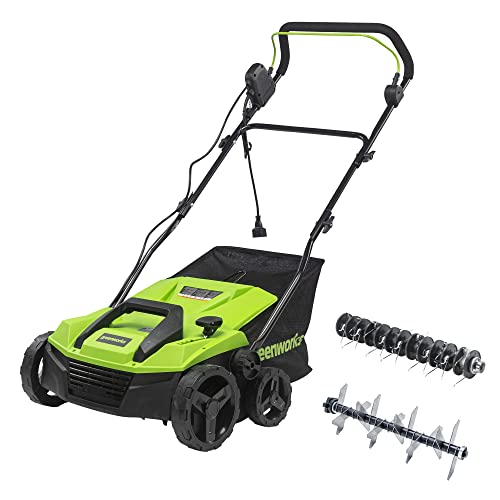
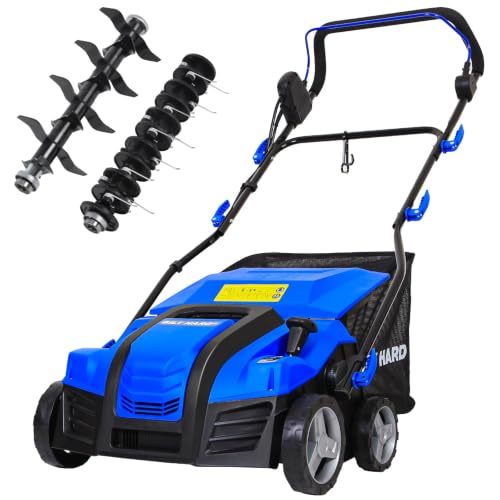
As an Amazon Associate we earn from qualifying purchases at no extra cost to you. Ratings are shown as listed on Amazon.
Thatch is the tightly interwoven layer of stems and roots between green grass and soil—not ordinary clippings sitting on top. If the layer is around ½ inch thick or more, removal may help; confirm by cutting out a small wedge of turf and measuring it. A thin layer does not call for an aggressive pass. Drought-stressed, newly seeded, or dormant lawns are poor candidates for forceful raking.
Compare the features that change the job
| Feature | Typical choices | What they mean in practice |
|---|---|---|
| Working width | About 12–16 in.; 16–18 in.; 18–20 in. | Narrower widths suit tight or divided lawns. Wider widths reduce passes on open ground but need more room to turn and store. |
| Working parts | Spring tines; fixed blades; interchangeable assemblies | Tines are generally gentler for surface thatch. Blades cut more deeply and are better suited to controlled renovation. |
| Depth adjustment | Lever or dial; stepped settings; fixed height | Adjustment makes it easier to start shallow and tune the pass. A fixed-height model offers less control over uneven or sensitive turf. |
| Debris handling | Rear bag; side or rear discharge; separate collection | A bag reduces loose debris but fills quickly in heavy thatch. Discharge is faster for large jobs, followed by raking or mowing to collect. |
Widths above are useful comparison bands, not a promise that every manufacturer offers each size. Always check the exact model’s specifications: published width is the strip covered per pass, not the clearance needed to maneuver it.
Choose by lawn size and thatch severity
| Your situation | Best fit | Why—and what to watch for |
|---|---|---|
| Small lawn, narrow gates, or several obstacles | About 12–16 in. wide, lightweight, with adjustable height | Easier to steer and store. Measure gate openings and the tightest route before buying; leave turning room around beds and trees. |
| Medium lawn with ordinary seasonal thatch | About 16–18 in. wide, spring tines, plus a collection option | A practical balance of coverage and control for a homeowner doing periodic maintenance. |
| Large, open lawn with substantial loose material | About 18–20 in. wide, durable tine assembly, discharge or a large-capacity bag | Covers ground faster, but a small catcher can turn the job into repeated stops. Check machine weight and storage space as well as width. |
| Thick thatch or a lawn being renovated | Adjustable machine that accepts both tines and blades | Begin with the less aggressive attachment or a shallow blade setting, then reassess. Avoid trying to remove the entire layer in one pass. |
Which power-rake style makes sense?
Electric corded: for a small, accessible lawn
A corded unit avoids battery runtime and refueling, and can suit a compact yard near an outdoor outlet. Its limits are the cable, outlet access, and careful cord management around the machine. It is a poor match for a large or obstacle-dense lawn if keeping the cord clear would slow the work or create a hazard.
Battery-powered: for easier movement and storage
Battery models are convenient where a cord would be awkward. Their useful working time depends on the battery, grass conditions, and how aggressively the machine is set; a second compatible battery may matter more than a small difference in working width. Check whether the battery and charger are included and whether they are compatible with tools you already own.
Gas-powered: for larger properties and longer sessions
Gas machines can suit extended jobs where cord length and battery changes are undesirable. The trade-offs are fuel and engine maintenance, noise, exhaust, and heavier handling. For a small suburban lawn, that extra capacity may not justify the upkeep.
Depth adjustment and collection: details worth checking
Depth controls are not directly comparable across brands: one machine’s numbered setting is not necessarily the same actual tine or blade height as another’s. Look for a clear adjustment mechanism and a stated operating range. On the first pass, set the tines to skim the surface or the blades to cut only lightly into the thatch. If soil is being thrown up, roots are tearing out in strips, or the lawn looks scalped, stop and raise the setting.
A catcher is most useful for light-to-moderate debris and lawns where leaving thatch in place is inconvenient. In a heavily matted lawn, it may fill after a short run. Discharge avoids frequent emptying, but plan on a follow-up pass with a rake or mower fitted with a suitable bag. Check whether the catcher comes with the machine, its capacity, and how it attaches; a bag that is difficult to remove can make repeated emptying tedious.
Buy for the job you’ll actually do
- Routine surface cleanup: favor spring tines, adjustable height, and easy debris collection.
- Occasional heavy thatch: look for both tine and blade options so one machine can handle lighter upkeep and more aggressive work.
- Lawn renovation: prioritize fine depth control and a blade assembly; renovation may also require overseeding and watering, not just raking.
- Limited storage or a difficult route: compare folded dimensions, machine weight, handle design, and whether it can pass through your gate and storage doorway.
Maintenance affects durability too. Tines and blades are wear parts and may bend or dull after repeated contact with stones, roots, or hard ground. Check that replacement assemblies are available before purchase. After use, clear packed grass from the underside, inspect fasteners and the working assembly, and store the machine dry. A model that is simple to clean and has replaceable wear parts is often a better long-term choice than one selected on width alone.
Bottom line
For a small lawn, prioritize maneuverability and shallow adjustment. For a medium yard, a mid-width dethatcher with spring tines and a practical catcher is a versatile choice. For a large lawn or serious renovation, prioritize a wider machine with interchangeable tines and blades, precise depth control, and a debris plan that will not require constant stopping. Match the tool to the measured thatch layer and turf condition—not simply to the most aggressive setting or widest deck.