Key takeaways
- Flow before pressure: GPM moves soap and rinses panels; PSI just concentrates force. A 1.4 GPM unit at 2000 PSI will out-detail a 3000 PSI machine that starves for water. Target 1.4 to 2.0 GPM and let pressure fall where it may.
- Power source honesty: Electric means 13 to 15 amps of clean current, which many residential outdoor outlets won’t deliver through a 100-foot cord. Gas frees you from that entirely but adds fuel storage, noise ordinances, and a pull-start ritual on cold mornings.
- Pump type and rebuildability: Axial pumps are sealed and cheap to replace but not to repair. Triplex pumps cost more upfront and let you swap seals on your own bench. For daily commercial cycles, rebuildability pays for itself inside a season.
- Chassis and transport reality: Weigh the machine, then imagine lifting it into a van bed forty times. Look for a welded frame, pneumatic or solid wheels sized for gravel, and a handle that doesn’t fold under load. Plastic shrouds crack; steel roll cages don’t.
- Foam cannon compatibility: Check the inlet fitting and minimum GPM your cannon needs. Onboard detergent tanks are convenient for downstream soap but produce thin lather compared to a proper high-pressure cannon on a quick-connect.
Mobile detailing lives or dies on your water setup. You pull into a driveway, unspool the hose, and discover the customer’s spigot trickles at four gallons a minute while your machine wants six. Or you’re running a generator that browns out the second the motor kicks on. Anyone who has rebuilt a pump in a parking lot knows the real spec sheet isn’t PSI at all — it’s flow rate, duty cycle, and whether the thing survives being loaded and unloaded thirty times a week.
This guide comes from a maker’s bench, not a marketing deck. I’ve cracked open unloader valves, swapped brass quick-connects for stainless, and learned the hard way which chassis bends when you strap it to a trailer rail. Below are six pressure washers worth considering for detailing work in 2026, plus the selection criteria that actually matter when your income depends on the machine starting. If you also refinish teak patio sets or strip paint from furniture between jobs, several of these pull double duty nicely.
Our top picks


As an Amazon Associate we earn from qualifying purchases at no extra cost to you. Ratings are shown as listed on Amazon.
🛒 Best Price Today on Amazon
Prime members get fast, free shipping on everything above, plus member-only deals. New members get a 30-day free trial — cancel anytime.
How to Choose a Pressure Washer For Mobile Detailing (2026)
- Flow before pressure: GPM moves soap and rinses panels; PSI just concentrates force. A 1.4 GPM unit at 2000 PSI will out-detail a 3000 PSI machine that starves for water. Target 1.4 to 2.0 GPM and let pressure fall where it may.
- Power source honesty: Electric means 13 to 15 amps of clean current, which many residential outdoor outlets won’t deliver through a 100-foot cord. Gas frees you from that entirely but adds fuel storage, noise ordinances, and a pull-start ritual on cold mornings.
- Pump type and rebuildability: Axial pumps are sealed and cheap to replace but not to repair. Triplex pumps cost more upfront and let you swap seals on your own bench. For daily commercial cycles, rebuildability pays for itself inside a season.
- Chassis and transport reality: Weigh the machine, then imagine lifting it into a van bed forty times. Look for a welded frame, pneumatic or solid wheels sized for gravel, and a handle that doesn’t fold under load. Plastic shrouds crack; steel roll cages don’t.
- Foam cannon compatibility: Check the inlet fitting and minimum GPM your cannon needs. Onboard detergent tanks are convenient for downstream soap but produce thin lather compared to a proper high-pressure cannon on a quick-connect.
The Best Pressure Washer For Mobile Detailing (2026)s Reviewed
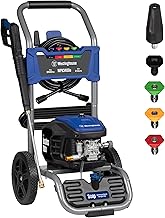
Westinghouse WPX3400e Electric
The brushless motor is the story here — it runs quieter, draws current more smoothly, and skips the carbon brush wear that kills cheaper induction units around the two-year mark. At 2.0 GPM it has genuine rinsing muscle for an electric, though you’ll want a dedicated 20-amp circuit and a short, heavy-gauge cord to keep voltage from sagging.
Westinghouse WPX3400 Gas
2.6 GPM is where mobile detailing gets comfortable: soap flows fast, rinse cycles shorten, and you’re never tethered to a customer’s electrical panel. The tradeoff is upkeep — oil changes, stabilized fuel, and enough noise that you’ll want to check local rules before doing early-morning driveway work in a tight neighborhood.
Sun Joe SPX3000
The PWMA-rated 2030 PSI is the honest number, and it’s plenty for automotive paint. Dual detergent tanks let you stage wheel cleaner and body soap without swapping bottles mid-job, which is a small workflow win that adds up across five cars a day.
Active 2.0 Electric
Purpose-built for detailing rather than adapted from a deck-cleaning machine, this one pairs 2.0 GPM with a deliberately modest 1800 peak PSI — the right priority order for clearcoat. It’s the pick if foam thickness and gentle rinsing matter more to you than blasting concrete.
CRAFTSMAN CMEPW1700
At 1700 PSI and 1.2 GPM, this is the lightweight backup or apartment-friendly starter, not the workhorse. What it does well is fit anywhere and start instantly, making it a smart second unit for interior-heavy jobs or touch-up visits.
Frequently Asked Questions
How much PSI is safe on automotive paint?
Keep working pressure between 1200 and 1900 PSI at the surface, using a 40-degree nozzle and a foot of standoff. Damage almost always comes from a narrow tip held too close, not from the machine’s rating.
Can I run a pressure washer off a portable generator?
Yes, with headroom. Electric motors draw a heavy startup surge, so size the generator to roughly double the running wattage on the nameplate. Undersizing causes voltage drop that cooks motor windings over time.
Do I need a water tank for mobile work?
If you can’t rely on customer spigots, a 35 to 65 gallon tank with a float valve keeps your pump fed at consistent pressure. Add an inline filter — grit is the single biggest killer of pump seals.
How do I winterize between jobs in cold weather?
Run pump antifreeze through the inlet until it exits the wand, then store the unit above freezing if possible. A single hard freeze with water trapped in the manifold can crack a pump head permanently.
Final Thoughts
For full-time mobile detailing where flow rate rules, the Westinghouse WPX3400 gas unit at 2.6 GPM gives you independence from unreliable outlets and cuts rinse time on every vehicle. If you’d rather stay electric and quiet, the WPX3400e brushless is the more durable long-term investment, while the Active 2.0 is the specialist’s choice — tuned for foam and paint safety rather than raw pressure numbers.