Our Top Picks
 Silky GomBoy Curve Professional Folding Saw 240mm240mm19.7 x 2.36 x 0.8 inches0.93 poundsCheck on Amazon
 Silky Professional Series PocketBoy Folding Saw 170mm Largeone_size7.25 x 2.75 x 1 inches0.66 poundsCheck on Amazon

Every yard reaches the moment when bypass shears stop being enough. A dead limb on the apple tree, a storm-torn branch hanging over the fence, an overgrown lilac that loppers can no longer close around: once wood passes roughly an inch and a half thick, the right tool is a pruning saw. Unlike the pruning shears already covered on this site, which snip small live stems, a pruning saw uses a long toothed blade to work through larger limbs with a series of controlled strokes, leaving a clean cut that heals well.
The five saws below cover the main shapes a home gardener is likely to want: a fixed curved blade for serious tree work, folding saws that ride in a pocket or tool bucket, and compact models for tight canopies. Each one cuts on the pull stroke unless noted, and each one was chosen for a clear job rather than as a near-duplicate of the next pick.
Disclosure: As an Amazon Associate, we earn from qualifying purchases made through links on this page, at no extra cost to you.
How to Choose a Pruning Saw
Match blade length to branch size. A useful rule is that the blade should be at least twice as long as the branch diameter you plan to cut, so the teeth can clear the kerf on each stroke. A 170 mm blade handles limbs up to about 3 inches comfortably, a 240 mm blade suits general work up to 4 or 5 inches, and a 330 mm blade earns its keep on limbs of 6 inches and beyond.
Curved or straight blade. Curved blades hook onto a branch and pull themselves into the cut, which makes them faster overhead and on larger wood. Straight blades track more precisely and fit into narrow forks where a curve would bind, and they are common on compact folding saws.
Fixed or folding. A fixed blade is always ready and usually ships with a scabbard, but it needs safe storage. A folding saw tucks the teeth into the handle, travels in a pocket, and suits mixed sessions where you switch between shears, loppers, and saw work.
Tooth count and tooth style. Coarse teeth, around 6 to 7 per inch, clear green wood quickly and resist clogging with sap. Finer teeth, around 8 to 10 per inch, leave a smoother finish on dry or hard wood but work more slowly. Impulse-hardened teeth hold an edge far longer than conventional teeth, though they cannot be resharpened with a file; when they dull, the blade is replaced.
Carry and upkeep. Look for a scabbard, a hard case, or a locking fold so the teeth stay covered between jobs. Wipe sap off the blade after use, and check whether a replacement blade is sold for the model you pick, since a fresh blade restores a good saw to full speed for years.
The 5 Best Pruning Saws
1. Silky Zubat Professional Curved Hand Saw 330mm (270-33)

The Zubat is the fixed-blade benchmark that arborists reach for, and it is the pick here for anyone with mature trees. Its 330 mm curved blade is mono-constructed, taper-ground, and hard chrome-plated, with impulse-hardened teeth in Silky’s MIRAI-ME pattern, ground with four cutting angles for a fast, smooth pull stroke. The curve keeps the blade seated in the kerf on overhead cuts, so long limbs come down with fewer strokes and less arm fatigue.
A molded rubber handle with a lanyard hole gives a secure grip, and the saw rides in a black polypropylene scabbard with a detachable belt holder, so it stays at your hip while you move between trees. Replacement blades are widely available, which makes the Zubat a long-term tool rather than a disposable one.
Specs
- Model: 270-33
- Blade: 330 mm (13 in) curved, taper-ground, hard chrome-plated
- Teeth: 6.4 per inch, impulse-hardened, non-set MIRAI-ME pattern
- Blade thickness: 1.5 mm
- Overall length: 18.75 in
- Handle: molded rubber with lanyard hole
- Carry: polypropylene scabbard with detachable belt holder
- Weight: not published
2. Silky GomBoy Curve Professional Folding Saw 240mm (717-24)
The GomBoy Curve takes the folding format and adds a gently curved blade, which gives it a more aggressive bite in green wood than straight folding saws of the same size. The 240 mm blade uses large teeth at 8 per 30 mm, impulse-hardened and chrome-plated, and it folds into a yellow rubber handle that is easy to spot in grass or leaf litter.
Silky ships this saw with a clear hard plastic case, so it can live in a tool bag or truck box without dulling against other gear. With a published cutting capacity of about 4.7 inches, it covers most routine pruning around a home garden while staying compact enough to carry all day.
Specs
- Model: 717-24
- Blade: 240 mm (9.5 in) curved, folding
- Teeth: large teeth, 8 per 30 mm, impulse-hardened
- Blade thickness: 1.4 mm
- Cutting capacity: about 4.7 in
- Handle: yellow GOM rubber
- Carry: clear hard plastic case included
- Weight: not published
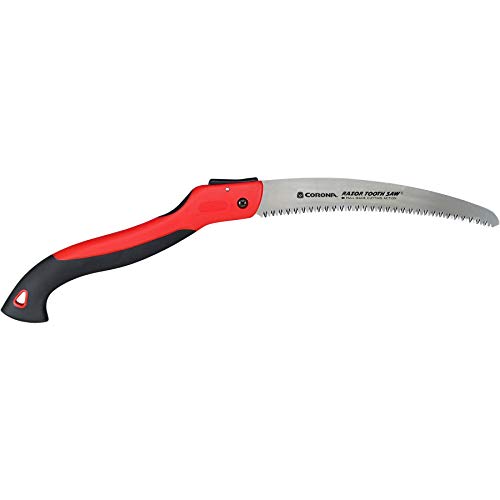
3. Corona RazorTOOTH Folding Pruning Saw 10 Inch (RS 7265)
Corona’s folding RazorTOOTH is the widely available garden-store option, built around a 10-inch curved blade with triple-ground teeth. Each tooth is ground on three sides, so the blade removes more material per pull and finishes cuts through branches up to 6 inches in diameter at roughly twice the pace of a conventional tooth pattern, according to the maker.
The blade is chrome-plated and taper-ground, the teeth are impulse-hardened, and the co-molded handle is shaped for one-handed use with a secure latch that keeps the blade closed in a bucket or apron pocket. The blade is replaceable, which extends the working life of the tool well past the first dull edge.
Specs
- Model: RS 7265
- Blade: 10 in curved, folding, chrome-plated, taper-ground
- Teeth: 6 per inch, triple-ground, impulse-hardened
- Cutting capacity: up to 6 in diameter
- Handle: co-molded ergonomic grip
- Blade: replaceable
- Weight: not published
4. Bahco 396-LAP Laplander Folding Saw
The Laplander is a Swedish-made folding saw with a straight 190 mm blade and XT toothing at 7 teeth per inch. It cuts on both the push and the pull, which sets it apart from the Japanese pull-only designs above and makes it forgiving for occasional users. The blade carries a low-friction coating that guards against rust and helps it glide through green and dry wood alike.
A two-component handle with a leather wrist strap keeps the saw in hand on a ladder, and a safety lock secures the blade both open and folded. At 200 g it disappears into a jacket pocket, and a replacement blade (396-BLADE) is sold separately for when the original finally dulls.
Specs
- Model: 396-LAP
- Blade: 190 mm (7.5 in) straight, folding, low-friction rust-protection coating
- Teeth: XT toothing, 7 per inch, cuts on push and pull
- Length: 405 mm open, 230 mm folded
- Handle: two-component plastic with leather wrist strap
- Lock: safety lock for open and folded positions
- Weight: 200 g (7.1 oz)
5. Silky PocketBoy Folding Saw 170mm Large Teeth (346-17)
The PocketBoy is the compact option for gardeners who want a saw within reach at all times. Its 170 mm straight blade folds into a color-coded red handle, and the large-teeth configuration at 8 per 30 mm is tuned for green wood and general pruning rather than fine finish work. The taper-ground blade is hard chrome-plated with impulse-hardened, non-set teeth.
Two locking positions let you angle the blade for flush cuts or work in tight forks, and the saw comes in a clear flip-lock case with a belt clip. It is the lightest-duty pick in this group, best kept for limbs up to about 3 inches, but it is also the one most likely to be in your pocket when a small job appears.
Specs
- Model: 346-17
- Blade: 170 mm (6.75 in) straight, folding, hard chrome-plated, taper-ground
- Teeth: large teeth, 8 per 30 mm (6.8 per inch), impulse-hardened, non-set
- Blade thickness: 1.4 mm
- Lock: two locking positions
- Carry: clear flip-lock case with belt clip
- Weight: not published
Comparison Table
| Saw | Type | Blade | Teeth | Best for |
|---|---|---|---|---|
| Silky Zubat 270-33 | Fixed, curved | 330 mm | 6.4 per inch | Large limbs and tree work |
| Silky GomBoy Curve 717-24 | Folding, curved | 240 mm | 8 per 30 mm | General pruning, all-day carry |
| Corona RazorTOOTH RS 7265 | Folding, curved | 10 in | 6 per inch | Fast cuts up to 6 in branches |
| Bahco 396-LAP Laplander | Folding, straight | 190 mm | 7 per inch | Pocket carry, push-and-pull cutting |
| Silky PocketBoy 346-17 | Folding, straight | 170 mm | 8 per 30 mm | Small limbs and tight canopies |
FAQ
What size pruning saw do I need for fruit trees?
For most home orchards, a blade between 240 mm and 330 mm covers the work. Choose a blade at least twice as long as the thickest limb you expect to cut, and lean toward the longer end if your trees are mature and you often remove scaffold limbs rather than small laterals.
Can a pruning saw replace loppers?
No, the two tools cover different ranges. Loppers handle live stems up to about 1.5 to 2 inches with a clean squeezing cut, while a saw takes over on thicker wood where lopper jaws will not close. Most gardeners end up owning both and switching based on branch diameter.
Why do most pruning saws cut on the pull stroke?
A blade under tension on the pull stays straight and resists buckling, so it can be thinner and still track well. A thin blade removes less material per pass, which means less effort and a narrower kerf. The Bahco above is the exception in this group, with teeth shaped to cut in both directions.
How do I cut a large branch without tearing the bark?
Use the three-cut method. First, make a shallow undercut a few inches out from the branch collar. Second, cut from the top just beyond that undercut so the limb drops without stripping bark. Third, make the final cut just outside the collar at a slight angle, leaving the collar intact so the wound can close.
Can I sharpen a pruning saw blade?
Conventional teeth can be touched up with a slim file, but impulse-hardened teeth, like those on the Silky and Corona picks here, are too hard for a file and are not meant to be sharpened. When one of those blades slows down, fit a replacement blade; every model in this guide has one available.
Conclusion
If you prune mature trees and want one saw that handles the biggest limbs, the Silky Zubat 270-33 is the standout pick, with the GomBoy Curve close behind for anyone who prefers a folding tool. The Corona RazorTOOTH folding saw covers everyday garden work with a blade found in almost any tool aisle, the Bahco Laplander adds push-and-pull cutting in a pocketable Swedish design, and the PocketBoy keeps a capable small saw on your belt for quick jobs. Match the blade to the thickest branch you realistically cut, keep the teeth covered between sessions, and any of these five will leave cleaner cuts than forcing shears or loppers past their limit.
More from Amazon
Programs that pair well with the guide above. Offers and eligibility are set by Amazon and may change.
A free business account with business pricing and bulk-buying tools for work, shop or home office.
Create a business accountFree shipping on eligible items, Prime Video and more. Eligible new members can start with a free trial.
Start a Prime free trialAudiobooks and podcasts to listen to on the go. Eligible new members can start with a free trial.
Try Audible freeAd-free music streaming. Eligible new subscribers can start with a free trial.
Try Music Unlimited freeAs an Amazon Associate we earn from qualifying purchases.