Our Short List of 3

- Power source: Pneumatic
- Coil angle: 15 degrees
- Nail length: 3/4 to 1-3/4 in
- Shank diameter: 0.120 in

- Power source: Pneumatic
- Coil angle: 16 degrees
- Nail length: 7/8 to 1-3/4 in
- Shank diameter: 0.120 in
- Power source: Pneumatic
- Coil angle: 15 degrees
- Nail length: 3/4 to 1-3/4 in
- Shank diameter: 0.120 in
All 5 Picks at a Glance
| Product | Specs | Action |
|---|---|---|
| 1. Bostitch RN46-1 Coil Roofing Nailer |
| Check price on Amazon |
| 2. Metabo HPT NV45AB2 Coil Roofing Nailer |
| Check price on Amazon |
| 3. MAX USA CN445R3 SuperRoofer Coil Nailer |
| Check price on Amazon |
 4. DeWalt DCN45RNB 20V MAX Cordless Coil Roofing Nailer |
| Check price on Amazon |
 5. Makita AN454 Coil Roofing Nailer |
| Check price on Amazon |
Our Top Picks
A roofing nailer is a specialist tool built for one job: driving wide-head roofing nails through shingles, felt and insulation board as fast as you can move along a course. Every model here feeds from a round coil canister holding about 120 wire-collated nails, so you reload far less often than with a stick magazine. That design sets it apart from other nail guns you may own. A brad nailer drives thin 18-gauge pins for trim and cannot hold a shingle. A palm nailer drives one loose nail at a time in tight framing spots. A flooring nailer is mallet-driven and built for tongue-and-groove boards, a completely different tool we covered in our flooring nailers guide. None of those can substitute for a coil roofing gun on a roof.
This guide compares five roofing nailers from Bostitch, Metabo HPT, MAX USA, DeWalt and Makita. Four are pneumatic; one, the DeWalt, is a cordless 20V MAX tool that leaves the hose on the ground. All five drive standard coil roofing nails in the common 3/4 inch to 1-3/4 inch range (the Metabo HPT begins at 7/8 inch) with 0.120 inch shanks. The differences that matter are weight, depth control, firing speed, jam clearing and how the tool behaves after hours of tar and grit.
Disclosure: As an Amazon Associate, we earn from qualifying purchases made through links on this page, at no extra cost to you.
How to Choose a Roofing Nailer
Power source. Pneumatic tools are lighter and fire all day as long as the compressor keeps up, but you drag a hose across the roof on every course. A cordless nailer removes the hose and compressor, a real help on repairs and small roofs, yet it weighs more and depends on charged packs.
Nail range and collation. Roofing nails for asphalt shingles usually run from 7/8 inch to 1-3/4 inches, with 1-1/4 inch the everyday length over decking. Coil angle is 15 degrees on most tools and 16 degrees on the Metabo HPT; both use widely stocked wire-collated coils, so check the coil box matches your tool. Every pick here holds 120 nails per coil.
Weight and balance. You hold this tool at arm’s length on a slope for hours. The spread here runs from 5.2 to 6.7 pounds before nails, hose or battery, and half a pound is easy to feel by mid-afternoon. A compact body also helps around chimneys and valleys.
Depth adjustment. Nails must sit flush: driven too deep, they cut the shingle mat; left proud, they telegraph through the course above and can back out. A tool-free depth dial lets you correct depth on the fly as decking density changes.
Actuation and clearing jams. Roofing guns fire in contact (bump) mode for speed, and some add a sequential mode for careful placement. Tar, grit and the odd bent nail will jam any tool eventually, so a nose or latch that opens quickly for clearing is worth having. A shingle guide hooks the edge of the course below and keeps exposure even without measuring each row.
Compressor match. A pneumatic tool needs 70 to 120 PSI and a compressor that can sustain airflow while you bump-fire along a course. A small pancake compressor can run one gun for DIY work if you pace yourself; crews need a larger unit.
1. Bostitch RN46-1 Coil Roofing Nailer
- Power source: Pneumatic
- Coil angle: 15 degrees
- Nail length: 3/4 to 1-3/4 in
- Shank diameter: 0.120 in
The RN46-1 is the long-running benchmark in this category, a pneumatic coil nailer that has been a default choice for shingle crews and serious DIY roofers for years. Its aluminum housing keeps weight at 5.5 pounds, and Bostitch gives it a driving power figure of 410 inch-pounds at 100 PSI, plenty for seating nails through architectural shingles and decking.
Depth control is a tool-free dial, so you can fine-tune as you move between the field of the roof and denser areas near the eaves. An adjustable shingle guide holds a consistent exposure from course to course. The canister takes 120 nails from 3/4 inch to 1-3/4 inches, from short nails for underlayment to the longest fasteners used on thick laminated shingles. For a homeowner re-roofing a house or garage, this is the safe, proven pick: parts and service knowledge are everywhere because so many are in use.
2. Metabo HPT NV45AB2 Coil Roofing Nailer
- Power source: Pneumatic
- Coil angle: 16 degrees
- Nail length: 7/8 to 1-3/4 in
- Shank diameter: 0.120 in
The NV45AB2, descended from the well-known Hitachi design of the same model number, is the speed pick in this group. Its cylinder valve drive gives a fast, crisp response, and Metabo HPT puts the firing pace at up to 3 nails per second. The side-loading magazine refills quickly, which matters when you burn through coils all day.
At 5.5 pounds it ties the Bostitch on weight, and small details aim at durability: a carbide-tipped push lever that wears slowly, plus rubber pads that protect the body when set down on shingles. Depth of drive adjusts without tools. One quirk is the nail range, which begins at 7/8 inch rather than 3/4 inch; that covers standard shingle work but rules out the shortest nails. The coil angle is 16 degrees, so buy coils marked for this tool. A 5-year warranty from the maker rounds out a package aimed at people who roof often.
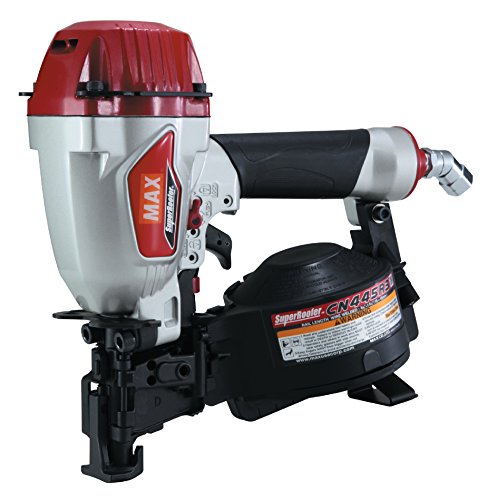
3. MAX USA CN445R3 SuperRoofer Coil Nailer
- Power source: Pneumatic
- Coil angle: 15 degrees
- Nail length: 3/4 to 1-3/4 in
- Shank diameter: 0.120 in
MAX built the first coil roofing nailer decades ago, and the CN445R3 SuperRoofer is its current model, aimed squarely at daily professional use. Its design focuses on the two things that kill roofing guns: tar buildup and wear at the nose. A tar-resistant nose, a removable contact foot and a self-cleaning end cap make the tool easier to keep running on hot, dirty roofs, and the maker backs it with a 5-year warranty.
The CN445R3 weighs 5.6 pounds, fires in contact actuation mode and drives the full 3/4 to 1-3/4 inch range on a 15-degree coil. A swivel air fitting helps the hose hang without twisting the tool in your hand. If your roofing work is frequent enough that cleaning time and downtime cost real money, this pick is built around reducing both.
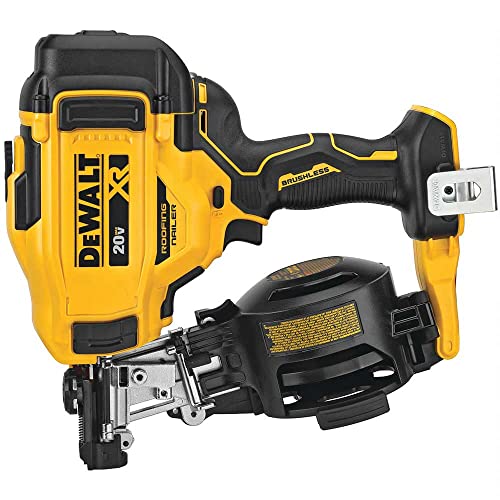
4. DeWalt DCN45RNB 20V MAX Cordless Coil Roofing Nailer
- Power source: Cordless, 20V MAX battery
- Motor: Brushless
- Coil angle: 15 degrees
- Nail length: 3/4 to 1-3/4 in
The DCN45RNB is the hose-free option. A brushless motor on the DeWalt 20V MAX platform drives the same 15-degree coil nails as the air tools, from 3/4 inch to 1-3/4 inches, with a canister holding up to 120 nails. There is no compressor to haul and no hose to snag on a ridge cap or manage on a ladder, which makes this tool genuinely handy for repairs, small roofs and finishing work.
DeWalt cites up to 3 nails per second in bump mode and up to 500 nails per charge with a 2.0Ah pack, roughly one square of asphalt shingles per charge. The nail tray adjusts without tools for different nail lengths, and a stall release lever returns the driver blade by hand if the tool stalls. Trade-offs are weight and runtime planning: at 6.7 pounds for the bare tool it is the heaviest pick here once a battery is added, and a full re-roof means rotating several packs. It is sold as a bare tool, so budget for batteries and a charger if you are new to the 20V MAX platform.
5. Makita AN454 Coil Roofing Nailer
- Power source: Pneumatic
- Collation: Wire coil
- Nail length: 3/4 to 1-3/4 in
- Shank diameter: 0.120 in
The AN454 is the lightest tool here at 5.2 pounds, thanks to an aluminum housing, and that alone earns it a look from anyone facing a big roof. Makita pairs the low weight with simple controls: a tool-less depth adjustment dial for flush nailing and an adjustable canister that loads in one step.
A small built-in magnet holds the last nail of a coil in place so it drives cleanly instead of being left behind. The AN454 takes the standard spread of coil roofing nails, 3/4 inch to 1-3/4 inches with 0.120 inch shanks, and runs in the usual 70 to 120 PSI band (0.49 to 0.83 MPa in the maker manual). It comes with an air fitting, hex wrench, oil and safety glasses, covered by a 3-year limited warranty from Makita. If low weight matters more than the extra service features of the MAX, this is the pneumatic pick to choose.
Comparison Table
| Model | Power | Nail length | Capacity | Weight | Standout point |
|---|---|---|---|---|---|
| Bostitch RN46-1 | Pneumatic | 3/4 to 1-3/4 in | 120 | 5.5 lb | Proven all-round pick |
| Metabo HPT NV45AB2 | Pneumatic | 7/8 to 1-3/4 in | 120 | 5.5 lb | Fast firing, side loading |
| MAX USA CN445R3 | Pneumatic | 3/4 to 1-3/4 in | 120 | 5.6 lb | Tar-resistant nose, easy upkeep |
| DeWalt DCN45RNB | Cordless 20V MAX | 3/4 to 1-3/4 in | 120 | 6.7 lb | No hose or compressor |
| Makita AN454 | Pneumatic | 3/4 to 1-3/4 in | 120 | 5.2 lb | Lightest of the five |
Frequently Asked Questions
What size nails does a roofing nailer use?
Roofing nailers drive wire-collated coil nails with wide heads and 0.120 inch shanks. Lengths run from 3/4 inch to 1-3/4 inches; 1-1/4 inch is the common choice for asphalt shingles over standard decking, while longer nails suit thick laminated shingles or re-roofing over an existing layer.
Can I use a roofing nailer for siding or fencing?
Not with the same fasteners or expectations. Siding work calls for longer nails, usually 1-1/4 to 2-1/2 inches, and siding nailers are built around that range. Roofing nails are short and wide-headed because the next shingle course covers them, so keep each tool on its own job.
How big a compressor does a pneumatic roofing nailer need?
The tool itself needs 70 to 120 PSI. For one gun in DIY use, a compact pancake or hot-dog compressor can keep up if you work at a steady pace and let it recover. Continuous bump firing along long courses, or several guns on one supply, calls for a larger compressor with more air storage.
Is a cordless roofing nailer enough for a whole roof?
For repairs and small roofs, yes. The DeWalt here is cited by its maker at up to 500 nails per charge on a 2.0Ah pack, about one square of shingles, so a full house means rotating several charged packs through the day. Crews doing whole roofs daily usually stay pneumatic and keep a cordless gun for small work.
Why do my roofing nails sit too deep or too proud?
Depth problems come from air pressure, the depth dial setting, or changes in decking density. Set the tool-free depth adjustment first, then fine-tune with small pressure changes inside the 70 to 120 PSI band. Test on a scrap of shingle over wood when you move to a new section, because overdriven nails cut the shingle mat and underdriven nails lift the course above.
Conclusion
For most people buying one roofing nailer, the Bostitch RN46-1 is the balanced choice: light, proven and easy to live with. The Metabo HPT NV45AB2 suits anyone who values firing speed and fast reloads, while the MAX CN445R3 is built for heavy use where tar and grit wear tools down. Choose the DeWalt DCN45RNB if cutting the hose matters most and your roofs are small to mid-size, and pick the Makita AN454 if the lowest weight is your priority.
More from Amazon
Programs that pair well with the guide above. Offers and eligibility are set by Amazon and may change.
A free business account with business pricing and bulk-buying tools for work, shop or home office.
Create a business accountFree shipping on eligible items, Prime Video and more. Eligible new members can start with a free trial.
Start a Prime free trialAudiobooks and podcasts to listen to on the go. Eligible new members can start with a free trial.
Try Audible freeAd-free music streaming. Eligible new subscribers can start with a free trial.
Try Music Unlimited freeAs an Amazon Associate we earn from qualifying purchases.