Key takeaways
- Frame material: Solid hardwood or thick multi-ply beats particleboard every time. If the listing says “engineered wood,” assume the corner joints carry the load and check whether they’re doweled and glued or just screwed through the end grain.
- Seat support system: Webbing and sinuous springs both work, but heavier sitters get more life from closely spaced springs over a solid deck. A slatted or plywood base under the cushion prevents the slow sag that no amount of fluffing fixes.
- Foam density, not thickness: A 7-inch cushion at low density collapses faster than a 5-inch cushion at 1.8 lb or higher. High-resilience foam wrapped in fiber gives you the deep-seat feel without the crater.
- Module count and connector type: More modules means more seams to shift. Metal snap connectors or interlocking brackets hold alignment far better than fabric straps or gravity alone, especially if someone sits on the joint between two pieces.
- Covers you can actually remove: Zippered, washable covers matter more on a heavy-use sofa. Check that the zipper runs the full cushion length and that the inner cover is stitched, not glued, so you can re-stuff later.
What's inside
Sit on enough flat-packed furniture and you start reading a spec sheet like a cut list. Where’s the load going? Is that a solid rail or a stapled strip of engineered board? For anyone over roughly 250 lbs, those questions stop being academic. Sectionals fail in predictable places: corner blocks that were never glued, sinuous springs stretched past their tolerance, and 1.2 lb-density foam that turns into a hammock by month four. The seams split, one leg splays, and suddenly the “seats seven” couch has one cushion nobody sits on.
This guide takes a builder’s view of oversized modular sectionals. Rather than counting throw pillows, we looked at frame material, seat-deck construction, per-module footprint, and how the pieces actually connect, since a modular sofa distributes weight completely differently than a one-piece frame. Every pick below is a large-scale modular or sleeper sectional suited to heavier bodies, with notes on what holds up and where you may want to add a bracket or a plywood slat of your own.
As an Amazon Associate we earn from qualifying purchases.


🛒 Best Price Today on Amazon
Prime members get fast, free shipping on everything above, plus member-only deals. New members get a 30-day free trial — cancel anytime.
How to Choose a/an Sectional Sofa For Heavy Person (2026)
- Frame material: Solid hardwood or thick multi-ply beats particleboard every time. If the listing says “engineered wood,” assume the corner joints carry the load and check whether they’re doweled and glued or just screwed through the end grain.
- Seat support system: Webbing and sinuous springs both work, but heavier sitters get more life from closely spaced springs over a solid deck. A slatted or plywood base under the cushion prevents the slow sag that no amount of fluffing fixes.
- Foam density, not thickness: A 7-inch cushion at low density collapses faster than a 5-inch cushion at 1.8 lb or higher. High-resilience foam wrapped in fiber gives you the deep-seat feel without the crater.
- Module count and connector type: More modules means more seams to shift. Metal snap connectors or interlocking brackets hold alignment far better than fabric straps or gravity alone, especially if someone sits on the joint between two pieces.
- Covers you can actually remove: Zippered, washable covers matter more on a heavy-use sofa. Check that the zipper runs the full cushion length and that the inner cover is stitched, not glued, so you can re-stuff later.
The Best Sectional Sofa For Heavy Person (2026)s Reviewed
108″ L-Shaped Modular Sectional with Pull-Out Sleeper, Dark Grey
The seven-seat L configuration spreads load across a wide footprint, and the hidden storage bays double as structural boxes that stiffen the base. Corduroy wears well under friction, and the removable covers make the inevitable spills a laundry problem instead of a replacement problem.
108″ U-Shaped Modular Sleeper Sofa, Dark Gray
The U layout puts two corner modules in play, which is where these sofas usually loosen first, so check and retighten the connectors after the first few weeks. In exchange you get genuinely generous seat depth and a pull-out bed that doesn’t sacrifice the storage compartments.
EEASE Moose Oversized Sectional
The solid wood frame is the headline here, and it’s the right one for heavier sitters; there’s real timber taking the load rather than a laminated shell. Deep seats and washable covers round it out, though plan for two people on assembly day because the modules are dense.
Legend Vansen Oversized Modular Sectional
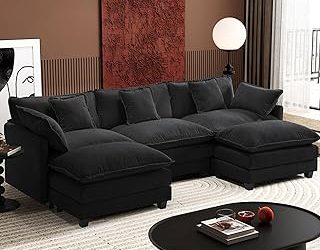
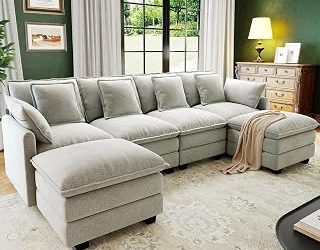
Reversible U or L orientation plus an ottoman gives you the flexibility to put the sturdiest modules where they’ll see the most use. The plush polyester holds shape reasonably well, and the deep seat platform is wide enough that you’re never perched on an edge.
108″ Chenille Cloud Sleeper Sectional with USB
Reclining backrests and USB ports add mechanical complexity, so this is the pick where hardware quality matters most; inspect the recline hinges on arrival. Chenille breathes better than most upholstery under sustained pressure, and the storage plus sleeper combination earns its footprint.
Frequently Asked Questions
What weight can a modular sectional actually hold?
Most oversized modular sofas list 250 to 400 lbs per seat, but the real limit is the weakest connector. Distributed sitting is fine; landing hard on a seam is what breaks things.
Can I reinforce a sectional myself?
Yes, and it’s worth doing. Add a 3/4-inch plywood panel cut to fit the seat deck, and screw steel corner braces into the frame rails where they meet. Ten dollars in hardware buys years.
Are sleeper mechanisms a weak point?
They can be. Pull-out frames add hinges and folding legs, so avoid using the open bed as seating and keep the center support leg making full contact with the floor.
How much clearance do I need for a 108-inch sectional?
Measure the full run plus 3 to 4 feet of walkway, and confirm doorway and stair-turn dimensions per module before ordering. Modular designs ship in manageable boxes, which is their main delivery advantage.
Final Thoughts
For pure structural confidence, the EEASE Moose earns the top spot on the strength of its solid wood frame. The Legend Vansen is the better buy if you want reversible layout options and an ottoman, while the 108″ L-Shaped Modular Sectional with sleeper and hidden storage delivers the most function per square foot. Any of the three will outlast a bargain sofa, especially with a plywood deck and a few corner braces added on assembly day.