Key takeaways
- Measure the top, not the leaves: Get your tabletop’s length and width with the leaves out first, then again with them in. Most flexible pads are meant to be trimmed with scissors, so buy slightly large and cut to fit — but custom pads need exact numbers, including how many leaves you own and their individual widths.
- Backing material decides whether it stays put: Flannel backing grips wood without adhesive and won’t trap moisture against your finish. Skip anything with a rubberized or foam backing that can react with lacquer and leave a permanent cloudy mark, especially on older tables.
- Match heat rating to how you actually serve: If you set dishes straight from the oven onto the table, look for a rating in the 400°F-plus range. Casual use with trivets can get by with far less, but a cushioned pad rated only for warm plates will telegraph heat right through to the finish.
- Thickness is a tradeoff, not a spec to max out: Thicker cushioning absorbs impact and quiets dishware, but it also builds a visible ridge at the table edge under a thin tablecloth. Around 1/16″ to 1/8″ is the sweet spot for everyday use; go thicker only if you’re protecting something irreplaceable.
- Check how it stores: A flexible vinyl pad rolls onto a cardboard tube and lives behind a door. Rigid custom panels fold at hinged seams and need real closet space — worth planning for before the box arrives, since creasing a rigid pad the wrong way ruins it.
What's inside
I refinished my grandmother’s walnut drop-leaf table twice before I learned my lesson. The first time it was a casserole dish that left a pale ghost ring in the finish. The second time it was my nephew’s science project and a bottle of glue that nobody caught fast enough. Sanding, staining, and rubbing out a topcoat is satisfying work, but it’s work you only want to do on your own schedule — not because someone set down a hot serving bowl. A table pad is the cheapest insurance policy in the house, and if you’ve ever spent a weekend with a random-orbit sander and a can of wipe-on poly, you already understand why.
The trouble is that “table pad” covers everything from a five-dollar roll of vinyl to a custom-fitted, felt-lined panel built to your tabletop’s exact footprint. Below I’ve broken down what actually matters when you’re shopping — thickness, backing material, heat rating, and how the pad handles leaves and seams — then reviewed the options worth your money in 2026. I’ve handled enough of these to know which ones slide around, which ones off-gas for a week, and which ones genuinely disappear under a tablecloth.
As an Amazon Associate we earn from qualifying purchases.



How to Choose a Table Pads For Dining Table (2026)
- Measure the top, not the leaves: Get your tabletop’s length and width with the leaves out first, then again with them in. Most flexible pads are meant to be trimmed with scissors, so buy slightly large and cut to fit — but custom pads need exact numbers, including how many leaves you own and their individual widths.
- Backing material decides whether it stays put: Flannel backing grips wood without adhesive and won’t trap moisture against your finish. Skip anything with a rubberized or foam backing that can react with lacquer and leave a permanent cloudy mark, especially on older tables.
- Match heat rating to how you actually serve: If you set dishes straight from the oven onto the table, look for a rating in the 400°F-plus range. Casual use with trivets can get by with far less, but a cushioned pad rated only for warm plates will telegraph heat right through to the finish.
- Thickness is a tradeoff, not a spec to max out: Thicker cushioning absorbs impact and quiets dishware, but it also builds a visible ridge at the table edge under a thin tablecloth. Around 1/16″ to 1/8″ is the sweet spot for everyday use; go thicker only if you’re protecting something irreplaceable.
- Check how it stores: A flexible vinyl pad rolls onto a cardboard tube and lives behind a door. Rigid custom panels fold at hinged seams and need real closet space — worth planning for before the box arrives, since creasing a rigid pad the wrong way ruins it.
The Best Table Pads For Dining Table (2026)s Reviewed
Custom Table Pads for Dining Tables (Handcrafted Since 1980)
This is the option I’d choose for a table I cared about, full stop — the 550°F rating and magnetic lock system between sections mean you get genuine protection with no gap where a spill can find bare wood. You’ll need to submit accurate measurements and wait for fabrication, but a made-to-shape pad sits flat and invisible in a way no trimmed sheet can match.
Traditional Custom Table Pads with MagnaLocs
Nearly identical in concept to the pick above, with the advantage that leaf sections are included in the build, so an extended table stays fully covered. The MagnaLoc joints hold alignment better than the old ribbon-tie systems I grew up with, and the folded sections stack neatly for storage.
LAMINET Deluxe Cushioned Heavy-Duty Table Pad
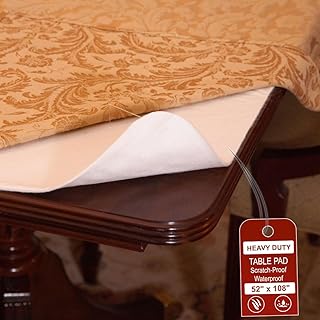
At 52″ x 108″, this covers most extended rectangular tables and gives you real cushioning rather than a thin barrier film. It’s my go-to recommendation for anyone who wants meaningful protection without commissioning custom work — trim it with a straightedge and a fresh utility blade for a clean edge.
Table Protector Pad with Flannel Backing (90″ x 54″)
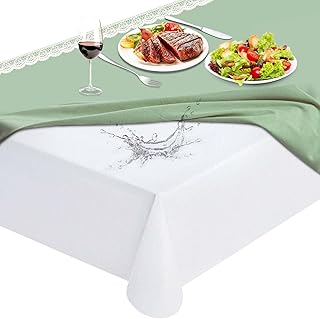
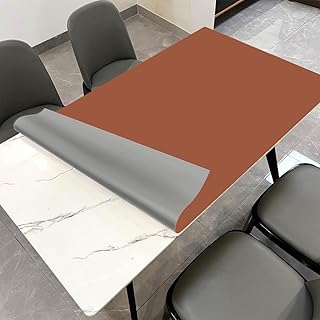
Straightforward heavy-duty vinyl with flannel backing that grips wood without slipping, sized for standard six-seat rectangular tables. The waterproof top wipes clean with a damp cloth, and it lays flat within a day or two of unrolling if you leave it weighted at the corners.
Quality Table Pad Protector, 90″ L x 54″ W
A solid value pick with the same flannel-backed construction and a slightly softer hand than most vinyl pads, which helps it drape rather than bridge over table edges. Good spill and scratch defense for daily family use, though I’d still reach for trivets under anything straight off the burner.
Frequently Asked Questions
Will a table pad damage my table’s finish?
A flannel-backed pad won’t, provided your finish is fully cured — wait at least 30 days after any refinishing work before covering it. Avoid pads with rubber or PVC backing in direct contact with lacquer or shellac, since plasticizers can migrate and leave a permanent haze.
Can I cut a vinyl table pad to fit?
Yes, and most are designed for it. Lay the pad on the table, weigh down the center, and trace the edge with a pencil on the underside, then cut about 1/8″ inside your line with a sharp utility knife against a metal straightedge. Scissors work too but tend to wander on thicker material.
Do I still need a tablecloth over the pad?
Not for protection, but most people prefer one for looks. The pad handles heat, moisture, and abrasion; the cloth handles appearance and keeps the vinyl surface from feeling clammy under bare forearms during a long meal.
How do I get the creases out of a new pad?
Unroll it and leave it on the table with a book at each corner for two or three days at room temperature. If a fold line persists, a hair dryer on low held several inches away will relax the vinyl — never use an iron directly on it.
Final Thoughts
If you’re protecting an heirloom or a table you built yourself, the Custom Table Pads with the magnetic lock system are worth every dollar and every day of the wait, and the Traditional Custom Table Pads with MagnaLocs are an equally strong choice when you need leaf coverage included. For everyone else, the LAMINET Deluxe Cushioned pad gives you serious protection at a fraction of the cost — trim it once, store it on a tube, and stop worrying about what lands on your table.