Our Short List of 3
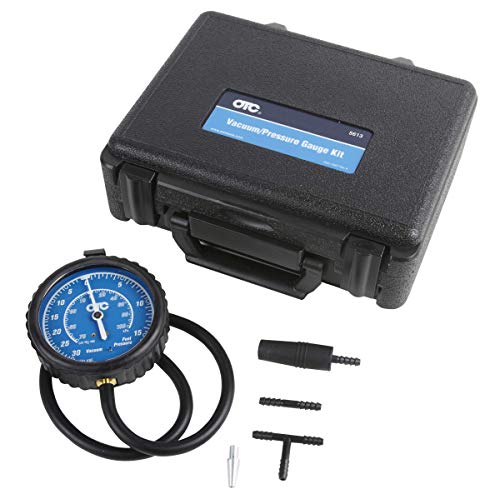
- Type: Vacuum and pressure gauge kit
- Dial: 3-1/2 in, chrome bezel, rubber boot
- Vacuum scale: 0–30 inHg and 0–70 cmHg
- Pressure scale: 0–15 psi and 0–100 kPa

- Type: Vacuum and fuel pressure tester kit
- Dial size: Not published
- Vacuum scale: 0–30 inHg and 0–70 cmHg
- Pressure scale: 0–10 psi and 0–70 kPa
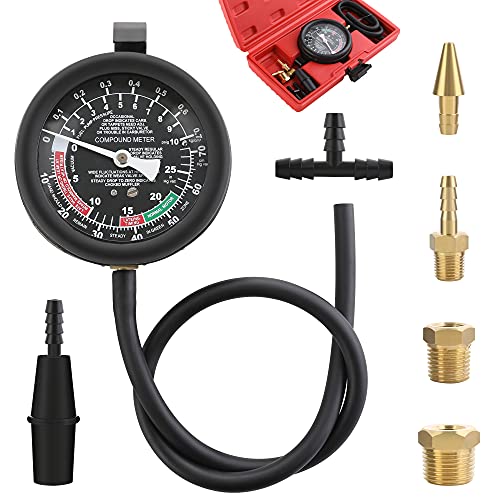
- Type: Vacuum and fuel pump tester kit
- Dial: 4 in, color-coded, rubber guard, hanging hook
- Vacuum scale: 0–28 inHg
- Pressure scale: 0–10 psi
All 5 Picks at a Glance
| Product | Specs | Action |
|---|---|---|
| 1. OTC 5613 Vacuum/Pressure Gauge Kit — the complete shop kit with the chart in the lid |
| Check price on Amazon |
| 2. Actron CP7803 Vacuum and Fuel Pressure Tester Kit — the long-running tune-up classic |
| Check price on Amazon |
| 3. Hromee Fuel Pump and Vacuum Tester Gauge Kit (HR4054) — the big 4 inch dial for pattern work |
| Check price on Amazon |
 4. HFS Fuel Pump Tester Gauge Kit — the simple kit with a storage box |
| Check price on Amazon |
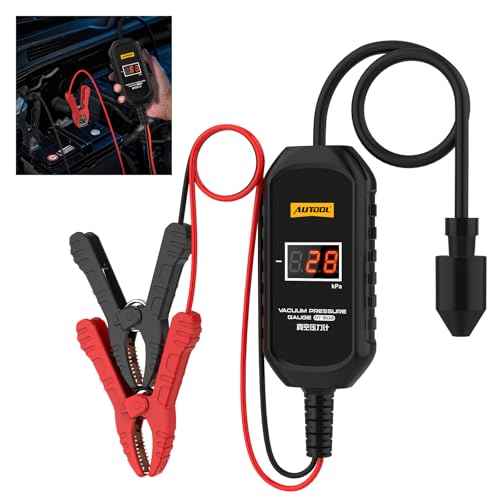 5. AUTOOL PT502 Digital Vacuum Pressure Gauge — the digital readout for exact numbers |
| Check price on Amazon |
Key takeaways
- Compare the best vacuum gauges and tester kits for reading manifold vacuum, finding leaks and valve faults, with dial sizes, dual scales and hose kits.
A vacuum gauge reads the suction an engine pulls in its intake manifold, and that single needle tells a trained eye a surprising amount: whether the rings seal, whether a valve is burnt, whether the ignition timing is late, whether the exhaust is choking the engine. It is one of the oldest diagnostic tools in the shop, and it still answers questions that a scan tool cannot answer at all, because no sensor reports manifold vacuum in this direct, mechanical way.
Three nearby tools are easy to confuse with this one. A fuel pressure tester for injected engines reads high rail pressure through a Schrader port; that is a different instrument, and the small pressure scale on the gauges below only suits low-pressure carburetor fuel pumps. A hand vacuum pump, the pistol-grip Mityvac pattern, creates vacuum to bleed brakes and test actuators; it applies a signal instead of reading the engine. A tire gauge reads positive pressure and tells you nothing about an engine. The five picks below only read: each tees into a manifold vacuum line and reports what the engine is doing.
Disclosure: As an Amazon Associate, we earn from qualifying purchases made through links on this page, at no extra cost to you.
How to Choose a Vacuum Gauge
Learn the needle before you shop. The whole value of this tool is a reading chart, and every good kit prints one in the lid or the booklet. A healthy engine at idle pulls a steady 17 to 21 inHg at sea level, and the needle should sit still. Expect the reading to fall by roughly 1 inHg for every 1,000 feet of altitude, so a sound engine in Denver reads lower than the same engine on the coast. A needle that swings in a regular rhythm, in time with one cylinder, points to a burnt valve or a valve with too little clearance. A low but steady needle points to late ignition timing or a vacuum leak. A needle near normal at idle that falls away and fails to recover at a steady raised speed points to a restricted exhaust, such as a clogged catalytic converter. Memorise those patterns and the gauge earns its keep.
Dial size decides how much of that you can see. The difference between a healthy engine and a burnt valve can be a swing of two or three inHg, and small movements vanish on a small face. A dial of 3.5 inches or larger spreads the scale out so a flicker is visible from the driver seat. Compact gauges are fine for a yes-or-no leak check, but for pattern work bigger is genuinely better, and a rubber boot matters because this tool gets knocked off fenders.
Look for dual scales. The main scale reads vacuum in inches of mercury, and a second scale in centimetres of mercury or kilopascals helps on imported engines whose service books quote metric figures. Most of these gauges are compound instruments: the same dial also carries a small positive pressure scale, usually 0 to 10 or 0 to 15 psi, for mechanical fuel pump checks.
Kit contents save a second purchase. The gauge alone is not enough; you need hose long enough to reach from the manifold to a spot where you can see the dial, plus a tee fitting so the engine keeps its vacuum line connected while you test, and tapered adapters for the hose sizes on the car. A 24 inch hose is the common minimum.
Analogue versus digital is a real fork. A mechanical bourdon tube gauge needs no power, survives drops and heat, and shows needle behaviour, the entire point of pattern diagnosis: a swing, a flicker, a slow fall. A digital gauge gives an exact number with no parallax error, and many hold the peak value on screen. The trade is that a number hides the rhythm a needle shows, and digital units need power. Most home shops are better served by an analogue gauge first.
Zero the gauge before you trust it. With the hose open to the air, the needle must rest exactly on zero; a gauge knocked a needle width off zero will lie by that much on every test. Some gauges have a small calibration screw on the face; on others, gentle handling is the only fix. Check zero every time and connect below the throttle plate.
The 5 Best Vacuum Gauges
1. OTC 5613 Vacuum/Pressure Gauge Kit — the complete shop kit with the chart in the lid
- Type: Vacuum and pressure gauge kit
- Dial: 3-1/2 in, chrome bezel, rubber boot
- Vacuum scale: 0–30 inHg and 0–70 cmHg
- Pressure scale: 0–15 psi and 0–100 kPa
OTC builds tools for working technicians, and the 5613 shows it: a 3-1/2 inch gauge with a chrome bezel and a rubber boot, four scales on one face, and a hard case whose lid carries the reading chart, so the diagnosis table is open in front of you while the needle moves. Vacuum reads 0 to 30 inHg with a 0 to 70 cmHg scale beside it, and the pressure side covers 0 to 15 psi and 0 to 100 kPa. The kit packs a 24 inch hose, a tee fitting, an in-line connector, a conical adapter and a universal fuel line adapter. If you want one kit that teaches the method while you use it, this is the one.
2. Actron CP7803 Vacuum and Fuel Pressure Tester Kit — the long-running tune-up classic
- Type: Vacuum and fuel pressure tester kit
- Dial size: Not published
- Vacuum scale: 0–30 inHg and 0–70 cmHg
- Pressure scale: 0–10 psi and 0–70 kPa
The CP7803 has been the default home garage vacuum gauge for decades, sold under the Actron and Sunpro names, and its instruction sheet is practically a short course in vacuum diagnosis, with named tests for exhaust restriction, PCV function and distributor advance. The gauge reads vacuum from 0 to 30 inches of mercury with a metric 0 to 70 cm scale, and the pressure side reads 0 to 10 psi for mechanical fuel pump testing. The kit includes a 24 inch rubber hose and four fittings: a universal adapter, a tee, a tapered hose adapter and a brass 1/8 NPT to barb fitting. It is a simple tool with nothing electronic to fail.
3. Hromee Fuel Pump and Vacuum Tester Gauge Kit (HR4054) — the big 4 inch dial for pattern work
- Type: Vacuum and fuel pump tester kit
- Dial: 4 in, color-coded, rubber guard, hanging hook
- Vacuum scale: 0–28 inHg
- Pressure scale: 0–10 psi
Hromee leans into the one feature that matters most for diagnosis: dial size. The 4 inch face is the largest in this group, with color-coded zones, and the wide scale makes the small rhythmic swings of a valve fault easy to follow from the fender. A rubber guard wraps the case and a hook on top hangs the gauge from the hood latch, keeping it in view while both hands are busy. Vacuum reads to 28 inHg and the pressure side to 10 psi. The kit adds a 2 foot hose, assorted connectors and a blow-molded case. For an older engine with a suspected valve complaint, that big readable face is the whole argument.
4. HFS Fuel Pump Tester Gauge Kit — the simple kit with a storage box
- Type: Vacuum and pressure gauge kit
- Dial size: Not published
- Vacuum scale: 0–28 inHg
- Pressure scale: 0–10 psi
Hardware Factory Store sells this kit as a straightforward answer to a simple need: a compound gauge, a rubber hose and adapters, packed in a storage box instead of a skin pack. The gauge reads engine vacuum to 28 inHg and fuel pump output pressure to 10 psi, covering the carburetor checks this class of tool exists for: idle mixture setting, valve adjustment checks, leak hunting and pump output. Because everything lives in its box, the hose does not kink around other tools and the gauge face stays clean. Pair it with the patterns in the guide above and it does the same work as the bigger names.
5. AUTOOL PT502 Digital Vacuum Pressure Gauge — the digital readout for exact numbers
- Type: Digital vacuum gauge
- Range: −101 to 0 kPa
- Power: Vehicle power, DC 10–14 V
- Current draw: Under 35 mA
The PT502 replaces the needle with a sensor and a numeric display, reading vacuum from −101 kPa up to zero with temperature compensation to keep the figure honest as the engine bay heats up. It runs off vehicle power, drawing under 35 mA from a 10 to 14 volt supply, so it never needs a battery swap mid-job. AUTOOL aims it at intake manifold, exhaust back pressure and EGR checks, and the steady digital value is handy for confirming a leak repair: note the number, fix the hose, and see the number climb. What you give up is needle behaviour; a rhythmic valve swing becomes a changing number rather than a visible rhythm.
Vacuum Gauges Compared
| Product | Dial or display | Vacuum scale | Pressure scale | Case |
|---|---|---|---|---|
| OTC 5613 | 3-1/2 in dial | 0–30 inHg / 0–70 cmHg | 0–15 psi / 0–100 kPa | Hard case, chart in lid |
| Actron CP7803 | Dial, size not published | 0–30 inHg / 0–70 cmHg | 0–10 psi / 0–70 kPa | Not published |
| Hromee HR4054 | 4 in dial | 0–28 inHg | 0–10 psi | Blow-molded case |
| HFS Tester Kit | Dial, size not published | 0–28 inHg | 0–10 psi | Storage box |
| AUTOOL PT502 | Digital display | −101 to 0 kPa | None, vacuum only | Not published |
Frequently Asked Questions
What should a vacuum gauge read at idle on a healthy engine?
Between 17 and 21 inHg, steady, on a fully warmed engine at sea level. Altitude lowers the figure by about 1 inHg per 1,000 feet, so judge the needle against your elevation, not a book figure alone.
Can a vacuum gauge find a vacuum leak?
It can tell you a leak is likely: a low, steady reading with correct ignition timing is the textbook leak pattern, and the reading often improves as you pinch off vacuum hoses one at a time until you isolate the leaking branch. Finding the exact split hose still takes your eyes and ears.
Can I test fuel pressure on a fuel-injected engine with one of these?
No. The pressure side of these compound gauges tops out at 10 or 15 psi because it is meant for mechanical pumps feeding a carburetor. Injected engines run far higher rail pressure and need a dedicated high-range tester.
What is the difference between a vacuum gauge and a hand vacuum pump?
A vacuum gauge only reads the vacuum the engine makes. A hand pump, the Mityvac pattern, creates vacuum itself, which is what you need to bleed brakes or test a vacuum actuator on the bench. Different jobs entirely.
Why does the needle fall when I hold the engine at a steady higher speed?
That is the classic restricted exhaust pattern. At idle the engine pulls a near normal reading, but as exhaust flow rises, a clogged converter or crushed pipe backs pressure up and manifold vacuum fades instead of recovering. Confirm it with a back pressure test before replacing parts.
Conclusion
For most home garages, the OTC 5613 is the pick to buy first: the dual-scale dial, the full adapter set and the reading chart in the lid teach the method while you work. The Actron CP7803 remains the dependable classic, the Hromee HR4054 wins on dial size, the HFS kit covers routine checks, and the AUTOOL PT502 serves anyone who prefers an exact digital number. Whichever you choose, warm the engine, check the gauge reads zero at rest, and let the needle tell its story before you buy a single part.
More from Amazon
Programs that pair well with the guide above. Offers and eligibility are set by Amazon and may change.
A free business account with business pricing and bulk-buying tools for work, shop or home office.
Create a business accountFree shipping on eligible items, Prime Video and more. Eligible new members can start with a free trial.
Start a Prime free trialAudiobooks and podcasts to listen to on the go. Eligible new members can start with a free trial.
Try Audible freeAd-free music streaming. Eligible new subscribers can start with a free trial.
Try Music Unlimited freeAs an Amazon Associate we earn from qualifying purchases.