Key takeaways
- Most efficient overall: Hayward TriStar VS 900 (1.85 total horsepower, listed efficiency up to 12.9 WEF at 230 V).
- Best for big pools, long plumbing runs, water features: Pentair IntelliFlo3 VSF (1.5 and 3.0 total horsepower versions, variable speed and variable flow, built-in wireless control).
- Best for Jandy automation owners: Jandy VS FloPro (dual-voltage versions, auxiliary relays for add-on devices).
- Best simple replacement: Pentair SuperFlo VST (2.2 total horsepower, three programmable speeds, dual-voltage).
- Best for higher-demand pools: Hayward TriStar VS 950 (2.70 total horsepower, 600 to 3,450 RPM range).
- Best for mixed-brand plumbing and retrofits: Hayward Super Pump VS, the variable speed version of a very common replacement footprint.
The best variable speed pool pumps for energy savings are the Hayward TriStar VS 900 for efficiency per watt, the Pentair IntelliFlo3 VSF for large pools with heavy plumbing and automation, the Jandy VS FloPro for Jandy-equipped systems, and the Pentair SuperFlo VST as a simple drop-in swap for an aging single-speed pump. Which one saves you the most depends less on the badge than on three numbers: your pool’s turnover flow, the voltage at your pump pad, and how low the pump can run for most of the day.
A variable speed pump saves energy because of a physics rule called the pump affinity law. Flow changes in proportion to motor speed, but power draw changes with the cube of speed. Run a pump at half speed and you move half the water while drawing roughly one eighth of the power. That is the entire business case, and it explains why the pumps below are judged mostly on how gracefully they run slow, not on how hard they can run fast.
Our top picks
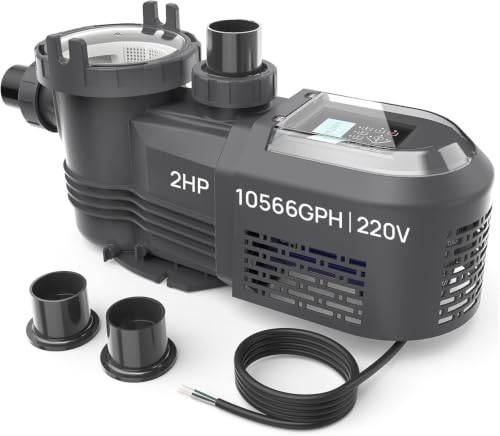


As an Amazon Associate we earn from qualifying purchases at no extra cost to you.
Quick answer: which pump fits which pool
- Most efficient overall: Hayward TriStar VS 900 (1.85 total horsepower, listed efficiency up to 12.9 WEF at 230 V).
- Best for big pools, long plumbing runs, water features: Pentair IntelliFlo3 VSF (1.5 and 3.0 total horsepower versions, variable speed and variable flow, built-in wireless control).
- Best for Jandy automation owners: Jandy VS FloPro (dual-voltage versions, auxiliary relays for add-on devices).
- Best simple replacement: Pentair SuperFlo VST (2.2 total horsepower, three programmable speeds, dual-voltage).
- Best for higher-demand pools: Hayward TriStar VS 950 (2.70 total horsepower, 600 to 3,450 RPM range).
- Best for mixed-brand plumbing and retrofits: Hayward Super Pump VS, the variable speed version of a very common replacement footprint.
How we chose these pumps
This guide is based on research, not first-person measurement. We compared manufacturer data sheets and published 2026 buyer guides for inground pool pumps sold in the United States. Every model named here is a current product line from a major pool equipment maker. Where sources disagreed on a figure, such as efficiency ratings that change with voltage or horsepower labeling, we either gave the range or described the pump by spec class and told you to confirm on the data sheet for your exact part number. We ranked by five criteria: efficiency at low speed, programmability, automation compatibility, plumbing and voltage fit, and the practicality of replacing the old pump.
Understand the specs before you shop
Total horsepower is not the number that matters
Total horsepower (THP) describes motor capacity at full tilt. A pump with a bigger THP is not automatically better, and for energy savings it often means you are paying for capacity you will rarely use. The more useful specs are the minimum and maximum RPM range and the efficiency rating at the speeds you will actually run. A 1.85 THP pump that turns low and efficiently can beat a 3.0 THP pump in annual energy use on a typical residential pool.
WEF: the efficiency metric to compare
Weighted Energy Factor (WEF) is the federal efficiency metric for pool pumps. It is expressed as gallons moved per watt-hour of energy across a standardized set of test speeds, so higher is better. The catch is that WEF changes with installed voltage. The same pump can post a noticeably higher number at 230 V than at 115 V, so any comparison must use the same voltage basis. When you see a high WEF in marketing, check which voltage it applies to.
Voltage: 115 V versus 230 V
Many variable speed pumps are dual-voltage and auto-sense the supply. Running at 230 V draws about half the current of 115 V for the same power, which cuts wiring losses and is generally the better choice for efficiency. Some pumps, including the Pentair IntelliFlo3 VSF in its 3.0 horsepower version, are listed for 208 to 230 V only. If your existing pump is wired for 115 V, confirm whether you have a 230 V circuit available before buying a 230 V-only pump. Electrical work belongs to a licensed electrician, and the pump must be on a GFCI-protected circuit and properly bonded as local code requires.
Plumbing size and unions
Most inground pools in the United States have 2 inch or 2.5 inch plumbing. The Hayward TriStar VS line uses two 2.5 inch union connections, while the IntelliFlo3 VSF supports 2, 2.5, or an optional 3 inch connection. A pump that is badly matched to pipe size will cost you energy through restriction and noise. Mismatched union footprints are the single biggest reason a swap turns into a plumbing job, so measure the existing center-to-center port spacing and note whether the old pump has a threaded or union connection.
ENERGY STAR and federal rules
Since the federal dedicated-purpose pool pump rule took effect in mid-2021, most new inground pumps sold in the United States are variable, multi-speed, or otherwise designed to meet minimum efficiency levels, so a brand-new single-speed pump is largely a thing of the past. ENERGY STAR certification is a useful extra filter: it indicates the pump meets a stricter efficiency level than the legal minimum. Not every listing identifies the certification, so check the manufacturer data sheet or the ENERGY STAR product finder for your exact model number rather than assuming.
Noise
Noise rises quickly with speed, which is another reason variable speed pumps are quieter in daily use. Manufacturers rarely publish comparable decibel figures, so use design clues: a fully enclosed fan-cooled motor, a well-sealed housing, and the ability to hold a low RPM for long stretches. If the pump sits near a bedroom wall or a patio, look for a model with a low minimum speed and set the schedule so the highest speed runs only when necessary.
The 2026 shortlist at a glance
| Pump | Total HP | Voltage | Efficiency (WEF) | Speed control | Best fit |
|---|---|---|---|---|---|
| Hayward TriStar VS 900 | 1.85 | 115/230 V | 12.9 at 230 V, 8.3 at 115 V | 600 to 3,450 RPM, programmable | Efficiency-first, average inground pool |
| Hayward TriStar VS 950 | 2.70 | 115/230 V | 10.1 at 230 V, 7.3 at 115 V | 600 to 3,450 RPM, programmable | Larger pool, water features, solar heating |
| Pentair IntelliFlo3 VSF | 1.5 or 3.0 (two versions) | 3.0 version: 208 to 230 V | Varies by version; about 7.1 listed for the 3.0 version | Variable speed and variable flow | Large pools, long pipe runs, wireless control |
| Jandy VS FloPro | Several versions (for example 2.7 HP DV2A) | 115/208 to 230 V auto-sensing on dual-voltage version | Check the data sheet for your version | Programmable speeds, two auxiliary relays | Jandy iAquaLink or Jandy controller systems |
| Pentair SuperFlo VST | 2.2 | 115/208 to 230 V | 9.0 at 230 V, 7.3 at 115 V | Three programmable speeds | Budget-minded swap for a single-speed pump |
| Hayward Super Pump VS | Confirm by model | Confirm by model | Confirm by model | Variable speed, programmable | Replacing a Super Pump footprint |
Note: figures above are manufacturer-published or widely cited values for the models listed. Efficiency changes with voltage, plumbing, and operating speed, so treat WEF as a comparison tool, not a guarantee of your bill.
Detailed picks
Hayward TriStar VS 900: best for efficiency
Spec line: 1.85 THP · 600 to 3,450 RPM · 115/230 V · two 2.5 inch unions · up to 12.9 WEF at 230 V
Best for: Average-size inground pools (roughly 15,000 to 25,000 gallons) with standard sweep and filter, where energy savings are the main goal.
Skip if: Your pool has multiple water features, a spillover spa, or a pressure-side cleaner that needs a lot of flow at once. The pump is also a poor fit if your plumbing is smaller than 2 inch or uses an odd union spacing.
- Pros: Very strong published efficiency; low minimum speed lets you run long, slow filtration cycles; dual voltage makes it flexible for retrofits; works with Hayward automation variants.
- Cons: Limited headroom for demanding feature loads; the best efficiency figures only apply at 230 V; the Hayward line has several non-interchangeable controller options, so confirm the version you need.
Hayward TriStar VS 950: best for higher-demand pools
Spec line: 2.70 THP · 600 to 3,450 RPM · 115/230 V · two 2.5 inch unions · 10.1 WEF at 230 V
Best for: Larger pools, pools with a solar heating loop, waterfalls, or a pressure cleaner that needs bursts of high flow.
Skip if: You have a small to average pool and are shopping purely for the lowest energy use. The TriStar VS 900 will usually cost less to run for that profile.
- Pros: More headroom when features are running; same low minimum speed as the 900; broad plumbing compatibility.
- Cons: Lower headline efficiency than the 900; larger motor than most pools need for plain filtration.
Pentair IntelliFlo3 VSF: best for large pools and wireless control
Spec line: 1.5 or 3.0 THP versions · variable speed and variable flow · 2, 2.5, or optional 3 inch connections · 3.0 version rated 208 to 230 V · built-in wireless connectivity
Best for: Large inground pools, long or complex plumbing runs, and owners who want app-based scheduling with optional control of extra devices.
Skip if: You only need basic filtration for a moderate pool, or you need a 115 V pump. The 3.0 horsepower version is a 230 V product.
- Pros: The variable flow feature holds a target flow rate as the filter loads up, which helps maintain consistent turnover; flexible port options; strong wireless app features.
- Cons: Large capacity means more cost up front; published WEF for the 3.0 version looks lower than the efficiency-focused Hayward picks because it is designed for larger loads.
Jandy VS FloPro: best for Jandy systems
Spec line: Multiple versions, including 2.7 HP DV2A · dual voltage on that version, 115/208 to 230 V auto-sensing · two auxiliary relays · adjustable base for common plumbing footprints
Best for: Pools already using Jandy controllers or iAquaLink, where integration and a single support relationship matter.
Skip if: You expect built-in app control without extra hardware. App access generally requires a compatible Jandy interface.
- Pros: Auxiliary relays let the pump switch other equipment; flexible footprint on the base; widely supported by installers.
- Cons: Efficiency figures vary between listings and versions, so verify the data sheet for the exact model; automation upgrades add cost.
Pentair SuperFlo VST: best simple replacement
Spec line: 2.2 THP · 115/208 to 230 V · three programmable speeds · RS-485 connectivity · 9.0 WEF at 230 V, 7.3 at 115 V
Best for: Replacing an old single-speed pump on a standard pool without rewriting your plumbing or automation.
Skip if: You want fully variable programming across many time blocks or a pump that adjusts automatically to filter loading.
- Pros: Drop-in design for a very common footprint; three presets are enough for most schedules; dual voltage.
- Cons: Fewer speed steps than premium models; efficiency is behind the top Hayward figure.
Hayward Super Pump VS: best for matching a legacy footprint
Spec line: Variable speed version of the Super Pump family · confirm total horsepower, voltage and union size for your part number
Best for: Owners replacing an existing Hayward Super Pump who want the same pad footprint and plumbing connections.
Skip if: You are building a new system or replacing the plumbing anyway. In that case, a newer pump family may offer better efficiency per dollar.
- Pros: Familiar fit with a widespread installed base; broad parts support.
- Cons: Specs vary by SKU, so some versions and voltages differ; always verify against the data sheet.
Worked example: what a variable speed pump saves
Here is a step-by-step way to estimate your own savings. The numbers are illustrative assumptions, not measured results. Swap in your own values from the pump label and your electric bill.
- Find your required turnover. A pool of 20,000 gallons that needs one full turnover per day must move 20,000 gallons in the run time. If you plan 10 hours, that is 2,000 gallons per hour, or about 33 gallons per minute.
- Estimate the old pump’s draw. An older single-speed pump around 1.5 horsepower commonly draws on the order of 1,500 watts while running. At 8 hours a day that is 12 kWh per day, or about 4,380 kWh per year.
- Apply the affinity law. If the variable speed pump runs at about half the old flow, a rough estimate of its draw is one eighth of the high-speed power. In practice, plumbing friction and the motor’s own losses mean the real number is higher, so assume something closer to 250 to 350 watts at low speed.
- Extend the run time. Moving the same water at half the flow takes about twice as long. Ten hours at 300 watts is 3 kWh per day, or about 1,095 kWh per year.
- Subtract. 4,380 minus 1,095 leaves around 3,285 kWh saved per year in this example, a cut of about 75 percent.
- Convert to your bill. Multiply the kWh saved by your local rate per kWh. Because rates vary widely, that last step is yours to do.
The takeaway: low and slow beats high and fast. If you cannot get a pump to run at low speed for most of the day because the filter, skimmer, or cleaner needs high flow, you will lose a big share of the savings. That is why the minimum RPM figure matters as much as the efficiency rating.
Match the pump to your pool: decision matrix
| If your pool has | Prioritize | Likely pick |
|---|---|---|
| Average inground size, simple plumbing, no features | Lowest energy use | Hayward TriStar VS 900 |
| Large pool or waterfall plus solar loop | Flow headroom | Hayward TriStar VS 950 or Pentair IntelliFlo3 VSF |
| Existing Jandy controller | Integration | Jandy VS FloPro |
| Old single-speed pump, want an easy swap | Simplicity | Pentair SuperFlo VST |
| Hayward Super Pump already in place | Matching footprint | Hayward Super Pump VS |
| 115 V circuit only | Voltage compatibility | Dual-voltage models such as TriStar VS or SuperFlo VST |
Speed programming: how to set it up for the biggest savings
A pump that can run slowly only saves money if you set it that way. The most efficient approach is to build a schedule around the jobs your pool needs.
- Main filtration: Run at the lowest speed that still gives adequate skimming and a full turnover. Many pools do well with a long daytime run at low RPM.
- Cleaner or sweep: If you have a pressure-side or suction-side cleaner, give it a short, higher-speed window rather than raising the main speed all day.
- Heater or solar: Gas heaters and solar systems have minimum flow requirements. Check the heater data plate and set a speed that meets it while it is firing.
- Chemical balance: Make sure your chlorinator or salt cell has enough run time and flow for it to produce what the pool needs.
- Prime and priming speed: Choose a pump with an adjustable priming speed and duration so it can pull water on startup without stalling.
If you run the pump through an automation controller, confirm the pump protocol is compatible before you buy. RS-485 communication is common, but each brand uses its own protocol and its own controller list, so cross-brand setups need extra checking.
Installation and safety notes
- Turn off power at the breaker and confirm it is off before touching any pump wiring. Pool pumps must be bonded and on GFCI protection per local electrical code. Use a licensed electrician if you are changing circuits.
- Relieve pressure in the filter and open the air relief before opening the pump lid or removing unions. Pressurized equipment can eject a lid or basket.
- Never run a pump dry. Check that the strainer pot is filled with water and the lid O-ring is seated and lubricated with a pool-safe lubricant.
- Keep the pump in a ventilated, dry location. Motors need airflow to cool and are not designed to sit in standing water.
- Protect against entrapment: a pool suction system must meet current drain cover standards. Do not modify suction plumbing without a qualified pool professional.
Frequently asked questions
How much can a variable speed pool pump save compared with a single-speed pump?
Savings commonly reach well over half of annual pump energy use, and often more. The exact figure depends on your old pump, your run time, and how low you can run the new one.
Because power falls with the cube of speed, even modest speed reductions create large savings. Use the worked example above with your own wattage and rate to estimate your own number.
Is a bigger horsepower variable speed pump better?
No. Bigger capacity helps only when your pool needs high flow, such as large waterfalls or long plumbing runs.
For plain filtration, a smaller pump running slowly is usually more efficient. Compare RPM range and WEF rather than total horsepower alone.
Do I need a 230 V circuit for a variable speed pump?
Not always. Many models are dual-voltage and run on 115 V or 230 V, but some larger versions are 230 V only.
The 230 V option generally gives better published efficiency. Have an electrician confirm the circuit and wiring before you buy.
Will a variable speed pump fit my existing plumbing?
It often will, but verify union size, port spacing, and whether your old pump used threaded or union connections.
The Hayward TriStar VS line uses 2.5 inch unions, while the Pentair IntelliFlo3 VSF supports multiple sizes. Adapters and adjustable bases can solve many footprint differences.
What does WEF mean and what is a good number?
WEF stands for Weighted Energy Factor, and it measures how much water the pump moves per unit of energy. A higher number is better.
Compare WEF only at the same voltage. The same pump can post a noticeably higher WEF at 230 V than at 115 V.
Does a variable speed pump work with my pool automation?
Usually, but compatibility depends on brand and protocol. Hayward, Pentair, and Jandy each have preferred controller families.
Check the pump data sheet for supported controllers and for communication options such as RS-485 or built-in wireless. Cross-brand setups often need an extra interface.
How long should I run my variable speed pump each day?
Most residential pools need one to two full turnovers every 24 hours, but run time varies with pool use, debris, weather, and sanitizer type.
Run at the lowest speed that keeps the water clear and meets heater and cleaner requirements, then adjust based on how the water looks and balances over a few weeks.
Are variable speed pumps quieter?
Yes, usually. Noise rises quickly with speed, so a pump running at low RPM most of the day is much quieter than a single-speed pump at full speed.
Published decibel values are rare, so judge by the minimum speed and enclosure design, and keep the highest speeds for short windows.
Bottom line
If you want the largest drop in your pool’s electricity use, start with the pump that matches your actual flow needs, then set it to run low and long. The Hayward TriStar VS 900 is the efficiency leader for an average pool, the Pentair IntelliFlo3 VSF and Hayward TriStar VS 950 cover demanding pools, the Jandy VS FloPro fits Jandy-based systems, and the Pentair SuperFlo VST is the simplest swap. Confirm voltage, union size, and controller compatibility on the manufacturer data sheet for your exact part number before you order.