Key takeaways
- Solid vs. engineered: Look for edge grain visible on the tabletop perimeter and end grain on the short sides. Glued-up panels from acacia, rubberwood, oak, or pine are genuinely solid; if the listing mentions MDF core or “wood veneer over board,” it’s a different product with a different lifespan.
- Leg attachment method: Bolted steel brackets and threaded inserts outlast bare wood screws driven into end grain. Trestle and pedestal bases distribute load better than four corner legs and eliminate the knee-knocking problem at the seats.
- Seating math, honestly: Budget 24 inches of table edge per person and at least 36 inches of clearance behind each chair. A 63-inch rectangle seats six comfortably; a 47-inch top is a genuine four-seater and pushes it at five.
- Finish and repairability: Oiled and matte lacquer finishes accept spot repairs with fine abrasive and a fresh coat. High-gloss and heavy poly are tougher day to day but show ring marks that require sanding the entire surface to blend.
- Movement allowance: Solid wood expands and contracts seasonally. Quality tables use figure-8 fasteners, Z-clips, or slotted brackets so the top can float. Rigid glue-and-screw attachment across the grain eventually cracks the panel.
What's inside
Anyone who has ever run a hand along the underside of a dining table knows the difference between furniture and fiction. Veneered particleboard photographs beautifully and fails quietly, usually around year three, when a swollen edge starts flaking near the seam and there’s nothing solid underneath to repair. Real wood behaves differently: it dents, it patinas, it can be sanded back and refinished on a Saturday. The hard part is telling the two apart from a product listing, especially when “wood” gets stretched to cover engineered panels with a photo-printed grain.
This guide sorts through the current crop of solid wood dining tables with a builder’s eye — what the joinery looks like, how the legs attach, whether the top is a glued panel or a floating slab, and how much assembly actually lands on you. We’ve focused on tables that hold up to real use: four to twelve seats, rectangular formats that fit apartments and farmhouse kitchens alike, and finishes you can maintain yourself instead of replacing outright.
As an Amazon Associate we earn from qualifying purchases.


🛒 Best Price Today on Amazon
Prime members get fast, free shipping on everything above, plus member-only deals. New members get a 30-day free trial — cancel anytime.
How to Choose a Wood Dining Room Table (2026)
- Solid vs. engineered: Look for edge grain visible on the tabletop perimeter and end grain on the short sides. Glued-up panels from acacia, rubberwood, oak, or pine are genuinely solid; if the listing mentions MDF core or “wood veneer over board,” it’s a different product with a different lifespan.
- Leg attachment method: Bolted steel brackets and threaded inserts outlast bare wood screws driven into end grain. Trestle and pedestal bases distribute load better than four corner legs and eliminate the knee-knocking problem at the seats.
- Seating math, honestly: Budget 24 inches of table edge per person and at least 36 inches of clearance behind each chair. A 63-inch rectangle seats six comfortably; a 47-inch top is a genuine four-seater and pushes it at five.
- Finish and repairability: Oiled and matte lacquer finishes accept spot repairs with fine abrasive and a fresh coat. High-gloss and heavy poly are tougher day to day but show ring marks that require sanding the entire surface to blend.
- Movement allowance: Solid wood expands and contracts seasonally. Quality tables use figure-8 fasteners, Z-clips, or slotted brackets so the top can float. Rigid glue-and-screw attachment across the grain eventually cracks the panel.
The Best Wood Dining Room Tables (2026) Reviewed
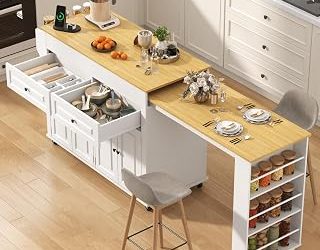
Transformer Table Solid Wood Extendable Dining Table
The extension mechanism here is the most thoughtfully engineered on the list — leaves store inside the base rather than in a closet, and the slide hardware stays aligned after repeated cycles. If you host irregularly and live in tight square footage, going from a two-seat console to a twelve-seat banquet without a second piece of furniture is worth the premium.
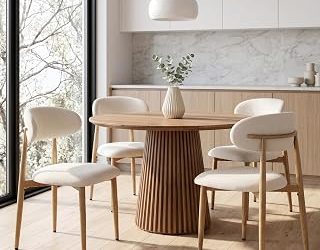
55″ Solid Wood Dining Table, Fluted Walnut
The fluted detailing on the base is real milled reeding, not applied trim, which means it survives cleaning and the occasional vacuum strike. At 55 inches it threads the needle for apartments — seats four generously, six in a pinch — and the mid-century proportions keep it from visually crowding a small room.
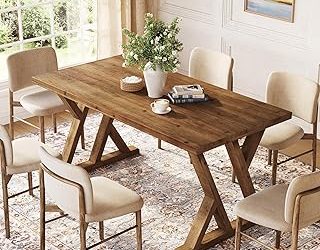
63″ Solid Wood Farmhouse Table, Natural Brown
Heavy-duty leg assemblies and a substantial glued panel put this in genuine workhorse territory; it’s the one on this list most likely to still be in service in fifteen years. The natural finish is light enough to sand and re-oil if you inherit a water ring, which is exactly what you want in a table that will see homework and holiday spills.
Merrick Lane Finnley 47″ Solid Wood Dining Table
The sculpted legs are the draw — lathe-turned profiles that read as considered rather than mass-produced, finished in a walnut matte that hides fingerprints well. Best suited to breakfast nooks and studio apartments where four seats is the honest ceiling.
63″ Solid Wood Farmhouse Table, Rustic Brown
Essentially the workhorse formula in a darker, more distressed finish that camouflages everyday marks better than a pale top. Assembly is straightforward with a socket wrench, though budget a helper for flipping the top once the base is bolted on.
Frequently Asked Questions
How do I know if a table is actually solid wood?
Check the edges and undersides in the product photos. Continuous grain that wraps from top surface to edge indicates solid stock; a grain pattern that stops abruptly at a thin banded edge means veneer. Weight is another tell — solid hardwood tops run heavy, and shipping weights under 60 pounds for a six-seater are suspicious.
Can I refinish these tables myself?
Solid tops, yes. Start at 120 grit, work up to 220, and finish with a hardwax oil or wipe-on poly in thin coats. Avoid aggressive belt sanding, since most factory tops are only three-quarters to one inch thick and you have limited material to remove.
What causes the top to develop gaps or cracks?
Almost always humidity swings combined with a top that can’t move. Keep indoor humidity between 35 and 55 percent, and if the top is screwed rigidly to the base, consider swapping in slotted brackets or figure-8 fasteners to let the panel breathe.
Do I need a tablecloth or protective pads?
Felt pads under anything ceramic or metal, yes. Full tablecloths aren’t necessary on a well-finished solid top, but trivets are non-negotiable — heat transfer through a hot dish will cloud most lacquers permanently.
Final Thoughts
For most households, the 63-inch solid wood farmhouse table in natural brown is the sensible buy: honest construction, real repairability, and enough seating for six without dominating a room. If space is your constraint rather than budget, the Transformer Table earns its price through genuinely clever extension engineering, while the 55-inch fluted walnut delivers the most design character per square foot for apartment dining.