A heavy duty steel shelf unit rated for 3,000 to 5,000 pounds is only as strong as its assembly. Skip leveling and one post carries more load than the others; leave a beam half-seated in its slot and it can drop under a stack of paint cans; forget to anchor a 70-inch unit to the wall and it becomes a tipping hazard. Most failures come from rushing the first ten minutes. Done properly, a two-person assembly takes 45 to 90 minutes and the unit will hold what the label promises for decades.
What You Need
| Item | Why | Optional? |
|---|---|---|
| Rubber mallet | Seats rivet connectors and shelf beams without denting the powder coat | No |
| 4-foot level (or 2-foot level plus straightedge) | Checks posts for plumb and shelves for level on sloped garage floors | No |
| Tape measure | Confirms diagonal measurements to square the frame | No |
| Work gloves | Stamped steel edges and rivet slots are sharp | No |
| Second person | Holding two 70-inch posts upright while seating the first beam is nearly impossible alone | Strongly recommended |
| Composite or plastic shims | Levels the unit on a sloped floor; garage slabs typically drop 1/8 inch per foot toward the door | Usually needed |
| Drill, 3/16 inch masonry bit or wood bit, and L-brackets with lag screws or concrete anchors | Anchors the unit to a wall stud or the slab to prevent tipping | No, for any unit over 60 inches tall |
| Adjustable wrench or socket set | Bolt-together models and leveling feet use 10 to 13 mm hex hardware | Depends on model |
| Utility knife | Opens packaging and trims plastic shelf edge protectors | Yes |
Step-by-Step
Step 1: Unpack and inventory the hardware (10 minutes)
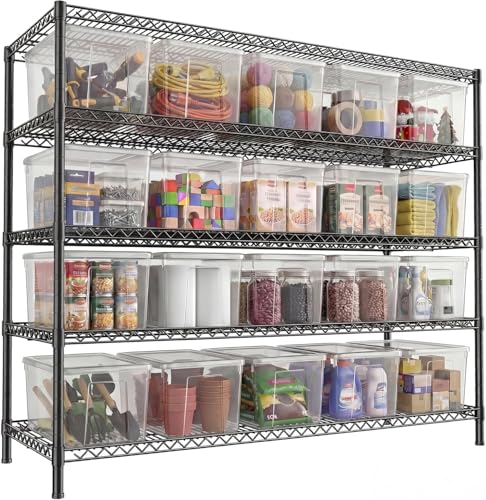
Lay every part on the floor in groups and count against the parts list. A typical 71-inch-wide, 24-inch-deep, 70-inch-tall unit like the 5,000-pound-rated black steel model at about $179.99 ships with 4 posts, 8 to 10 beams, 4 or 5 decks, and 32 to 40 rivet connectors. Wire units like the REIBII 55.5-inch 3,200-pound 5-tier at about $127.99 use plastic sleeve collars, usually 20 for five shelves, plus leveling feet. A missing connector discovered at step 6 means a full stop.
Our top picks

As an Amazon Associate we earn from qualifying purchases at no extra cost to you.
Step 2: Prepare and level the floor position (10 minutes)
Sweep the spot and lay the level on the slab where each post will land. Garage floors slope toward the door for drainage, often 1 to 2 inches across a 24-inch depth. Mark which corners are low and stage shims there. If the unit has threaded leveling feet, screw them all the way in for now. Leave at least 2 inches between the wall and the back posts so you can reach in to attach wall brackets later.
Step 3: Build the bottom frame first (10-15 minutes)
On rivet-style units, lay two posts parallel on the floor, slots facing each other, and tap the two short end beams into the lowest slot you plan to use. Rivets drop down into the keyhole; a firm mallet tap seats them with a solid click. Repeat with the other two posts, stand both end frames up, and connect them with the long front and rear beams at the same slot count from the bottom. On wire units, snap the plastic collars onto the posts at the lowest groove, then press the shelf down over all four collars with the mallet.
Step 4: Square the frame and set the top beams (10 minutes)
With the bottom shelf level installed, measure diagonally corner to corner across the front face. The two diagonals should match within 1/4 inch on a 71-inch unit. If they differ, push the tall corner toward the short one until they agree. Now install the top shelf beams the same way. Having the bottom and top tied together locks the posts parallel and makes the middle shelves easy.
Step 5: Install the intermediate shelves (10-15 minutes)
Decide spacing first: 18 to 20 inches between shelves for tote bins, 12 inches for paint and chemicals, 24 inches or more on the bottom for a shop vac. Count slot holes from the floor on every post; slots are typically 1-1/2 to 2 inches apart, so being off by one leaves a shelf visibly tilted.
Step 6: Drop in the shelf decks (5 minutes)
Steel decks lay onto the beam lips and may need a mallet tap at the corners; particleboard or MDF decks (often 5/8 inch thick) simply rest in the frame. Wire decks are already in place on collar-style units. Push each deck fully back so the front lip is flush with the front beam. Any deck that rocks means a beam is not fully seated.
Step 7: Level the unit (5-10 minutes)
Set the level on the top shelf front to back and side to side. Slide shims under the low posts or spin out the leveling feet until the bubble centers. On a 70-inch unit, a 1/4 inch difference at the base translates to nearly 3/4 inch of lean at the top, which is enough for round objects to roll off. Recheck plumb on the front posts with the level held vertically.
Step 8: Anchor to the wall or floor (10 minutes)
Locate a stud behind a rear post with a stud finder. Attach an L-bracket to the post near the top, then drive a 1/4 x 2-1/2 inch lag screw through the bracket into the stud. If no stud lines up, screw a 2×4 cleat across two studs first. On slab-only setups, drill 3/16 inch holes through the foot plates and use concrete screws. Then load heaviest items on the bottom shelf, spread weight across each deck rather than in one corner, and push the unit side to side to confirm it does not rack.
Mistakes to Avoid
Using a steel hammer instead of a rubber mallet: it chips powder coat and starts rust. Counting slots from the top on one post and the bottom on another: posts are often not symmetrical. Placing particleboard decks in a damp garage without sealing the edges: they swell and sag within a season. Reading the total rating as a per-shelf rating: 5,000 pounds usually means 1,000 per shelf across five shelves.
How Often
Inspect the unit twice a year. Check that rivets remain fully seated, that the frame has not racked (re-measure the diagonals), that shims have not walked out, and that wall anchors are tight. Re-level after any garage flooding or slab settling. If you move the unit, disassemble at least the top two shelves; dragging a loaded unit stresses the rivet slots and bends posts.
When to Call a Pro or Replace
A single bent beam or cracked deck can usually be replaced through the manufacturer for $15 to $40. Replace the whole unit if a post is bent more than 1/4 inch, rust has eaten through the base, or the rivet slots have stretched so beams no longer lock. Call a handyman, typically $75 to $150 per hour, if you must anchor into a concrete block wall with no accessible studs or want several units ganged and anchored as a run. Garage shelving sold in 2026 is overwhelmingly boltless rivet style designed for two homeowners with a mallet, so a pro is rarely needed for a single unit.
FAQ
Can one person assemble a heavy duty steel shelf?
It is possible by building the unit flat on its back and tilting it up, but a 70-inch unit weighing 100 to 150 pounds is hard to raise alone without popping beams loose. A helper for 20 minutes makes it safer.
How much weight can each shelf really hold?
Divide the total rating by the number of shelves and treat that as an evenly distributed load. A 5,000-pound, 5-shelf unit is about 1,000 pounds per shelf; a 3,200-pound wire unit is roughly 640 pounds per shelf. Point loads, like a single engine block, should be kept well under half of that.
Do I have to anchor it to the wall?
For anything over 60 inches tall, yes. Even a fully loaded unit can tip if someone pulls a heavy bin from a top shelf or leans a ladder against it. One L-bracket into a stud is enough.
What if my garage floor is badly sloped?
Shim the low posts with stacked composite shims or 1/4 inch plywood squares, or buy a unit with threaded leveling feet that adjust about 1 inch. For slopes over 1-1/2 inches across the unit’s depth, build a leveled 2×4 base frame and set the unit on top.