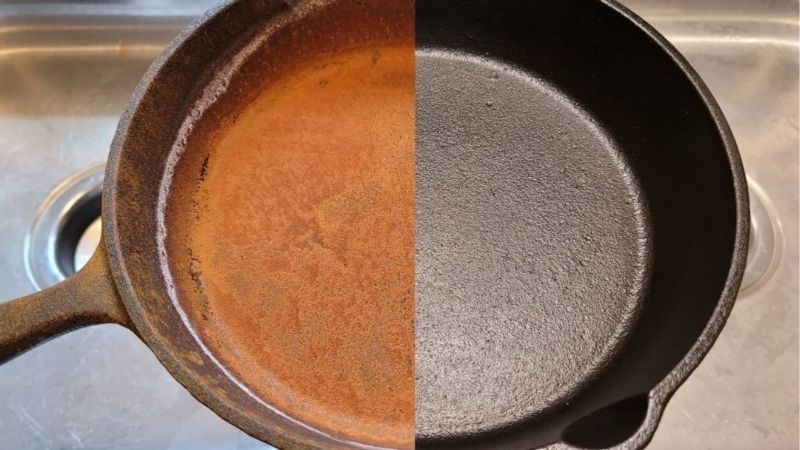
Orange patches on a cast-iron skillet usually mean moisture reached exposed iron where the protective seasoning has worn thin. You can often save the pan by scouring away the corrosion, washing off residue, drying it thoroughly, and restoring the exposed surface. The safest approach to how to remove rust from cast iron starts by identifying whether the cookware is bare iron or enamel-coated. Allow roughly a short hands-on cleaning session for a small patch, with substantially more time if the pan needs an oven-seasoning cycle and a full cooldown.
Quick Answer: On a cool, uncoated cast-iron pan, scrub rusty areas with steel wool or a cast-iron rust eraser, then wash with mild dish soap, rinse, and dry immediately. Apply a nearly invisible coat of cooking oil. If heavy cleaning has exposed significant bare metal, follow your cookware maker’s oven-seasoning instructions before cooking.
As an Amazon Associate we earn from qualifying purchases.
By DIY Ideas 4 Home Editorial Team
Before You Start: Tools, Materials and Safety
Rust is not simply a harmless change in color. The USDA Food Safety and Inspection Service’s article Is it safe to use rusty utensils?, updated August 14, 2024, advises removing all rust before using cookware. You do not need a specialized chemical treatment for typical surface corrosion, but you do need an abrasive suited to the finish and a plan for drying the metal before fresh oxidation starts.
| Tool or Material | Size or Spec | Why You Need It | Substitute |
|---|---|---|---|
| Steel wool or cast-iron rust eraser | Small hand-held abrasive, for bare iron only | Lifts rust from the affected surface | Another cookware-maker-approved rust-removal pad |
| Mild dish soap | Small amount in warm water | Removes loosened corrosion and cleaning debris | Nonabrasive dishwashing liquid |
| Lint-free towel or paper towels | Clean and dry | Removes water immediately after rinsing | Clean cotton kitchen cloth |
| Cooking oil | Thin film of canola or vegetable oil | Protects clean bare iron and prepares it for seasoning | Manufacturer-approved neutral seasoning oil |
| Oven and mitts, if reseasoning | Use the pan maker’s oven method | Restores a protective finish after extensive scouring | Skip oven treatment when the maker permits spot maintenance |
Check Whether Your Cookware Is Bare Iron
Traditional seasoned cast iron has an exposed cooking surface protected by baked-on oil. A Lodge guide titled Seasoned Cast Iron Cleaning & Care describes this coating as carbonized oil; once it is scratched, washed away, or undermined by moisture, the iron can oxidize. A small orange dot and a pan coated in flaky reddish rust are different jobs, so inspect the interior, outer walls, handle, and bottom before reaching for an abrasive.
Enameled cast iron has a glasslike finish over the metal and should not be treated like an uncoated skillet. Lodge’s Cleaning & Care: Lodge Enameled Cast Iron says its enameled pieces do not require seasoning. For rust around an exposed rim, Lodge recommends a nylon sponge with dish detergent, careful drying, and a little oil at the rim. Do not attack the enamel itself with the same steel-wool technique used on bare iron.
Know When to Stop Before Scrubbing
Let the pan cool completely before handling it. A Lodge Rust Eraser product warning specifically says not to use that abrasive on hot cast iron. If the cooking surface is cracked, pieces are breaking away, or an enamel coating is deeply chipped, do not assume rust removal alone will make the cookware dependable again. Obtain an assessment from the manufacturer or replace severely compromised cookware.
Keep the work area clear of food and use a sink or counter surface that can be cleaned afterward. Abrasion releases reddish residue and may remove some black seasoning as well; Lodge’s How to Restore and Season a Rusty Cast Iron Skillet says that loss is expected during restoration. Avoid harsh mystery chemicals, wire-brush power tools, and improvised acid soaks when a manufacturer-approved hand scrub will address the problem.
How to Remove Rust From Cast Iron Step by Step
Lodge’s manufacturer guide, How to Restore and Season a Rusty Cast Iron Skillet, establishes the useful order: physically remove the rust first, wash the pan, dry it, and rebuild protection where necessary. Resist the temptation to cover orange corrosion with oil before it has been cleaned away. The seven steps below begin with the smallest intervention likely to solve the problem and reserve prolonged oven treatment for a genuinely stripped surface.
Step 1: Inspect the Rust and Choose Your Approach
Run a dry cloth across the cool pan to distinguish removable food residue from a rough, rusty patch. Check where the handle joins the body, the lip under pour spouts, and the underside because moisture can collect there unnoticed. When rust covers only one small area and the surrounding seasoning remains intact, plan a localized scrub. Widespread rust with loose dark flakes indicates that a more thorough restoration may be needed after cleaning.
Do not confuse an uneven brown seasoning layer with active oxidation without examining it. Lodge’s How to Season page notes that some new skillets show a brown area where factory seasoning has not fully carbonized. That cosmetic mark may not need a rust treatment at all. Actual loose orange powder, by contrast, should not remain on a food-contact surface. The USDA article on rusty utensils supports removing corrosion before cooking rather than treating it as part of the patina.
Step 2: Scrub the Rust From the Cool Pan
Use steel wool or a dedicated rust eraser on the affected bare-iron surface, working deliberately across the orange areas. Lodge’s How to Clean page explicitly permits steel wool for rust removal even though it does not recommend metal scrubbers for everyday washing. Keep the pressure controlled and check progress frequently so you do not strip sound seasoning far beyond the damaged patch. Rust trapped in small surface irregularities may require a second pass, not harder scrubbing everywhere.
For an extensive restoration, continue across the affected interior and exterior until loose reddish material is gone. The manufacturer’s restoration guide accepts that some dark seasoning will come away as rust is removed. That is preferable to leaving a patch that can continue to corrode under an oily coating. Stop if you discover a deep crack or serious material loss instead of trying to grind the problem away; abrasion removes contamination, not structural damage.
Step 3: Wash Away Abrasive and Rust Residue
Take the scrubbed skillet to the sink and wash it with warm water and mild dish soap. Pay attention to the sidewalls, outer bottom, and underside of the handle where rusty dust can settle. Lodge’s How to Restore and Season a Rusty Cast Iron Skillet prescribes warm, soapy water immediately after steel-wool scouring. Soap is appropriate here; the claim that a drop of modern dish detergent inevitably destroys a cast-iron pan is not supported by Lodge’s routine care guidance.
Rinse until the water runs free of visible debris and the surface no longer feels gritty. Do not place the pan in a dishwasher or leave it soaking while you clean something else. Lodge identifies soaking, machine washing, and prolonged wetness as common causes of rust. Set your dry towel within reach before rinsing so there is no long pause between removing residue and drying exposed iron.
Step 4: Check for Remaining Rust
Examine the skillet in bright light while it is still at the sink. If you see another obvious orange island, clean that area again rather than hiding it beneath a coat of oil. Look particularly at ridges, helper handles, and the outer base; a cooking surface can appear clean while rust remains elsewhere. Use touch carefully: you are checking for loose rough residue, not trying to make cast iron as smooth as polished stainless steel.
A gray or silvery patch after scouring may be exposed clean iron rather than a failed cleaning job. Expect color differences where old seasoning was removed, and avoid unnecessary sanding for a matching appearance. The practical endpoint is that the red corrosion and abrasive debris are gone. If the pan keeps shedding chunks of metal, has extensive deep pitting, or will not clean without aggressive grinding, stop and consider replacing it instead of assuming another polish will restore ordinary cooking reliability.
Step 5: Dry the Skillet Immediately and Completely
Wipe the entire piece with a clean lint-free towel, including grooves under the rim and embossed lettering on the base. Lodge’s five-step restoration guide allows placing the pan on a stovetop over low heat for a few minutes to remove residual moisture after towel drying. If you choose this option, remain at the stove and switch off the heat once the metal is dry. Do not heat a pan still carrying cleanser, and never leave an empty pan warming unattended.
Watch for water emerging around the handle or under the lip as the skillet warms. Dry those spots again before proceeding. A tiny water bead can undo careful rust removal if the pan is left exposed for a long period. Allow the cookware to become safe to handle before spreading oil with a cloth. The order matters more than speed: do not seal in visible water, and do not reach for a hot pan barehanded.
Step 6: Wipe on a Thin Protective Coat of Oil
Use a cloth to distribute a very small amount of canola or vegetable oil over the clean, dry exposed iron. Cover the inside, outside, base, and iron handle if those surfaces were abraded. Lodge’s How to Clean instructions recommend a thin coat after drying, while How to Restore and Season a Rusty Cast Iron Skillet cautions against oil thick enough to drip when the skillet is tilted. Wipe the pan again with a dry cloth until the finish looks nearly dry rather than wet and glossy.
For a tiny rust spot that did not remove much surrounding seasoning, this cleaning and oiling may be enough to resume normal use, according to Lodge’s How to Fix Common Cast Iron Concerns. If most of the finish was lost or the pan has many bare patches, a proper oven treatment is a more reliable next step. Oiling bare iron for storage is not identical to rebuilding the fully bonded cooking layer, so make that decision from the actual condition of the surface.
Step 7: Reseason if the Finish Was Stripped
For heavily scrubbed bare-iron cookware, follow the pan maker’s complete oven-seasoning directions. Lodge’s rust-restoration guide instructs users of its cookware to preheat an oven to 450 to 500°F, place the lightly oiled pan upside down on the center rack, and bake for one hour. The guide places foil on the lower rack to catch drips and recommends turning off the oven and allowing the skillet to cool inside. Do not put foil on an oven floor if the appliance manual forbids it.
These are Lodge’s instructions, not an automatic setting for every skillet, enamel piece, or wooden-handled pan. Consult the specific cookware instructions and the oven’s safety guidance before beginning. Seasoning may produce odor or some smoke, so keep normal kitchen ventilation available and avoid starting a cycle you cannot supervise. Once the cookware has cooled, check that it feels dry rather than tacky. The separate seasoning guide explains how to build the finish further if a single cycle leaves the surface uneven.
Products That Help
The Lodge Rust Eraser A-RUSTY1 offers a targeted alternative to loose steel wool when working on an uncoated pan. Lodge’s official Rust Eraser product page lists its size as 3.56 inches long, 0.94 inch wide, and 0.5 inch high, and says it removes rust down to bare metal, which then needs reseasoning. The page listed a sale price of $10.90 against a regular $12.95 as of October 2026. Check the current price before buying; a clean steel-wool pad is a practical lower-cost option for occasional small patches.
Lodge Seasoning Spray Oil A-SPRAY can make it less messy to distribute oil after cleaning. Its manufacturer’s product page describes 100% canola oil without propellants or additives and lists an 8.8-inch-tall bottle at $11.95 as of October 2026. The spray is optional, not a rust remover: you still need to scour and wash first, and you must wipe away nearly all visible excess oil. Ordinary canola or vegetable oil from the pantry fulfills the same protective role when applied correctly.
Common Mistakes to Avoid
Do not postpone drying until the next day or leave the skillet face down on a damp towel. Avoid abrasive scouring of intact enamel, and do not assume dark uneven seasoning is always rust. Aggressive sanding can remove more functional finish than necessary while failing to address poor storage. When you are unsure about a vintage piece with an unidentified coating, seek product-specific advice before using strong cleaners or heating it at a high temperature.
Another common problem is stopping after the rust looks gone but before protecting the newly exposed iron. Lodge’s cleaning sequence always pairs cleaning with drying and oiling, and its restoration sequence adds oven seasoning when needed. Conversely, excessive oil may leave a sticky film. Keep the layer thin, store the cookware in a dry place, and inspect it after its next wash. A controlled, repeatable cleaning routine is more useful than an improvised chemical bath that can strip additional finish.
Frequently Asked Questions
Rust removal solves the visible problem, but the next wash and storage conditions determine whether the skillet stays clean. These questions address common decisions that arise after the immediate restoration.
Can I Soak Rusty Cast Iron in Vinegar?
Some restoration methods use diluted vinegar, but soaking time and compatibility depend on the degree of corrosion and the cookware’s finish. Lodge’s published How to Restore and Season a Rusty Cast Iron Skillet method does not require a vinegar bath; it starts with steel wool or a rust eraser followed by warm, soapy water. For an ordinary rusty skillet, begin with that simpler manufacturer-supported method instead of an unmeasured acid soak that may remove sound seasoning.
Why Does My Cast Iron Rust in a Cabinet?
Stored cast iron can rust when moisture remains after washing or the storage area stays damp. Lodge’s Seasoned Cast Iron Cleaning & Care and How to Clean resources identify prolonged wetness as a common cause of corrosion. Dry the pan before putting it away, check for condensation or a wet shelf liner, and avoid trapping a damp lid against the rim. Fix the moisture source rather than repeatedly scrubbing the same spot.
Is Deep Pitting the Same as Surface Rust?
No. Surface rust is a coating that can often be scrubbed away; deep pitting means the iron itself has lost material. Removing orange residue cannot replace metal or repair a crack. If the cooking surface has severe cavities, broken sections, or a wobble suggesting physical damage, consult the maker before using the cookware. A family heirloom may be worth a professional opinion, but not every badly deteriorated skillet is suitable for cooking.
Does Black Residue Mean the Rust Is Back?
Not necessarily. Black material can be old seasoning or cooked-on residue, whereas fresh rust is commonly orange to reddish brown and powdery. Lodge’s How to Fix Common Cast Iron Concerns explains that seasoning may appear uneven and that some buildup can flake when it has not bonded well. If residue continues coming off in sheets, clean the loose finish and assess whether reseasoning is needed. Do not use color alone as a substitute for inspecting the pan.
Final Thoughts
Once you know how to remove rust from cast iron, pay attention to where the rust first appeared. A recurring patch near the underside or rim often points to how that area is dried or stored, not to a need for stronger abrasives. Mark the spot mentally, check it after the next wash, and protect it before putting the skillet away. Buy a Lodge Rust Eraser or dedicated seasoning spray only if your current cleaning tools make that routine difficult; preventing the next wet-storage episode is the more valuable fix.