Key takeaways
- Three published heat stages let users step below full 1,500-watt output.
- ClimaSense occupancy sensing can respond when a workroom empties.
- ETL listing and a three-year limited warranty appear on Lasko’s page.
A smart space heater should do more than turn on from a phone. Compare thermostat behavior, offline controls and electrical fit before paying for Wi-Fi. Our overall choice, the Lasko AR122, pairs a 1,500-watt ceramic heater with app control, occupancy detection and a three-year limited warranty. Buyers who need a fixed wall installation have more specialized options. Wireless control never makes an electric heater safe to operate unattended, and an app cannot compensate for an overloaded outlet or blocked airflow.
Quick Verdict: Choose the Lasko AR122 for a freestanding smart heater with three power levels, an ETL-listed design and touch controls. Choose the Dreo WH719S instead when a wall-mounted design and 120-degree vertical airflow adjustment matter more. These are editorial selections based on manufacturer product documents and US listings as of October 2026, not our own performance testing. Check the current price, the exact model suffix and the power connection before ordering.
As an Amazon Associate we earn from qualifying purchases.
By DIY Ideas 4 Home Editorial Team
5 Smart Space Heaters Reviewed
We selected actual Wi-Fi-enabled heater models, then compared their published 120-volt output, installation format, control methods, physical size and maker-described safety provisions. US manufacturer prices ranged from $79.99 on sale for the Lasko AR122 to $149.99 for the Heat Storm Phoenix in October 2026. Prices are snapshots, not promised checkout totals. A crucial screening step was the Consumer Product Safety Commission’s November 2024 recall of specific GoveeLife and Govee Wi-Fi heaters, recall 25-036; none of those recalled models appears below. Every option still requires its own safety checks.
| Product | Best For | Key Spec | Listed Price (as of October 2026) | Watch Out For |
|---|---|---|---|---|
| Lasko AR122 | Best Overall: movable room heat | 1,500 W; Wi-Fi; 750/1,300/1,500 W; ETL listed | $79.99 sale ($99.99 regular), Lasko | Needs unobstructed floor clearance; no handheld remote |
| Dreo WH719S | Wide wall-mounted airflow | 1,500 W; 120-degree vertical oscillation; app and voice | $129.99, Dreo | Drilling required; standard-plug version is not ALCI |
| Dreo WH517AS | Bathroom-adjacent wall positioning | 1,500 W; ALCI plug; 30-degree manual outlet tilt | $119.99, Dreo | Confirm manufacturer-approved wet-area installation |
| Heat Storm A-1000-WX-WiFi | Lower-wattage wall heat | 500/1,000 W; Wi-Fi; 4.1 to 8.3 A | $129.99, Heat Storm | Less maximum heat than 1,500 W picks |
| Heat Storm A-1500-PHX-WIFI | Infrared wall heating with full output | 750/1,500 W; Wi-Fi; 40 to 99 F thermostat | $149.99, Heat Storm | Wall mount only; 3 ft cord limits outlet choice |
Lasko AR122: Best Overall
Best For: Households wanting Wi-Fi controls in a movable tower, with in-room occupancy sensing and a clear warranty.
The AR122 gets our overall recommendation because it handles ordinary room changes without making the buyer commit to a wall. Its Aria for Home app, voice compatibility and occupancy-aware ClimaSense function address different needs: setting a temperature, controlling a heater while present and allowing the unit to respond when the room becomes empty. The feature is particularly useful in a home office with irregular occupancy. Compared with the fixed Dreo and Heat Storm models, the tall tower is also easier to relocate when work or furniture arrangements change. No occupancy sensor should be treated as a substitute for switching the heater off before leaving.
Lasko’s product page for the AR122 specifies a 120-volt heater with 750-watt low, 1,300-watt medium and 1,500-watt high modes. It identifies a 12-hour timer, widespread oscillation, Google Assistant and Alexa support, overheat shutoff, tip-over detection and ETL listing. Lasko advertised $79.99 during an October 2026 sale, against a $99.99 regular price. That puts the AR122 below the other Wi-Fi models in this comparison at the documented prices. The value comes from the complete control and safety feature set, not a claim that it creates more heat per watt.
Its 22-inch height and roughly 7.9-inch square footprint matter more than the tower’s narrow appearance. Lasko lists a 4.0-pound unit weight and a three-year limited warranty, materially longer than Dreo’s standard 12-month new-product coverage. Because it sits on the floor, leave the clearance specified in its instructions, avoid high-traffic paths and keep fabric from drifting into the intake. The maker includes touch controls but no separate handheld remote, so buyers unwilling to use a phone must be comfortable operating the front panel. Use a wall receptacle, not a switched power strip.
Pros:
- Three published heat stages let users step below full 1,500-watt output.
- ClimaSense occupancy sensing can respond when a workroom empties.
- ETL listing and a three-year limited warranty appear on Lasko’s page.
Cons:
- A floor-standing tower cannot free up the walking area like a wall unit.
- There is no handheld remote if the app is inconvenient.
Who Should Buy It: Pick AR122 for a room whose furniture changes; choose Dreo WH719S when keeping the floor completely clear is more important.
Dreo WH719S: Best for Wall Airflow
Best For: Buyers with a suitable interior wall who want wide vertical heat direction and app-based thermostat settings.
Warm air leaving a wall heater may collect in one part of a room if the outlet angle is fixed. The WH719S is designed around that problem, using a 120-degree vertical oscillating outlet instead of the Heat Storm units’ more fixed direction. That gives it a defensible role in a study or sitting room with a clear wall and multiple seating positions. Dreo also offers voice and Dreo-app operation. It is less convenient than the movable Lasko when the available outlet is behind a bookcase or the wall has artwork and shelves.
Dreo’s product page for the WH719S states a 41 to 95 degrees F thermostat range with one-degree adjustment increments, compatibility with Alexa and Google Home, and a 120-degree airflow sweep. The US model is rated at 1,500 watts on a standard household supply, with a $129.99 price displayed by Dreo as of October 2026. Dreo also describes a detachable filter and an included drilling guide. Those are practical maintenance and setup details, but they do not remove the need to confirm the bracket is secured to the specified wall construction.
Published WH719S dimensional listings describe a cabinet approximately 20.08 inches wide, 13.39 inches high and 4.72 inches deep. Plan for the manufacturer’s required clearances beyond the cabinet outline; leave the supply cable unobstructed and outside walkways. Dreo’s US warranty terms give new products 12 months of coverage for material and workmanship defects. This is the standard-plug WH719S, not the WH739S variant with a different plug, and it must not be presented as a bathroom-rated alternative. A buyer concerned about splash exposure should examine the WH517AS documentation and local electrical rules instead.
Pros:
- Its 120-degree vertical movement targets more than one room zone.
- Dreo app and two voice assistants support hands-free setting changes.
- One-degree thermostat settings give more granularity than basic dials.
Cons:
- Installation needs a drill and a wall that meets bracket requirements.
- The WH719S standard plug should not be confused with an ALCI version.
Who Should Buy It: Choose WH719S to distribute warmth along a wall; compare Lasko AR122 if portable floor placement better fits the room.
Dreo WH517AS: Best for Bathroom-Adjacent Walls
Best For: Buyers seeking a manufacturer-marketed bathroom wall heater with an ALCI plug and local temperature controls.
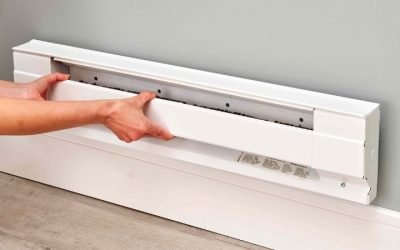
The WH517AS has an important distinction from Dreo’s general-purpose WH719S: Dreo sells this specific configuration with an appliance leakage current interrupter plug. That makes it the more appropriate model to investigate for a suitable bathroom or dressing-area installation, rather than assuming any Wi-Fi heater can tolerate moisture. The outlet has a 30-degree manually adjustable tilt, which is less flexible than the WH719S’s motorized vertical sweep but sufficient when the warmth needs to point toward one standing area. Proper clearance and manufacturer instructions remain necessary despite the ALCI feature.
Dreo’s product page for the Smart Wall-mounted Heater 517AS with ALCI Plug specifies a 1,500-watt ceramic system, three heating settings, a fan-only mode and a 24-hour timer. The thermostat operates across 41 to 95 degrees F in one-degree increments. The maker displayed a $119.99 US price in October 2026, and the chosen listing explicitly says Smart WiFi with ALCI Plug. Lowe’s product specification listing for WH517AS separately records 120-volt use, 12.5-amp maximum draw, and an overheat shutoff. Its listing identifies an ETL safety listing; buyers should confirm the marking on the exact unit delivered before installation.
Lowe’s dimensions for the WH517AS are 12.2 inches wide, 15.75 inches tall and 4.72 inches deep, with a 70.8-inch power cord. That cord length can determine whether a legal mounting position can reach a suitable wall outlet without an extension. Ask a qualified electrician about the required GFCI protection, receptacle placement and installation zone in a bathroom; the ALCI plug does not override those requirements. The Lowe’s listing states a one-year limited warranty and indicates the model lacks a tip-over switch, which is understandable for a correctly installed fixed-wall design but still worth noting. Do not take a bathroom suitability claim to mean shower enclosure use.
Pros:
- ALCI-equipped configuration is explicitly identified on the US listing.
- Seventy-inch-plus cable allows more outlet reach than Phoenix’s three feet.
- Fan-only mode provides a nonheating option after the season.
Cons:
- The outlet tilt is manual, not the WH719S’s powered airflow sweep.
- Safe bathroom placement may require professional electrical advice before mounting.
Who Should Buy It: Consider WH517AS for a location approved by its installation instructions; select Heat Storm A-1000-WX-WiFi for lower-wattage dry-room use.
Heat Storm A-1000-WX-WiFi: Best for Lower-Wattage Heat
Best For: A small dry room needing discreet Wi-Fi wall heating without using the full 1,500-watt output of larger heaters.
The WX gives buyers a meaningful electrical choice rather than another cosmetic variation of a 1,500-watt heater. Its lower maximum draw is useful when a room needs modest supplemental warmth and occupants do not want to select a larger high-output unit. At full power it still demands a dedicated share of the circuit’s available capacity. Heat Storm’s quartz infrared system provides warmth through a wall-mounted cabinet rather than a movable ceramic tower, and the digital thermostat permits temperature adjustments at the unit. A low-output heater cannot overcome severe heat loss or replace proper insulation.
Heat Storm’s product page for model A-1000-WX-WiFi lists a 500-watt low mode, a 1,000-watt high mode and an economy setting that changes output automatically. The manufacturer specifies 4.1 to 8.3 amps of current draw, 3,400 BTU per hour maximum heat output and 40 to 44 dB of operating noise. That decibel range is the maker’s figure, not an independently comparable lab measurement. Wi-Fi scheduling, child lock, a touch-screen thermostat and an included remote are also listed. Heat Storm priced the WX at $129.99 in October 2026, equal to the published Dreo WH719S price despite its lower ceiling.
The WX is roughly 13 inches long, 4 inches deep and 17 inches tall, according to Heat Storm’s published dimensions. Its listed weight of 6.1 pounds makes wall fastening simpler than many heavy fixed units, but correct anchors still depend on the substrate. The manufacturer describes the exterior as cool to touch and lists a tip-over safety feature; treat those as supplementary protections rather than permission to place furniture against the cabinet. Heat Storm provides a one-year warranty and a 30-day return policy on its US storefront. Neither the Wi-Fi app nor the 500-watt setting proves the unit will lower a household bill unless heating time or the volume of heated space changes.
Pros:
- A documented 1,000-watt maximum limits peak draw to about 8.3 amps.
- Two distinct power levels offer a lower 500-watt heating option.
- Included handheld remote remains useful when phone control is inconvenient.
Cons:
- Its price matches the stronger Dreo WH719S at the listed prices.
- Maximum output can be insufficient in poorly insulated or larger rooms.
Who Should Buy It: Choose A-1000-WX-WiFi for modest heating loads; switch to Heat Storm A-1500-PHX-WIFI when a full 1,500-watt infrared model is justified.
Heat Storm A-1500-PHX-WIFI: Best for Infrared Walls
Best For: Buyers who prefer a higher-output quartz infrared wall heater with a phone app and a short, fixed cable run.
The Phoenix is the Heat Storm option to consider when the WX’s 1,000-watt limit is not enough. Its 1,500-watt top setting matches the Lasko and Dreo choices on electrical heat output, but the infrared quartz layout, wall-mounted format and Smart Life app create a different ownership experience. The cabinet also has a lower heating mode for milder conditions. Unlike a portable tower that can be moved after renovation, the Phoenix is best purchased once you know exactly where a wall heater will remain through the season.
Heat Storm’s Phoenix Infrared Heater with Wi-Fi product page identifies model A-1500-PHX-WIFI and specifies 750-watt and 1,500-watt heating modes, drawing 6.25 to 12.5 amps at 120 volts. It publishes a thermostat setting range of 40 to 99 degrees F and a maker-rated noise range of 42 to 47 dB. The manufacturer also describes a touchscreen, child lock, tip-over shutoff and Wi-Fi connection with a Smart Life app. Its listed price is $149.99 as of October 2026, the highest of these five. The premium does not reflect higher wattage than the $79.99-sale Lasko AR122; it primarily buys this specific mounted infrared format.
Heat Storm’s specification sheet within the Phoenix product page gives cabinet dimensions of 19 inches long, 4 inches deep and 16 inches high, and a unit weight of 8.45 pounds. The 3-foot power cord has immediate placement consequences: the final bracket position must reach a correctly located wall receptacle without a power strip or extension lead. The product page specifies wall mounting only and includes wall hardware and a handheld remote. One-year warranty coverage is listed by Heat Storm. If the chosen spot cannot clear curtains, storage or a bed, relocating the heater is the right answer, not routing a plug behind the furniture.
Pros:
- 750-watt low mode provides a defined step down from 1,500 watts.
- Smart Life app supplements the physical touchscreen and handheld remote.
- Thermostat settings extend from 40 to 99 degrees F as stated.
Cons:
- Three-foot cord severely narrows the acceptable receptacle locations.
- Wall-only configuration cannot become a floor heater with included feet.
Who Should Buy It: Buy A-1500-PHX-WIFI for a permanent infrared heating position; consider Dreo WH517AS when an approved ALCI-equipped installation is essential.
How to Choose a Wi-Fi Space Heater
Start with the place where you can safely operate the heater, not the app’s screenshots. This lineup includes one floor tower and four wall-mounted models, all designed for the US 120-volt market. Heat output is governed by wattage and operating time. App schedules can reduce waste by avoiding unnecessary heating, but a 1,500-watt electric resistance heater does not generate more heat per unit of electricity simply because it uses Wi-Fi. The Consumer Product Safety Commission’s 2026 winter safety guidance advises direct wall-outlet connections, clearance from combustible materials and switching portable heaters off for sleep.
Match Heat Output to the Room and Circuit
Compare the maximum wattage before relying on a maker’s square-foot coverage estimate. At full output, the four 1,500-watt models deliver broadly similar amounts of electrical heat, while the Heat Storm WX produces less at 1,000 watts. A living room losing heat rapidly through windows may need insulation improvements or a professionally designed fixed heating solution, not a higher claimed coverage label. The WX offers a meaningful reduction in maximum electric demand, but a low-wattage heater that runs continuously may use more total energy than a larger model operated briefly.
A 1,500-watt appliance on a 120-volt outlet draws approximately 12.5 amps, leaving limited room for other large loads on a 15-amp household branch circuit. The precise capacity depends on the circuit, existing loads and installation. Heat Storm publishes 6.25 to 12.5 amps for the Phoenix and 4.1 to 8.3 amps for the WX, giving a directly comparable starting point. Do not assume a wall outlet is suitable because a plug physically fits; have an electrician evaluate recurring breaker trips, loose connections, hot receptacles or questionable wiring.
Check App, Voice and Offline Controls
Decide what the phone actually needs to do. A programmable temperature setting is useful when the room is occupied, while a shutdown timer can prevent forgetting a manual switch. Lasko’s Aria for Home system adds occupancy-related automation; the Dreo models use Dreo’s app and support Alexa or Google voice controls; Heat Storm uses Smart Life and includes handheld remotes. These systems are not interchangeable. Review current app compatibility, account requirements and wireless setup on the maker’s site, especially if the household shares a router or uses guest Wi-Fi.
Then pretend the router is offline. Can you reach the buttons, read the temperature display and switch the heater off without a phone? The AR122 provides front touch controls but no handheld remote, while the Heat Storm heaters include both a remote and on-unit interface. The Dreo wall models also provide local operation. Smart-home routines should never bypass a physical safety shutoff or be used to start unattended room heating. Treat remote access primarily as a convenience for checking settings and shutting a unit down, rather than as permission to warm a vacant home.
Measure the Installation Space and Outlet Reach
Stand at the actual mounting position and check the heater’s complete footprint, not only its advertised height. The WH719S occupies roughly 20 inches horizontally, whereas the Dreo WH517AS is about 12 inches wide. The Heat Storm Phoenix extends about 19 inches and has just 3 feet of cord; moving it an inch or two can affect whether the cable reaches a wall outlet. The Lasko is 22 inches tall and can be placed without drilling, but its floor footprint still needs a safe buffer from foot traffic, furniture and curtains.
The CPSC says portable heaters should remain at least 3 feet from combustible objects and be plugged directly into a wall outlet, never a power strip or extension cord. Follow model-specific mounting clearances, which may differ from the portable-heater rule. Do not run the cord through a wall, under a rug or behind fabric. Bathroom outlets introduce additional code requirements; the Dreo WH517AS’s ALCI plug is a feature to verify, not a substitute for GFCI protection or compliant installation. A licensed electrician is the right person to assess questionable existing receptacles.
Review Safety Records and Ownership Costs
Smart functionality is a reason to inspect recall history more closely, not less. In CPSC recall 25-036, announced November 7, 2024, model numbers H7130, H7131, H7132, H7133, H7134 and H7135 from GoveeLife or Govee were recalled because of overheating and fire risk associated with wireless control. The CPSC reported about 512,500 recalled units in the US. This is model-specific evidence and should not be generalized to unrelated appliances or brands. Before buying any smart heater, match the complete suffix on the seller listing and unit label against the current CPSC recall database.
Compare the actual warranty and how easy it is to obtain replacement help. Lasko gives the AR122 a three-year limited warranty, Dreo states 12 months for new units, and Heat Storm lists one year for its Wi-Fi units. There is no consumable filter subscription among these five choices, although the Dreo WH719S has a reusable filter to inspect and clean as instructed. The largest running cost is electricity, driven by the chosen wattage, thermostat cycling, local utility price and occupied heating time. Choose a product that fits how you use the room rather than expecting an app to overcome poor insulation.
Frequently Asked Questions
Wi-Fi compatibility and heater safety are separate questions. These answers cover everyday ownership concerns that are easy to overlook when comparing specifications.
Can a smart heater be powered through a smart plug?
No general-purpose smart plug should be used as a shortcut for heater automation. The CPSC specifically instructs consumers to plug electric space heaters directly into wall outlets, not power strips or extension cords. A plug-in relay introduces another electrical connection that must carry the appliance’s load, and many heater manufacturers prohibit such accessories. Use the heater’s built-in controls and its own approved app features instead. If the manufacturer does not explicitly allow an accessory, do not treat a generic wattage label as authorization.
Will a Wi-Fi heater continue heating if internet access fails?
Local heating may continue under the unit’s existing physical thermostat or control setting, but remote adjustments can stop until connectivity returns. Exact recovery behavior depends on the model and firmware, so consult its user guide before relying on a schedule. The Lasko AR122 has a front touch panel, and the Heat Storm WX and Phoenix have local thermostats and remotes. Some automations depend on an account, a wireless router or a cloud service; a failed connection should not be treated as a reason to leave a heater running without supervision.
Can one Wi-Fi heater warm a whole open-plan house?
Usually not. A 1,500-watt portable unit is better treated as supplemental heat for an occupied area than a replacement for a central system. Doorways, tall ceilings and large windows make the heat requirement very different from a closed, insulated bedroom. The maker’s coverage number is an estimate under assumptions that might not match your home. A fan-driven ceramic unit can distribute warmth within a room, but it does not increase the amount of heat produced at a fixed wattage. For multiple large rooms, obtain a heating-load assessment rather than buying several heaters on claimed square footage alone.
How do I prevent a heater’s app schedule from running overnight?
Disable scheduled start times, check any voice-assistant routines and use the device’s own power button to switch it off before sleeping. Review both the manufacturer’s app and any linked home-automation platform, since deleting a routine in only one place may leave another active. The CPSC’s 2026 winter guidance says to turn portable heaters off while sleeping. A countdown timer may be useful while a person remains awake in the room, but it is not a replacement for verifying that the heater is off when the room becomes unoccupied.
Final Thoughts
For a flexible office or living area, our choice remains the Lasko AR122 because it combines a 1,500-watt ceramic heater, ETL-listed protection, occupancy-aware controls and a three-year warranty without requiring wall installation. If the heater must stay off the floor, the Dreo WH719S is the more targeted option for directing warmth vertically. One buying detail can reverse either choice: an available outlet that cannot safely serve the unit at its intended location. Confirm the model number, current price, CPSC recall status and the installation instructions before placing the order, and never rely on wireless control to make unattended heating acceptable.