Key takeaways
- Two specified power settings allow 750-watt or 1,500-watt operation.
- Product documentation includes separate thermal and tip-over shutoff functions.
- Wall-mount capability and wheeled floor placement support changing room arrangements.
A panel space heater can free up floor space and deliver quiet supplemental warmth, but a slim profile does not tell you how much heat a unit makes. The models here span 400 to 1,500 watts, from flat wall panels intended for modest rooms to a freestanding mica heater that also mounts on a wall. We compared the actual heating output, temperature controls, mounting arrangements and published safety information so you can choose based on the room rather than an inflated coverage claim.
Quick Verdict: The De’Longhi HMP1500-6A is the Best Overall choice because its 750- and 1,500-watt settings, wall-mount option and published tip-over and thermal protections give buyers more flexibility. Choose the Envi LE5012P for a fixed, fanless 500-watt installation instead. These are editorial selections based on manufacturer documents and US listings as of October 2026, not hands-on tests. Check the current price and mounting instructions before ordering.
As an Amazon Associate we earn from qualifying purchases.
By DIY Ideas 4 Home Editorial Team
5 Panel Space Heaters Reviewed
We selected five identifiable US-market products using manufacturer product pages, technical documents and current listings, not unverified marketplace performance claims. Listed prices ranged from $129.95 to $269.00 in October 2026. Importantly, these are resistance heaters: a 500-watt panel cannot produce the same continuous heat as a 1,500-watt model simply because its maker describes it as efficient. Use the comparison to narrow the correct output and installation type before judging appearance or features.
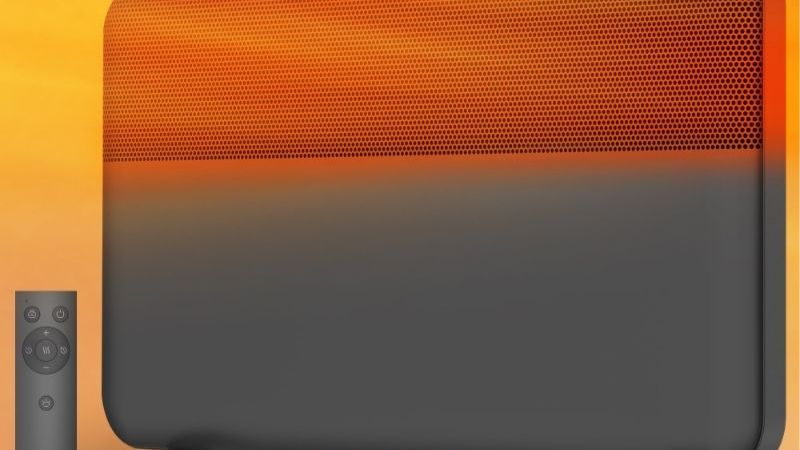
| Product | Best For | Key Spec | Listed Price (as of October 2026) | Watch Out For |
|---|---|---|---|---|
| De’Longhi HMP1500-6A | Best Overall: flexible room use | 750 or 1,500 W; 120 V; wall or floor | $129.95 | Floor hardware needs clearance |
| Envi LE5012P | Quiet bedroom zone | 500 W; 120 V; wall-mounted | $179.95 | Modest output in drafty rooms |
| Stiebel Eltron CNS 150-1 Plus | Permanent high-output wall zone | 1,500 W; 120 V; digital controls | $269.00 | More wall space and higher price |
| EconoHome 400W with Heat Guard | Low-profile small-room heating | 400 W; 120 V; plug-in thermostat | $159.00 | Guard and mounting affect clearance |
| Smart Envi SE5012P | App-based thermostat scheduling | 500 W; 120 V; smart controls | $199.96 | Extra cost without extra wattage |
De’Longhi HMP1500-6A: Best Overall
Best For: A buyer who wants one quiet panel heater for either a wall location or occasional floor placement.
De’Longhi makes the broadest practical compromise in this group: it has the output to supplement a cooler living area without committing the buyer to permanently mounting a low-wattage panel. Unlike the Envi models, it can be set on its supplied rolling feet, then relocated when the room arrangement changes. That flexibility matters if you are still learning which room needs extra heat. Its mica heating element spreads warmth from a broad surface, although the housing still needs open clearance.
De’Longhi’s product page for the HMP1500-6A identifies a 120-volt heater with 750- and 1,500-watt heat settings, an adjustable room thermostat, and automatic tip-over and thermal shutoffs. The company’s October 2026 US listing showed $129.95. The 1,500-watt rating provides three times the maximum heat output of a 500-watt panel while drawing substantially more power on high; none of these products eliminates the expense of prolonged electric-resistance heating. A lower setting gives the owner a useful option when full output is unnecessary.
De’Longhi publishes housing dimensions of approximately 27.4 inches wide and 22.5 inches tall for this model, with the installed configuration affecting its depth. Its wheeled base and carry handle are practical for a finished living area but awkward beside an already crowded desk or narrow doorway. The product page states that the mica heater can also be wall mounted, so confirm which hardware comes with the currently sold HMP1500-6A package. Keep the air path clear, inspect the cord regularly, and use a properly rated wall outlet.
Pros:
- Two specified power settings allow 750-watt or 1,500-watt operation.
- Product documentation includes separate thermal and tip-over shutoff functions.
- Wall-mount capability and wheeled floor placement support changing room arrangements.
Cons:
- The floor configuration occupies more circulation space than a fixed Envi panel.
- At maximum output, it draws more power than the 400-watt EconoHome.
Who Should Buy It: Choose the HMP1500-6A for movable supplemental heat; choose the Stiebel Eltron CNS 150-1 Plus if a dedicated digital wall installation is the priority.
Envi LE5012P: Best for Quiet Bedrooms
Best For: A homeowner who wants steady supplemental heat from a simple, fanless wall panel with a manual thermostat.
The LE5012P is built around a different routine from the De’Longhi: mount it once, leave the floor clear and let natural convection gradually circulate warm air. It is particularly appealing in a room where fan noise and a loose floor appliance would be unwelcome. The compromise is decisive: its 500-watt output is appropriate for modest heat loads rather than recovering a poorly insulated room from a deep setback on a freezing evening.
Envi’s product page for the third-generation LE5012P lists 500 watts, 120 volts, a 4.17-amp draw and a manual temperature-controlling thermostat. The listed US price was $179.95 as of October 2026. The same page describes its Wall-Sens feature, which shuts off the heater when removed from the wall. Envi’s owner’s manual identifies the LE5012P by model number and details the mounting method and operational limitations. The brand advertises room coverage around 130 to 150 square feet, but that is an estimated use case and not a guarantee for every building.
The body is approximately 19.3 inches wide, 22.2 inches tall and 2 inches deep, with a 6-foot plug-in cord and a listed 10-pound unit weight. The narrow depth helps in passages where a rolling heater would be intrusive, although the installer still must follow the clearance drawing and avoid drapes or furniture blocking airflow. Envi lists a three-year limited manufacturer warranty for a new LE5012P. The walls and outlets available in your actual room are more important to installation than the heater’s advertised coverage figure.
Pros:
- Fanless natural convection avoids the constant sound of a blower.
- Wall-Sens is designed to stop operation when the heater is dismounted.
- Six-foot cord simplifies placement near a suitable 120-volt wall outlet.
Cons:
- Five hundred watts may not overcome rapid heat loss in a large room.
- Manual thermostat lacks the app-based scheduling offered by Smart Envi SE5012P.
Who Should Buy It: Buy LE5012P for a quiet fixed bedroom zone; choose the De’Longhi HMP1500-6A when faster heating recovery is more important.
Stiebel Eltron CNS 150-1 Plus: Best for Fixed Zones
Best For: Owners planning a permanent, high-output wall heater with digital temperature adjustment and an unobstructed mounting location.
Stiebel Eltron’s CNS 150-1 Plus treats the wall heater as part of the room’s planned layout rather than an appliance moved between spaces. Its digital controls and natural-convection airflow work well when a small room needs consistent supplemental heat throughout the day. Compared with a 500-watt Envi, the available output is much higher, but that also raises circuit loading and running cost. Buyers paying the premium are getting installation-focused features, not a magical efficiency improvement.
Stiebel Eltron’s specification sheet for the CNS Trend and Plus series identifies the CNS 150-1 Plus, item 201996, as a 1,500-watt, 120-volt heater drawing 12.5 amps on rated output. The maker specifies a built-in thermostat, overheat protection and a frost protection setting, and lists conformity to UL 1278 and UL 2021 in its technical documentation. Home Depot listed this particular CNS 150-1 Plus at $269.00 in October 2026. That is a meaningful premium over the De’Longhi’s listed price, even though both have 1,500-watt maximum ratings.
The official submittal sheet gives a 22 15/16-inch width, 17 3/4-inch height, about 3 15/16-inch depth and a 13.2-pound weight. It also documents a cord-and-plug arrangement for the 120-volt version, whereas related 240-volt CNS models are hardwired; do not mistake one for the other. The separate installation manual gives clearances that must be kept around the upper outlet grille. Stiebel Eltron’s residential warranty covers defects in materials and workmanship for three years, with exclusions and labor costs detailed in the actual warranty document.
Pros:
- Digital thermostat and frost setting support a fixed-room heating routine.
- Rated 1,500-watt output matches the group’s high-output portable choice.
- Manufacturer submittal sheet identifies UL 1278 and UL 2021 conformity.
Cons:
- Wall mounting commits to a specific location and required grille clearances.
- At $269.00, its listed price exceeds De’Longhi HMP1500-6A substantially.
Who Should Buy It: Select CNS 150-1 Plus for an established wall-heating zone; take the Envi LE5012P for a smaller 500-watt heating load.
EconoHome 400W: Best for Slim Installations
Best For: A small, reasonably insulated room where a thin wall surface and a separate plug-in thermostat matter most.
The EconoHome kit addresses a specific constraint that bulkier convection heaters cannot: finding a place for heat where the usable wall depth is minimal. The panel itself is remarkably thin, and the included heat guard and reflector distinguish this kit from a bare 400-watt slab. It is not a sensible substitute for a 1,500-watt heater in a basement with exposed walls. This pick works when the intended space and heat demand really are small.
EconoHome’s product page for its 400W Wall Heater with Thermostat and Heat Guard Cover lists 400 watts, 120 volts and a rated draw of about 3.33 amps. The current 400-watt kit is identifiable on the company’s store as SKU MW-EH-D-+TH+AL-400W, with a $159.00 price in October 2026. Its listing includes a plug-in adjustable thermostat, reflector, heat guard and overheat protection, and states conformity to UL 2021. Treat the maker’s square-foot claims as rough estimates; they depend on insulation and outdoor conditions.
The maker reports a panel measuring about 24 inches by 24 inches, with a thickness around 0.4 inch before considering the installed guard and wall spacers. It also specifies a roughly 5.9-foot cord and a three-year warranty. That configuration needs enough open wall area for the bracket pattern, even though the heating face is flat. The detachable plug-in thermostat should be positioned and used as directed rather than buried behind a sofa or enclosed cabinet. Check that the separately fitted guard is included in the actual retail bundle.
Pros:
- The 0.4-inch panel body uses very little wall depth.
- Included guard and reflector distinguish this from a bare heating panel.
- Separate plug-in thermostat provides adjustable control for the 400-watt element.
Cons:
- Four hundred watts can be overwhelmed by an uninsulated exterior room.
- Guard and wall spacers make installed depth greater than panel thickness.
Who Should Buy It: Choose this 400-watt kit for narrow-wall supplemental warmth; move to the Stiebel Eltron CNS 150-1 Plus when the room requires a much larger heat input.
Smart Envi SE5012P: Best for App Control
Best For: A buyer who wants the quiet Envi format but prefers phone scheduling to a mechanical temperature dial.
The Smart Envi SE5012P improves control, not heat production. Its digital interface and app are convenient for occupied room schedules, and its appearance retains the wall-mounted footprint that makes the standard Envi useful in bedrooms. A homeowner who simply turns heat on when entering a room may be better served by the cheaper manual Envi. Remote-control convenience also introduces an extra layer of device setup that not everyone wants for a basic heater.
Envi’s product page for the fourth-generation SE5012P specifies 500 watts at 120 volts, a rated current of 4.17 amps and digital and smart-app thermostat control. It showed a sale price of $199.96, against a displayed $249.95 comparison price, in October 2026. The manufacturer’s Smart Envi specification sheet identifies the SE5012P as a distinct model from the manual LE5012P. Do not interpret its scheduling features as evidence it heats a room faster; both plug-in heaters have the same 500-watt maximum output.
Envi lists the SE5012P body at 19.3 inches wide, 22.2 inches high and about 2 inches deep, with a 6-foot cord and a 10-pound product weight. Its installation still requires clear air passages and a suitably placed outlet. Smart features are most worthwhile where regular occupancy hours justify schedule changes, not because someone assumes the app makes heat less costly per kilowatt-hour. Verify current app platform compatibility on the SE5012P listing rather than relying on controls listed for a different Envi generation.
Pros:
- Built-in digital interface supports temperature adjustments beyond a mechanical dial.
- App controls make repeated room-use schedules easier to manage.
- The wall-mounted 500-watt design avoids taking up floor space.
Cons:
- Phone control adds setup and possible connectivity problems to simple heating.
- Cost exceeds LE5012P without increasing the maximum 500-watt heat output.
Who Should Buy It: Buy SE5012P for programmable quiet heating; choose the De’Longhi HMP1500-6A if substantial heat output matters more than remote control.
How to Choose a Panel Space Heater
The most important difference among these products is not their flat appearance: they consume between 400 and 1,500 watts at rated output and have very different installation expectations. Measure the wall, identify the available outlet and decide whether you need short bursts of warmth or slow, steady supplemental heat. A panel cannot repair inadequate insulation, and electrical-resistance heating is usually a poor whole-home substitute for a properly sized heat pump.
Match Wattage to Heat Loss
Think of 400 or 500 watts as a modest supplement for a relatively stable, enclosed room, not a universal room-size promise. Envi suggests around 130 to 150 square feet for its 500-watt panel, while Stiebel’s technical sheet estimates 150 square feet for its 1,500-watt CNS Plus under average insulation assumptions. The very different maker estimates show why square-foot claims should not be the ranking system: window losses, air leakage, ceiling height and outdoor temperature can dominate. Select output using real heat demand rather than the largest marketing coverage number.
The US Department of Energy explains that heat pumps can use considerably less electricity than resistance heaters to supply an equivalent heating service. A flat panel does not multiply the energy supplied by an ordinary wall outlet. If a 1,500-watt unit is necessary every evening, investigate drafts and consider an appropriate permanent HVAC solution instead of adding several tiny panels. For occasional heating, a smaller unit’s lower power draw may be useful precisely because it delivers less heat.
Choose a Mounting and Power Connection
De’Longhi HMP1500-6A can stand on its feet or mount on the wall; the remaining products here are designed for a fixed wall position. Confirm the complete installed dimensions, required anchor type, spacing from floors, and access to the controls before buying. The EconoHome panel is very thin by itself but requires added space for its guard. A unit that fits the available width may still be unsuitable under a shelf, behind curtains or beside furniture if the manual requires an open convection pathway.
All five selected variants are listed for 120-volt operation, but that does not make any available outlet appropriate. Stiebel’s CNS 150-1 Plus draws 12.5 amps at 1,500 watts, a significant load on a typical 15-amp residential circuit. US Consumer Product Safety Commission guidance issued in 2026 says plug-in space heaters should connect directly to the wall, not an extension cord or power strip, and recommends at least three feet of separation from flammable materials for portable units. Follow each model’s own wall-mount clearance instructions, and have fixed wiring evaluated by a qualified electrician.
Compare Thermostat Behavior
A thermostat helps limit operation when the room has reached the chosen temperature, but it does not make the resistance element produce more heat per watt. The LE5012P offers a straightforward manual thermostat, the Smart Envi has an app and digital control, and the Stiebel Plus uses an onboard digital interface with extra modes. Meanwhile, the De’Longhi combines a dial thermostat with two distinct power levels. Decide whether adjustable output, temperature maintenance or remote scheduling would materially change how you actually use the unit.
Scheduling may save energy if it reduces the hours a heater operates. It will not automatically save money when the heater maintains the same temperature for the same hours. Plan for the heater to turn off when the room is unattended unless the specific manufacturer’s instructions authorize another use; do not leave a portable unit running while sleeping contrary to CPSC safety advice. A simple dial and direct observation can be more appropriate than remote operation in a home with limited electrical capacity.
Check Safety Documentation and Long-Term Cost
Before purchasing, read the owner’s manual for the exact model and generation. De’Longhi identifies tip-over and thermal protections, while Envi describes its wall-removal shutoff and Stiebel publishes a technical submittal detailing overheat protection and applicable UL standards. Those are different protections rather than interchangeable guarantees. Check whether the unit is currently subject to a recall through the CPSC database, and inspect the condition of the installed receptacle and household circuit. Never cover the heating surface with fabric.
At an illustrative electricity rate of 18 cents per kilowatt-hour, using a 1,500-watt heater on high for four hours a day costs roughly $32 for a 30-day month. Under identical assumptions, a 500-watt heater costs about $11 and a 400-watt unit about $9, but those smaller units also deliver substantially less heat. Actual thermostat cycling, electricity tariffs and room heat loss change the bill. The lower-wattage choice only saves if it provides adequate comfort without needing to run additional heaters or the main system harder.
Frequently Asked Questions
These questions cover installation and operation details that may change the purchase even after you have selected the right wattage.
Can a panel heater be installed under a window?
Sometimes, but the specific heater’s installation manual must permit the location and its required clearances. Window coverings can hang into the hot-air outlet path even if the unit fits physically below the sill. Check Stiebel’s clearance diagram or Envi’s wall-mount instructions against the actual curtains, window trim and furniture in the room before drilling.
Do mica and convection panels work the same way?
Not exactly. The De’Longhi uses a mica heating element and can be used with portable supports, whereas the Envi and Stiebel wall units are designed around convection through a fixed installation. Both categories rely on electric resistance to make heat, and some heat reaches a person or surface by radiation. The difference for a buyer is chiefly airflow, installation, controls and where the warmth is delivered.
Can you paint an electric panel heater?
Only when the exact manufacturer explicitly permits painting, and only with the materials and method the maker specifies. EconoHome markets a paintable surface on certain wall panels, but the same permission must not be assumed for a De’Longhi, Envi or Stiebel enclosure. Paint can block vents, change surface temperatures or conceal warnings. Check the owner’s instructions for the specific panel and never paint an operating unit.
Is a 500-watt panel enough for a cold basement?
Often not on its own, especially if the basement has bare concrete, air leaks or significant moisture. A 500-watt heater has one-third of the rated heat output of a 1,500-watt heater; using a fanless panel does not change that energy limit. Address bulk water and humidity issues before adding heat, and compare the building’s actual heat load with the heater’s rated output. If the space needs sustained high output, consider a properly sized installed system.
Final Thoughts
The De’Longhi HMP1500-6A remains the most versatile panel space heater here because it offers two real heat settings, floor or wall placement and published shutoff protections at a lower listed price than the dedicated 1,500-watt Stiebel CNS 150-1 Plus. Choose Envi LE5012P when a permanent, quiet 500-watt bedroom zone is adequate; upgrade to SE5012P only if you will use the app. Before checking out, compare the actual wall clearance drawing with your furniture and confirm the model number, outlet capacity and current price on the listing.