
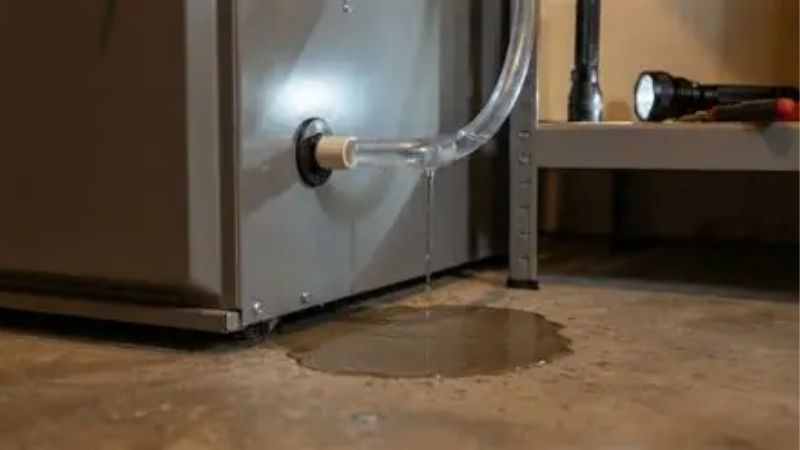
A puddle beneath a furnace usually means water is escaping a condensate drain, pump, humidifier, or nearby cooling component rather than following its intended path. The answer to why is my furnace leaking water also depends on whether heat or air conditioning was running. High-efficiency gas furnaces make condensate normally, but a wet cabinet or floor is not normal drainage. Water near wiring, suspected combustion problems, or a gas odor calls for a different response from a minor drain issue.
Quick Answer: Turn the system off if water is reaching electrical parts, then look without opening the cabinet for a wet drain hose, overflowing pump, humidifier supply connection, or AC drain. Contain water if it is safe to do so. If you smell gas, leave without operating switches and call the utility or 911 from outside.
As an Amazon Associate we earn from qualifying purchases.
By DIY Ideas 4 Home Editorial Team
Why Your Furnace Leaks Water: 5 Common Causes
Locate the first wet surface, then note which equipment was running before you found the puddle. Carrier’s furnace-leak guidance identifies the condensate system, pump, humidifier, and sometimes a heat exchanger as potential sources. A furnace room can also contain plumbing equipment whose leak happens to run beneath the furnace, so floor location alone is not proof.
| Symptom or Sign | Likely Cause | First Check | DIY or Pro |
|---|---|---|---|
| Dripping during a heat call near a small drain hose | Blocked or frozen furnace condensate line | Look for kinks, ice, or standing water from outside the cabinet | Visual check DIY; internal trap work pro |
| Water around a floor-level collection tank | Condensate pump or discharge failure | Check whether the pump tank is full or power is interrupted | External check DIY; replacement or wiring pro |
| Water near a duct-mounted humidifier | Humidifier feed, pad, or drain leak | Trace visible hose and fitting surfaces without disconnecting them | Visual check DIY; plumbing repair pro |
| Wet floor only while cooling | Evaporator coil condensate overflow | Check for dampness at the AC drain pan or line | External check DIY; clogged pan or coil pro |
| Rust, staining, or water inside the heat-exchanger area | Vent or internal furnace failure | Stop operation and document visible signs | HVAC pro urgently |
1. The High-Efficiency Furnace Condensate Drain Is Blocked
Trane explains that furnaces rated at about 90% AFUE or higher capture additional heat through a secondary heat exchanger. This causes water vapor in combustion exhaust to condense into liquid, which is supposed to drain through a dedicated route. The U.S. Department of Energy’s direct-vent equipment guidance describes condensing furnaces in the 90% to 98% AFUE range. Producing this water is expected; releasing it onto the floor is not.
Look for an external drain tube, a damp elbow, or moisture where the line enters a floor drain. Sediment, a low spot holding water, a dislodged connection, or a frozen outdoor section can interrupt the route. Do not disconnect a furnace condensate trap or open combustion-related compartments to force the water out. These parts may interact with the furnace’s venting and pressure controls.
2. The Condensate Pump Cannot Empty Its Reservoir
Some installations collect water in a small pump tank because the discharge must travel upward before reaching a drain. An obstructed discharge tube, failed motor, stuck float, power interruption, or poor installation can leave that reservoir overflowing. A high-water safety switch may also interrupt heating, which explains why a leak sometimes arrives with a no-heat complaint. Whether the pump serves the furnace, AC, or both depends on the layout.
If the unit is accessible from dry flooring, note whether its reservoir is visibly overfull, whether it has an outlet connection, and whether the discharge tube appears pinched. A silent pump is not enough to diagnose failure; some pumps cycle only when the tank fills. Leave testing of live wiring, internal float switches, and pump replacement to qualified personnel if there is any electrical exposure.
3. The Whole-House Humidifier Has a Water-Line Leak
A furnace-mounted humidifier uses the home’s water supply, so a drip can continue even if the furnace itself is not making condensate. Trane describes deteriorated humidifier pads, damaged drains, and loose connections as possible leak sources. A supply tube or fitting may also produce a narrow stream that follows the ductwork before reaching the floor, disguising where the leak begins.
Compare dampness on the humidifier housing with water at the base of the furnace. If there is an identifiable, accessible humidifier shutoff valve and the owner’s manual permits it, closing that valve may limit further leakage while you arrange a repair. Never assume a valve on an unfamiliar line controls only the humidifier. Do not open pressurized fittings or change an electrically controlled valve as a first troubleshooting step.
4. The Air Conditioner Is Overflowing Near the Furnace
If the leak occurs in cooling season, the furnace may be an innocent bystander. Many split systems place the indoor evaporator coil on or beside the furnace cabinet. Warm household air deposits moisture on the cold coil, and a drain pan directs the resulting water away. Trane’s furnace-leak guidance identifies a blocked AC condensate drain or overflowing pan as a common reason water appears near the furnace when cooling is on.
Notice whether the thermostat was calling for cooling, whether the line near the coil cabinet feels wet, and whether the drain pan is visible without removing a panel. Poor airflow can also allow the cooling coil to ice up, followed by unexpected meltwater. Have an HVAC technician diagnose icing or an overflowing secondary pan rather than continually restarting the cooling system and allowing more water to spill.
5. Venting or a Heat Exchanger Has a Serious Problem
Persistent water stains inside the furnace, unusual rust around its internal components, or water appearing where an external drain cannot explain it deserve prompt professional evaluation. Carrier notes that heat exchanger faults can be both a water-leak concern and a combustion safety concern. A failed exchanger is not confirmed by a puddle alone, and a homeowner should not attempt to prove or dismiss that possibility by opening the burner compartment.
Condensate handling and venting are engineered together in a condensing furnace. Changes to slopes, seals, and drain traps can affect more than water disposal. If the gas furnace shuts down repeatedly, makes unusual combustion noises, or has extensive interior corrosion, leave it off for service. If a carbon monoxide alarm sounds, exit immediately and call emergency services rather than approaching the furnace to investigate.
How to Stop a Furnace Water Leak Step by Step
Your safe troubleshooting boundary is the outside of the cabinet, its visible drain route, and nearby appliances. You are looking for enough evidence to prevent more damage and direct the repair, not for an excuse to bypass a safety control. Carrier’s furnace guidance recommends shutting equipment down when water may reach energized components and consulting a professional when the source is not accessible.
Step 1: Make the Area Safe and Shut Off the System
Keep people away from wet electrical outlets and appliances. If the path to a dry, accessible thermostat or service disconnect is safe, turn the system off according to its manual; if standing water surrounds the controls, do not approach them. Photograph the puddle from a safe position, then place towels or a shallow container only where doing so cannot touch wiring, hot venting, or gas equipment.
Do not apply this normal shutoff sequence if you smell rotten-egg gas. The American Gas Association instructs occupants to leave the building, avoid electrical switches or other spark sources, and call 911 or the gas utility from outside. The CDC also advises immediate evacuation and an emergency call if a carbon monoxide alarm activates. Neither condition is a drain-cleaning project.
Step 2: Separate Furnace Condensate From Other Water Sources
Look around the room before blaming the heater. A water heater relief discharge, laundry standpipe, plumbing joint, or nearby floor drain may be higher than the puddle and allow water to travel along the concrete. A dry strip of paper towel held against accessible, non-electrical exterior piping can help identify which side is wet, but avoid reaching behind energized equipment or disturbing attached hoses.
Next, use the thermostat history or your observation of the previous cycle. A leak after heating points toward furnace condensate or humidification; one after cooling suggests the evaporator drain. This timing is evidence, not a final diagnosis, because a shared pump may serve multiple drains. Write down the pattern for the service technician instead of deliberately running a leaking system to recreate it.
Step 3: Inspect Visible Hoses, Drains, and Pump Connections
Follow an exposed condensate line with your eyes from the cabinet or coil outlet to its approved termination. Check for a kink, loose external fitting, detached tube, ice near an exterior outlet, or water backing up at the drain. Do not remove glued fittings, force a wire into a pipe, or pour a cleaner into an unidentified opening; a furnace drain can include a model-specific trap and materials that should not be exposed to household chemicals.
If a pump is present, note whether the receptacle area is dry and whether its reservoir looks unusually full. Do not reset a tripped protective device repeatedly to keep the furnace running. Some safety switches intentionally stop the equipment to prevent overflow. An HVAC contractor can isolate the water source, service a clogged trap, check a discharge check valve, and restore the intended drainage arrangement.
Step 4: Check the Humidifier and Cooling Drain From the Outside
Inspect the supply fitting and cabinet seam of any whole-house humidifier without removing its cover or touching the water line. If dampness starts there rather than at the furnace’s condensate outlet, note that distinction. During cooling weather, examine the accessible area around the evaporator housing and its drain connection. A damp coil cabinet after extended cooling suggests the AC side may need attention.
Do not bypass a pan overflow switch, leave a leaking humidifier feed pressurized without a reason, or assume a blocked air filter can be solved by washing an unspecified filter. Filter types and replacement instructions vary by model. If you see visible icing, keep cooling off and tell the technician when it occurred; a restriction or refrigeration fault can cause the same symptom as a clogged drain.
Step 5: Document the Fault and Arrange the Correct Repair
Give the technician the model number from an accessible exterior label, the day the leak began, recent changes in thermostat mode, and photos of wet components. Ask whether the repair concerns the furnace trap, a pump, an AC drain, a humidifier fitting, or internal combustion hardware. The distinction matters because replacing a pump will not repair a cracked drain pan, and cleaning a coil drain will not repair a leaking humidifier supply.
After service, request a demonstration that water drains to the intended location without reaching the floor and that any overflow shutdown works as designed. If there is extensive standing water or soaked building material, arrange appropriate drying as well. For continuing prevention, the CDC recommends a qualified annual inspection of fuel-burning heating systems; ask the contractor to include drainage and venting in the visit.
Products That Help
A Little Giant VCMA-15ULS condensate pump, model 554405, is a possible replacement where an installer confirms that a lift pump is required. Its manufacturer’s product page lists a 0.5-gallon tank, 65 gallons per hour at 1 foot of lift, and a 15-foot shutoff head; that last figure is not a promise of useful flow at the maximum height. It has a safety switch, but discharge tubing is not included, so have a technician match the system’s route and wiring before ordering.
RectorSeal’s Safe-T-Switch SS2, SKU 97087, uses a 3/4-inch adapter at the auxiliary outlet of a compatible primary AC drain pan, according to its product page. It is an overflow-control option for an appropriate cooling drain, not a universal replacement for an internal furnace safety switch. For early warning without modifying the HVAC system, the GoveeLife Water Leak Detector 1s kit pairs H5044 gateway hardware with H5059 sensors and advertises an adjustable alarm up to 105 dB. Check that the kit includes the gateway needed for remote alerts.
When to Call a Pro
Call an HVAC professional promptly for water inside the gas furnace cabinet, recurring shutdowns, corrosion near combustion or venting components, a leaking pump with wet electrics, or any inaccessible drain obstruction. A contractor should also handle gas lines, burner assemblies, heat exchangers, power connections, and condensate traps tied to combustion pressure. Do not keep restarting a unit whose high-water switch is stopping it.
For an immediate gas smell, follow the American Gas Association’s evacuation instructions instead of waiting for an appointment. For an active carbon monoxide alarm, follow CDC emergency guidance and leave the home. If the water has reached a breaker panel or an outlet, keep clear and arrange safe electrical isolation by qualified personnel. A floor puddle by itself cannot distinguish a routine drain repair from a safety problem.
Frequently Asked Questions
The age and design of the furnace, whether it is heating or cooling, and where water first appears determine the next action more reliably than the size of the puddle.
Is Any Water Coming Out of a Furnace Normal?
Yes, water flowing through the designated drain of a condensing gas furnace is expected. Trane explains that its secondary heat exchanger removes more heat from exhaust gases and produces condensate as a result. What is not normal is that water reaching the floor, electrical components, or a part of the cabinet that should remain dry. Check whether the outlet is routing liquid to the approved drain.
Could Condensate From a Furnace Damage a Metal Drain?
It can be more corrosive than ordinary household water because gas combustion condensate may be acidic. Drainage materials and neutralization requirements depend on the installation and local rules, so do not replace a plastic drain section with metal simply because it seems stronger. Ask the service contractor whether a neutralizer or a different disposal route is required for your furnace and plumbing configuration.
Why Does the Leak Appear Only After Freezing Weather?
A condensate outlet exposed to freezing conditions can become obstructed by ice, allowing water to back up toward the appliance. Carrier’s furnace-leak guidance includes frozen drain lines among winter leak explanations. Photograph the outdoor termination from a safe location, but do not chip ice from a vent, apply open flame, or use an electrical heater around wet equipment. Have the installation checked for a durable, manufacturer-approved solution.
Will Replacing My Furnace Air Filter Stop a Water Leak?
Not necessarily. A restricted filter can contribute to poor cooling airflow and coil icing, which may cause meltwater near the furnace during AC operation. It does not correct a disconnected gas-furnace condensate line or a leaking water-fed humidifier. If the filter is due for replacement, use the size and type specified by the system manufacturer, then address the drainage fault independently.
Final Thoughts
If you are still asking why is my furnace leaking water after identifying the first wet component and the heating or cooling mode, leave the equipment off and give that information to an HVAC contractor rather than opening combustion compartments. A replacement pump is worth considering only when a technician confirms a pump fault; a leak alarm is useful for detecting a recurrence but will not stop one. Before buying any drain accessory, confirm the furnace model, drain configuration, and the exact component needing repair.
