
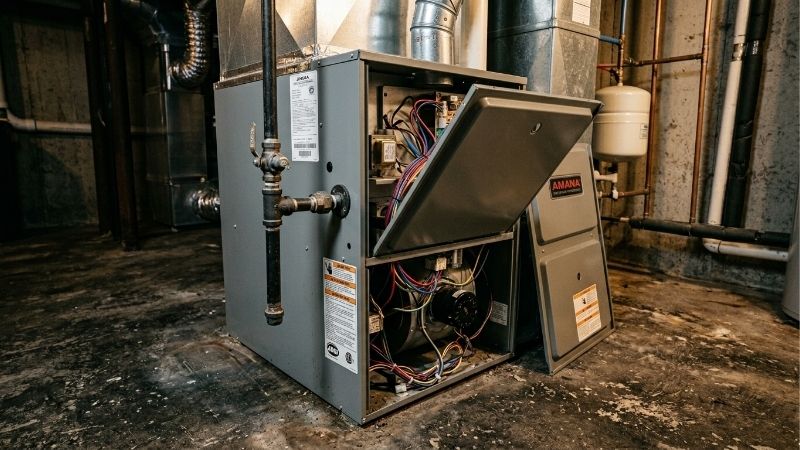
A furnace can hum softly, click as it starts, and push air through the registers without being defective. If you are asking why is my furnace making noise, the useful clues are the kind of sound, the moment it starts, and whether heating still works. Whistling often points to restricted airflow; rattles may come from ductwork or an unsecured exterior panel. A fresh boom at ignition, metallic grinding, or a sharp electrical buzz deserves more caution.
Quick Answer: First compare the sound with the furnace’s normal startup and blower noise, then check an accessible filter and unblocked vents. If you hear a loud ignition bang, smell gas, notice smoke, or hear harsh grinding or electrical buzzing, stop troubleshooting and call a qualified technician. Suspected gas leaks require immediate evacuation rather than switching the furnace off.
As an Amazon Associate we earn from qualifying purchases.
By DIY Ideas 4 Home Editorial Team
Why Your Furnace Is Making Noise: Common Causes
Carrier’s furnace troubleshooting guide and Trane’s guide to buzzing furnaces both distinguish ordinary operating sounds from airflow restriction, loose ductwork, and mechanical trouble. A furnace makes several sounds in one heating cycle, so the location and timing matter as much as volume. The table identifies a reasonable first check, not a diagnosis you can confirm without inspecting the system.
| Symptom or Sign | Likely Cause | First Check | DIY or Pro |
|---|---|---|---|
| High whistle while air blows | Dirty filter, restricted return, or duct gap | Look at the filter and accessible registers | Basic airflow check; pro if persistent |
| Rattle or popping at vents | Loose grille, vibrating panel, or expanding duct | Listen for the exact source from outside the cabinet | Exterior check; pro for internal vibration |
| Metallic scraping or squealing | Blower wheel, bearings, or another moving part | Note whether it starts with the fan | Pro; stop running if severe |
| Sharp buzz or hum without normal airflow | Motor under strain or electrical component | Observe whether it occurs before the fan starts | Pro; no electrical disassembly |
| Sudden boom at burner ignition | Possible delayed ignition or combustion fault | Note whether the sound coincides with startup | Stop use and call a pro |
Whistling From Restricted Return Airflow
A whistle is often air being forced through a narrow opening. A heavily loaded filter, a blocked return grille, or a poorly fitted filter can change pressure and create a pitch that was not present last week. Carrier and Trane both recommend checking filters and registers first when a furnace whistles. The sound can be most obvious near the main return rather than at the furnace itself.
Look for household items covering a return, a filter that is visibly loaded with dust, or a filter bent out of its track. A whistle that remains after those checks may come from duct joints, undersized returns, or an airflow problem that needs measurements. Do not solve the noise by leaving out the filter or selecting a high-restriction replacement without confirming system compatibility.
Rattles, Clicks, and Expanding Ductwork
Sheet-metal ducts warm up, cool down, and respond to changing blower pressure. A brief click or pop shortly after a heating cycle starts or ends can be ordinary expansion; a continuous buzz-rattle from one register suggests a loose grille or joint. The Carrier furnace troubleshooting guide specifically lists loose duct connections and panels among possible rattling sources.
Find out whether the rattle comes from a room register, a visible section of duct, or the furnace cabinet. That distinction prevents an avoidable repair call for a loose exterior grille while ensuring a cabinet vibration is not dismissed. A deep bang inside the burner compartment must not be treated as the harmless duct pop heard elsewhere in the house.
Squealing or Grinding From the Blower Assembly
The circulating blower is a moving mechanical assembly. When a sound resembles metal scraping, a high-pitched squeal, or rough grinding, worn bearings, wheel contact, or another blower-related failure may be involved. Carrier’s furnace blower motor repair guide identifies grinding and squealing as reasons for professional inspection, especially when airflow weakens or the motor struggles to start.
Do not lubricate a motor through a cabinet opening, reach toward a wheel, or test a running fan with the access door removed. Many modern blower motors are not maintained like older oil-port motors, and the correct repair depends on the exact equipment design. Severe scraping should prompt a shutdown using the normal control only when there is no suspected gas leak, followed by service.
Buzzing That Points to Electrical Trouble
A gentle steady hum during blower operation is different from a sharp buzz that persists while the fan fails to move air. Lennox’s March 2026 article on furnace buzzing names loose wiring, a transformer, a capacitor, and a strained blower among possible causes. These cannot be distinguished reliably by sound alone, and a furnace cabinet contains electrical parts that can remain hazardous after a simple thermostat adjustment.
Clues that increase concern include a hot electrical odor, repeated breaker trips, lights flickering in step with the equipment, or buzzing that appears even when there is no call for heat. Do not repeatedly reset a tripping breaker or substitute a capacitor. Document the timing and ask a licensed HVAC technician to perform the electrical tests.
A Loud Bang or Rumbling Near Ignition
Combustion makes a different set of sounds from ductwork. A brief burner light-off is normal on many gas furnaces; a forceful boom when the burners ignite can signal delayed ignition or another combustion fault. Carrier’s troubleshooting guide identifies loud ignition noise as a problem that requires expert diagnosis. A prolonged, unfamiliar rumble at the burner end also merits professional attention rather than a do-it-yourself burner cleaning attempt.
If there is a rotten-egg gas odor or a sound suggesting escaping gas, leave the building immediately. The U.S. Consumer Product Safety Commission’s 2024 gas-leak guidance says not to operate lights, electronics, or a phone before leaving and to contact the gas utility or emergency services from outside. If a carbon monoxide alarm sounds, evacuate and call 911; carbon monoxide itself has no warning odor.
How to Check a Noisy Furnace Step by Step
Start with observations that do not expose burners, moving blower parts, or energized wiring. ENERGY STAR’s heating and cooling maintenance checklist separates homeowner filter checks from work that belongs to a contractor, including gas connections, burner combustion, and heat-exchanger inspection. If a new noise is violent, the system repeatedly trips a breaker, or there is a fuel-gas concern, skip these steps and arrange service immediately.
Step 1: Identify the Sound and When It Happens
From a safe, occupied area, listen for a single normal heating cycle only if the furnace is otherwise behaving normally. Note whether the sound appears before ignition, exactly when the burners light, after the circulating fan begins, or as the ductwork cools. Write down where it is loudest: beside a return grille, at one supply register, or near the furnace enclosure. A short recording may help a technician understand an intermittent issue.
Compare what you hear with prior operation. Trane identifies a blower hum and a click before ignition as sounds that can be normal. A new harsh noise, one that rapidly grows louder, or a bang precisely at burner ignition belongs in a different risk category. Do not keep cycling the thermostat to reproduce a dangerous sound for a recording.
Step 2: Inspect the Accessible Air Filter
Set the thermostat to Off and use the designated furnace service switch or other shutdown method specified by the owner’s manual before opening a user-accessible filter cover. Find the filter location and airflow arrow in the manual or on the existing filter. If the filter is disposable and visibly dirty, replace it with the same nominal size and a filtration rating appropriate for that system; do not assume the highest MERV number is the best match for its blower and ductwork.
ENERGY STAR’s maintenance checklist advises checking, cleaning, or replacing HVAC filters once a month, with actual replacement depending on condition and the filter instructions. Its general heating-and-cooling guidance also gives a three-month maximum interval for ordinary filters; a particular deep-media filter may have a different manufacturer-approved schedule. Reinstall the filter in the airflow direction shown, close its cover, and never operate the system deliberately without a required filter.
Step 3: Restore Clear Paths at Supply and Return Vents
Walk through the rooms served by the furnace and find furniture, rugs, stacked boxes, or curtains covering return-air grilles. Move obstructions away and make sure normally open supply registers have not been shut to force extra heat into another room. Trane specifically points to covered returns and closed registers as first checks for a whistling furnace. A clear air path can lower noise without any furnace disassembly.
Do not adjust hidden dampers, resize a return opening, or pull duct connections apart to chase a whistle. If the sound stops near one register but remains in the main return or furnace housing, the underlying issue might be duct sizing, filter pressure drop, or a leak. A technician can measure total external static pressure and airflow against the installation requirements instead of guessing from noise alone.
Step 4: Examine Visible Grilles and Exterior Panels
After switching the equipment off in accordance with the owner’s manual, check a room register for an obvious loose screw or displaced cover. A correctly seated grille is a reasonable homeowner fix if it can be reached without a ladder or contact with wiring. Look from outside the furnace for a service panel that is visibly misaligned, but do not remove combustion or blower access covers to search for hidden vibration.
Exterior metal parts can vibrate even when the blower works correctly, whereas a noise within the burner area may point to a much more serious issue. If the furnace has an access-door interlock, do not tape or bypass it to observe operation. Record the cabinet model and any warning code visible through a designed viewing window; leave internal fasteners and component mounting to the service technician.
Step 5: Recheck Safely and Decide Whether to Stop
If the only problem was a dirty filter, a blocked grille, or an accessible loose register, restore normal covers and controls before one routine heating cycle. Listen to the same location as before and check whether airflow feels consistent between rooms. If the whistle or rattle is gone and the system starts and stops normally, make a note of the fix and inspect the filter more regularly during heavy-use weather.
If the noise persists or there is weak airflow, intermittent heat, frequent short cycling, or any indication of motor strain, stop treating it as a household maintenance task. Carrier’s blower motor guidance lists grinding, squealing, and circuit-breaker trips as signs for professional diagnosis. Describe the sequence of sounds and what you already checked; that is more useful than suggesting an internal part needs replacement based on the sound alone.
Products That Help
The Filtrete MPR 1000 Allergen Defense Air Filter (1-inch) is a concrete replacement option when a compatible disposable filter is visibly loaded. According to 3M’s product page, the line is rated MPR 1000 and MERV 11; the manufacturer advises changing its 1-inch filters at least every 90 days. Purchase only the dimensions that fit your filter rack and a rating your furnace documentation allows. A different filter or lower-resistance option may be preferable if the duct system has airflow limitations.
The First Alert CO710 Carbon Monoxide Alarm is a safety accessory rather than a way to diagnose a noisy furnace. First Alert’s CO710 product page describes a built-in 10-year battery and an 85-decibel alarm. Confirm its current availability and placement requirements before buying. A CO alarm cannot replace combustion inspection, and a working alarm must never be used as permission to continue operating a furnace with suspected delayed ignition or a gas leak.
When to Call a Pro
Book qualified HVAC service for a boom near burner ignition, rumbling that appears to originate in the combustion chamber, grinding at the blower, a persistent electrical buzz, or a whistle that remains after accessible filters and registers have been checked. Request inspection of airflow and duct pressure when the symptom is primarily a whistle; for grinding or buzz, the contractor should evaluate the motor and electrical components. ENERGY STAR’s maintenance checklist calls for a professional to inspect burner combustion, heat exchangers, gas or oil connections, and start-to-stop operation.
Use a higher urgency threshold for a burning electrical smell, repeated breaker trips, smoke, or a sudden loud mechanical sound. If you smell gas, do not touch switches and do not wait for a routine appointment: leave at once and call from outside. If your CO alarm activates, the CPSC’s emergency guidance instructs occupants to go outside immediately and call 911. These are evacuation scenarios, not steps in a noise diagnosis.
Frequently Asked Questions
Some noises are best interpreted by what the controls are telling the furnace to do. These questions cover common situations that sound alarming but do not necessarily indicate a failed component.
Why Does the Fan Run After the Burners Turn Off?
Many forced-air furnaces keep the circulating blower running briefly after the heat source shuts down to move residual warmth through the house. The precise delay depends on the control board and model. Also check whether the thermostat fan is set to On rather than Auto. If the fan runs continuously despite the expected settings, or airflow is unusually weak, arrange a service evaluation rather than changing internal control-board settings.
Can My Furnace Make Noise Even When Heat Is Off?
Yes. A thermostat fan set to On may circulate air without a heating call, and some HVAC accessories or shared ductwork can also make a low hum. However, a new continuous buzzing from the cabinet while the blower is idle should not be labeled normal. Lennox’s 2026 furnace buzzing guide notes that electrical components, including a transformer or capacitor, can produce buzzing outside the usual heating cycle. Have persistent electrical sounds investigated.
Will a Higher-MERV Filter Make a Furnace Quieter?
Not necessarily. Filtration efficiency and pressure drop are not the same thing, and pressure drop depends on the filter’s construction, size, loading, and the air volume passing through it. A very restrictive filter can increase airflow noise in an unsuitable system. Choose a filter consistent with the furnace manual and have a contractor investigate pressure or duct-sizing issues rather than buying increasingly dense filters in an attempt to silence a whistle.
Should I Seal a Whistling Duct With Tape?
Only after confirming the source is an accessible duct joint and not an airflow restriction or a vent, combustion air path, or appliance connection. Randomly covering seams can hide the problem and ordinary cloth duct tape is not appropriate for long-term HVAC sealing. Have a contractor assess significant leakage and recommend materials rated for the actual duct location. Never seal furnace combustion openings, flues, safety switches, or access panels to reduce sound.
Final Thoughts
If the answer to why is my furnace making noise changes after you replace a dirty filter or uncover a return, you have a useful clue, not proof that every underlying airflow issue is solved. Note the date, filter specification, and whether the sound returns during the next cold spell. A new noise that occurs at ignition, from an electrical component, or with poor heat output calls for a technician who can evaluate the furnace in operation. Before purchasing another filter or alarm, confirm compatibility with the furnace and follow the product’s installation instructions.
