
why is my humidifier not misting: No visible mist is NORMAL for many evaporative humidifiers: they release moisture as invisible vapor. Low measured output is a separate question.
Quick Answer: First identify the humidifier type. Evaporative units often work without visible mist; check a hygrometer and falling tank level instead. On ultrasonic or warm-mist units, check power, water, tank seating, level placement and humidity settings. Mineral deposits or a blocked float/nebulizer may require manufacturer-approved cleaning; stop if the unit leaks, overheats or has electrical damage.
Unplug before checking a tank, float or nebulizer; let steam or warm-mist components cool. Do not operate a humidifier to the point of wet windows or walls.
As an Amazon Associate we earn from qualifying purchases.
By DIY Ideas 4 Home Editorial Team
Why This Happens: Causes and Warning Signs
Each line below ties a real-world decision to a visible outcome and an explicit limit. Start with the first check that fits the symptom rather than treating the whole list as required repairs.
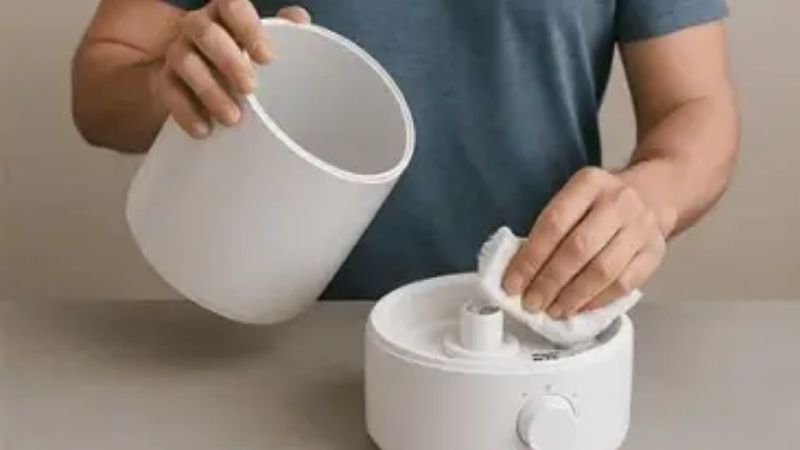
| Decision point | Owner action | Result to check | Stop or exception |
|---|---|---|---|
| Identify humidifier technology | Check whether the unit is evaporative, ultrasonic or warm-mist in its manual. | An evaporative unit may operate with no visible mist; compare hygrometer readings and tank water use. | Do not assume absent visible vapor proves a failed unit. |
| Check simple setup | Check user-accessible power, water level, level base and tank seating. | Confirm the warning indicator clears only after proper assembly. | Unplug before moving a tank or touching wetted parts. |
| Review humidistat settings | Compare selected RH with the measured room RH. | A setpoint already satisfied may suppress output normally. | Do not force humidity upward when windows or walls are damp. |
| Inspect approved service surfaces | With the unit unplugged and cool, inspect only a maker-accessible float, wick or nebulizer for scale. | Follow the model cleaning procedure for that exact component. | Never probe an ultrasonic disc or warm-mist heating enclosure. |
Evaporative units may have no visible mist
Evaporative wick/fan units emit no visible mist; if tank level falls over 24 h the unit can still be working.
The word ‘misting’ can be misleading because not every humidifier makes a visible cloud. An evaporative unit moves air through a wet wick and releases water vapor that you usually cannot see. For this type, a falling tank level and a change in room humidity provide better clues than looking for droplets above the outlet. An ultrasonic humidifier, by contrast, normally produces visible mist when its settings call for output. Identify the technology on the label or manual first, and do not assume a machine is broken simply because its outlet looks dry. The appropriate test follows how that model is designed to operate.
Visible mist expected on most ultrasonic models
Honeywell states that ultrasonic creates visible mist via nebulizer vibration; evaporative wick + fan creates invisible vapor; warm mist boils water; vaporizer electrodes heat water.
For an ultrasonic model, check the straightforward conditions before suspecting a failed nebulizer. Is there water in the correctly seated tank, does the base rest level, and is the unit actually set to release mist? Look for a low-water message or a float that appears obstructed in an accessible area, but do not remove guarded components. Mineral deposits can affect the mist-making surface, so follow the maker’s cleaning method if scale is visible. Avoid scraping a nebulizer or applying unapproved acidic or abrasive products. The goal is to restore normal water contact and operation without damaging a delicate membrane.
Empty tank or interrupted power
Honeywell HUL520: power/outlet, tank water, level surface, mineral deposits on nebulizer, tank securely seated.
An automatic humidistat may keep the fan or display active while suppressing new moisture because the measured humidity is already at its selected target. Check the current relative humidity from a separate properly placed hygrometer if possible, and compare it with the unit’s setpoint. Moving the room sensor directly into a mist plume can produce a misleadingly high reading. Do not raise the target to an excessive level merely to force visible mist; watch for condensation on windows and walls. If room humidity is already adequate, the absence of output can be correct behavior rather than a repair issue.
Humidistat has already reached its setting
HoMedics UHE-CMTF91-B manual cites humidistat set below current room RH, low water, dirty membrane and water outlet valve for no mist.
Tank not seated or float alarm triggered
AIRCARE MA0800 says a full tank with fill light may mean incorrectly installed float rod or housing seating; recheck manual fit.
How to Interpret the Evidence
Evaporative units move vapor through a wetted wick; microscopic vapor does not look like the aerosol plume from ultrasonic units.
Ultrasonic transducer/nebulizer creates a fine aerosol, but mineral deposits can interfere with its motion; controls can pause output when RH setpoint is reached.
How to Check the Problem Safely
Begin with observable conditions and proceed only through permitted user controls. A safety alarm, damaged part, live connection or inaccessible component ends the do-it-yourself path.
Step 1: identify humidifier technology
Check whether the unit is evaporative, ultrasonic or warm-mist in its manual. An evaporative unit may operate with no visible mist; compare hygrometer readings and tank water use.
Do not assume absent visible vapor proves a failed unit.
Honeywell HWM845B lists empty tank, unlevel unit, mineral buildup on nebulizer and low power among no-mist causes.
The tank and water-delivery path deserve a visual check, but only through the parts meant to be handled by the owner. Remove and reseat a tank according to the model’s instructions, keeping electrical controls dry. If the base is leaking, the tank is cracked, or the float does not move as described by the manual, discontinue use rather than improvising a shim or bypass. For warm-mist models, first account for the heat and scald risk; let the unit cool completely before any permitted maintenance. A sealed heater assembly should never be dismantled just to chase a missing plume.
Step 2: check simple setup
Check user-accessible power, water level, level base and tank seating. Confirm the warning indicator clears only after proper assembly.
Unplug before moving a tank or touching wetted parts.
Honeywell HUL535: no water, nonlevel base, deposits on nebulizer, low power settings can explain weak/no mist.
A useful after-check is to record the room humidity and tank water level at two normal observation points rather than staring at the outlet. An evaporative machine may quietly increase room moisture while looking inactive. An ultrasonic machine that still produces no mist after correct setup and approved cleaning may need a model-specific reset or manufacturer service. Record any indicator code, fan behavior, and whether the problem began after replacing a wick or moving the tank. This information is more useful than repeatedly emptying and refilling the machine without knowing which function is failing.
Step 3: review humidistat settings
Compare selected RH with the measured room RH. A setpoint already satisfied may suppress output normally.
Do not force humidity upward when windows or walls are damp.
Step 4: inspect approved service surfaces
With the unit unplugged and cool, inspect only a maker-accessible float, wick or nebulizer for scale. Follow the model cleaning procedure for that exact component.
Never probe an ultrasonic disc or warm-mist heating enclosure.
Products That Help
Useful supplies for the specific checks above can include Honeywell HUL520 humidifier, Honeywell HUL535 humidifier and digital hygrometer. Confirm the exact size, device compatibility and applicable maintenance instructions first. Equipment and tools do not remove the need to stop for a safety fault.
When to Call a Pro
Give the service provider the model number, the symptoms in time order, your observed operating conditions and any displayed fault code. Do not open sealed electrical, refrigerant or combustion components to collect this information.
Frequently Asked Questions
The answers below separate normal operation, owner-accessible checks and conditions that require manufacturer support or professional service.
Why is my humidifier running but not making mist?
Evaporative humidifiers often produce invisible moisture. First identify the technology, then check a hygrometer and water consumption instead of judging by visible mist.
Does an evaporative humidifier show steam?
No. A fan-and-wick evaporative humidifier normally releases invisible vapor rather than a visible jet of mist.
Can hard water stop an ultrasonic humidifier from misting?
Yes. Mineral scale can reduce ultrasonic output on some models. Follow approved nebulizer cleaning instructions while unplugged, without probing the mechanism.
Should I turn the humidity target up to 60% to force mist?
No. Higher humidity is not a diagnostic fix. The EPA warns against humidifier output above 50% RH and advises reducing it if windows or walls become damp.
Final Thoughts
Check whether the unit is evaporative, ultrasonic or warm-mist in its manual. Never probe an ultrasonic disc or warm-mist heating enclosure.
